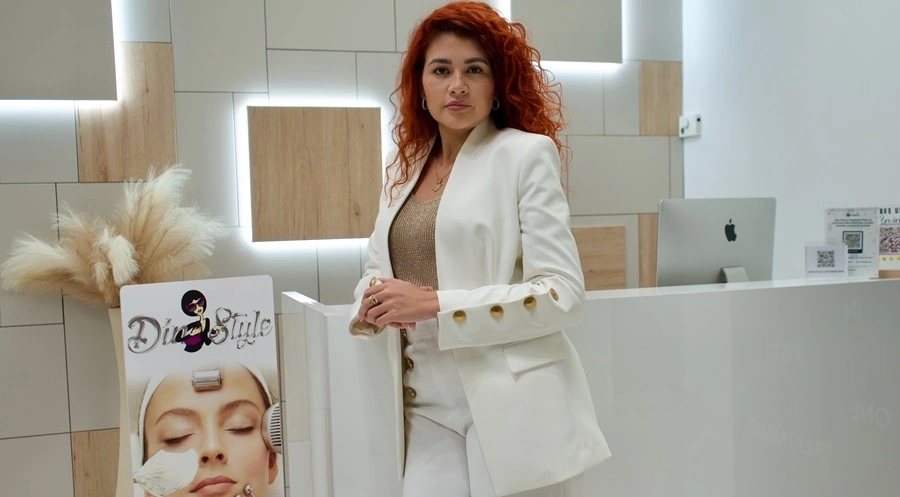
Diana is a mother, entrepreneur and founder of three aesthetic clinics providing cosmetic treatments in South Florida.
MIAMI.- At just over thirty years old, Diana Ramos Gomez embodies a story of remarkable improvement within the recent Cuban exile. She arrived in the United States in 2015 without money, without language and without a support network, only with the certainty that she wanted to build a life different from the one she had been denied in Cuba, where she worked from the age of 19 first as a makeup artist and then as the owner of her own beauty salon.
Today she is a mother, businesswoman and founder of three aesthetic clinics that provide cosmetic treatments in South Florida, an unusual achievement for someone who began serving clients from a makeshift room in her apartment. Her career combines discipline, faith, sacrifice and a fierce determination not to repeat the limits that marked her on the Island.
When did you open your first salon in Cuba?
At 22 years old I managed to open my own salon in Cuba. It was a very artistic room, decorated with the help of my friends from art school. With the little we had we raised it. It was called the same as my current business in the United States: Din Style. The name was suggested by a friend, and it has remained that way all these years. From Cuba I kept the same logo, the same doll, and above all the same essence.
How did you maintain a business in a country where the necessary supplies did not even exist?
It was crazy. Anyone who has not lived in Cuba cannot imagine what it is like to have a business without a place to buy the resources you need. Everything was difficult: constant attacks from inspectors, threats, pressure from the government, questions about where what we used came from.
The Cuban is very enterprising, but they killed our dreams. You could give it your all and still only go as far as they wanted. Growing up was almost impossible. But, at the same time, having experienced that prepared me to arrive in the United States without fear. If you manage to start a business in Cuba, you can start a business anywhere.
You mentioned that you suffered more surveillance when your husband decided to abandon a medical mission. What happened?
My husband is a doctor and deserted from a mission in Venezuela looking for a better future and to pursue his career freely. When that happened, inspectors immediately began arriving at my business. They knew everything. They tried to intimidate me, they threatened that I would have to ask him to come back. It was a very hard stage.
Fortunately, when he arrived in the United States he was able to claim me. I was able to emigrate and move forward with him. He resumed his career, studied a lot and today we work together.
When did you arrive in the United States?
I arrived in 2015. At that time there was a law that allowed the deserting doctors claim their wives and children within three months. I was able to come thanks to that law and it changed our lives forever. We start from scratch: study, learn the language, resume our careers. The Cuban has strength, drive and charisma; what he lacked were opportunities. Here you have them all.
What were those first years like?
Very difficult. In Cuba they do not teach us financial education, nor how to run a business. We had to study a lot, learn the language, organize ourselves. The most important thing was discipline. Nothing comes by luck; It comes by sacrifice. We learned to focus, to look forward and not compare ourselves to anyone. Financial preparation and discipline were key.
Immigrants—and even more so Cubans who arrive here with nothing, starting from scratch—can’t imagine the obstacles they are going to go through or everything they are going to have to suffer. I always tell my friends who have just arrived: “Focus on the fact that you are in the best country in the world. I promise you that all these sacrifices will be worth it.”
My husband and I have an anecdote that we never forget. When he first arrived in the United States, he lived with an uncle he barely knew and who had been here for more than 40 years. When he told him that I was coming three months later, his uncle replied that if his wife arrived, then he had to leave the house. He didn’t want to have two strangers under his roof.
My husband called me to tell me to cancel the ticket because we had nowhere to live. I answered him: “We slept in the car, but I’m going.” I came prepared for everything: here I had no mother, no father, no family; I knew anything could happen.
In the end, a cousin knew that I had nowhere to stay and opened the doors of her house to me. Later, when my husband and I became independent, the real start from scratch began: paying for a new place, working tirelessly. I left work at 12 at night and went to school in the morning. We had only one car. My husband worked and then had to stay for hours talking to the building guard, without eating or bathing, until I could pick him up at dawn.
I remember one day when we had no gas, we had no food, and we didn’t have a dollar. We went to the market with the card Food Stamps and my husband told me: “The only alternative is to ask someone to let us buy their food with the card and to give us, at least, 20 dollars for gas.”
When he approached a woman to explain, she began to yell at him: that this is why the Cubans were the way they were, that we came to “end this government,” that the government gave this aid “so that they could eat and not to do those things.” He offended us without knowing our history, without knowing that we only needed gasoline to get to work.
I never forgot that. That’s why I say: don’t judge any Cuban or anyone who has recently arrived. You can’t imagine what they have to go through to simply eat or get gas, things that many here take for granted. For a newly arrived immigrant, none of that is easy. Sometimes, it’s almost impossible.
Does your husband currently work with you?
Yes. Here aesthetics is closely linked to medicine. He returned to his studies, completed a master’s degree in nursing and today is dedicated to medical beauty within Din Style, in our three locations.
How did they begin to expand in the United States?
I started in a small room in my apartment. I always say it: yes it is possible. That’s how I built a clientele. There came a point where I had too many clients for that space and we decided to open our first office. We had little time in the country, there was fear, but we did it.
The first office was in Brickell. The clients were afraid to come at first because Cubans don’t frequent Brickell much, but it worked. Two years later we opened Kendall, a very family-friendly office. Then came West Palm Beach.
Today Din Style is a big family: our clients bring their daughters, I have seen girls grow up.
What sets them apart and what services does Din Style offer?
We have traveled the world taking the most advanced courses, and I think that is what has made my business grow every year and our clients trust us so much. They see that, three to four times a year, we are in different countries learning the newest techniques and looking for the latest products on the market.
They always tell me: “Diana, you do improve yourself, you do take courses.” And it’s true. I invest a large part of my earnings in training. More than on marketing or anything else, I prefer to spend my money on learning, to be able to offer excellent service.
At Din Style we have everything: laser hair removal, permanent makeup, botox, facial harmonization (we were pioneers in Miami)… practically anything you need for your face, we do it.
If you had to advise those who come from Cuba and want to start a business, what would you tell them?
Let them listen to advice from others with experience, that they can achieve everything they dream of here.
This country has all the tools, but you set the limits yourself. It is important to know what type of business you want and what experience you want to offer.
Put heart, humility and gratitude into it. Each client chose you from thousands.
Study, prepare, keep growing. The road will have ups and downs, sleepless nights, stress… but also enormous rewards.
How did they manage to grow so fast when they were so young? What is the secret?
For me, the secret is not to lose focus. Many, when they have quick success after coming from having nothing, begin to spend on luxuries, to show off. I don’t. I continued living the same, with my same cheap car, saving money and preparing myself.
That approach allowed Din Style to grow quickly.
About the future: we had five locations (a franchise in Naples and a location in Orlando). They are no longer there. Today we have three and I am happy, although sometimes I wake up wanting five more. I don’t know yet what the limit is, but I do want to always maintain excellence.
Have you thought about what your life would have been like if your husband had not deserted the mission?
I’ve thought about it a lot. The first years here were very hard: no family, no language, no money. Sometimes you think about going back. But I know that, if it hadn’t been for then, at some point I would have decided to leave Cuba.
My husband’s decision changed our lives. We were hungry, needy, but it was worth it. My mother today lives peacefully here, my children were born here. My oldest son knows the history of the Cuban people; He says he wants to be president of Cuba to help Cubans. He is very proud.
Is it difficult to start a business as a woman and having small children?
Yes, very much. It is impossible to give 100% in everything: being a perfect mother, perfect wife, businesswoman, studying, exercising… you can’t.
There are days for children and days for business. I think my children will be more proud to see what I have built. A happy and fulfilled mother is a better mother.
With the help of my husband and my family I achieved it. I divide myself between my children, my business, my husband and myself.