Greater spending on works and programs
By 2026, the local government proposes to allocate 2,000 million pesos to the road repaving program and 500 million to the patching program.
For the recovery of 12 underpasses of Calzada de Tlalpan, an investment of 80 million pesos is expected; 477.3 million for the road lighting program; 400 million for the improvement of schools.
The Water Secretariat will have 19,000 million, an increase of 26% to the 2026 budget for the management of the resource, sewage works and attention to the hydraulic network.
Regarding social programs:
– From the Cradle and Healthy Women, Protected Childhoods: 920.1 million pesos
– Universal Pension for Men from 60 to 64 Years: 1,768.5 million pesos
– Pension for People with Permanent Disabilities: 578.5 million pesos
– Canteens for Wellbeing in Mexico City: 573.9 million pesos
More money for security
For this year, 29,507.4 million pesos will be allocated to the Secretariat of Citizen Security, 4.9% higher than that of the year that is about to conclude.
Another 150 million for the construction of the first police hospital and 100 million for the purchase of new C5 security cameras.
Mayors with more resources; dissatisfied opposition
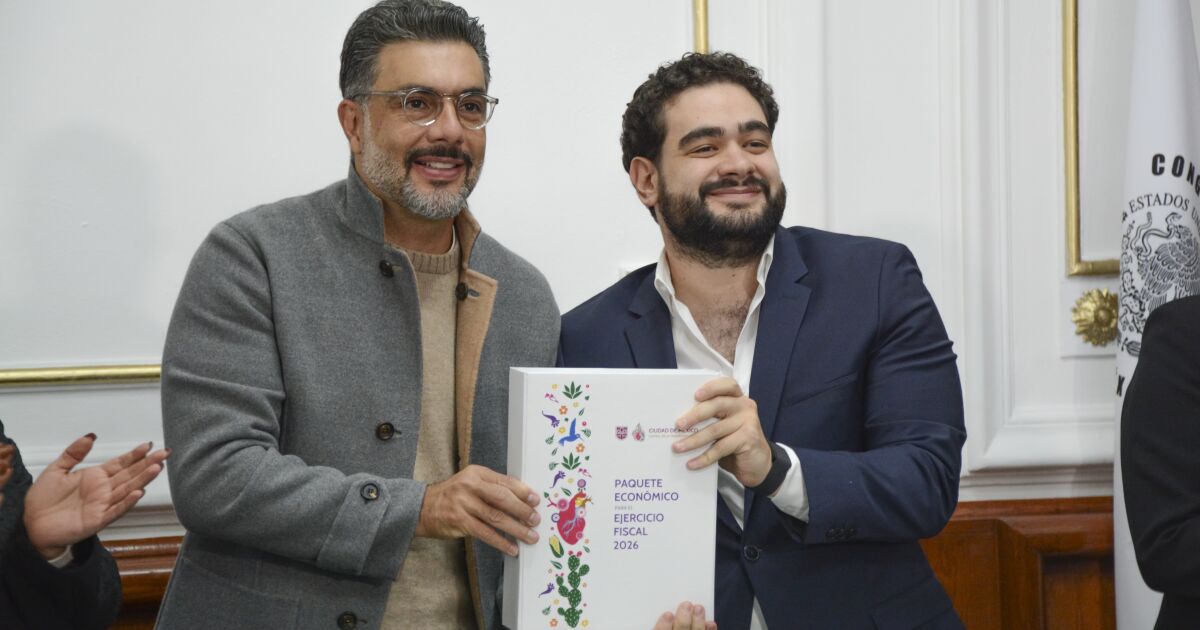
The capital government anticipates spending 57,600.2 million pesos for next year, which compared to 53,582 million the previous year, represents a growth of 7.5%. This percentage increase will be the same for the 16 districts.
By population size, Iztapalapa It will be the mayor’s office with the largest budget, with 7,773.1 million pesosfollowed by Gustavo A. Madero with 6,339.4 millionand Alvaro Obregon with 4,246.2 million.
In contrast, mayors like Miguel Hidalgo and Cuauhtemocheaded by the PAN member Mauricio Tabe and the alliance Alessandra Rojo de la Vegawill receive allocation proposals ranging from 3,227 and 4,463 million pesosdespite the fact that both asked Congress for budget increases of up to 85%.
At a press conference, the mayor of Miguel Hidalgo, Mauricio Tabe, who chairs the National Association of Mayors (ANAC), requested that the Fund for Social Infrastructure (Fais) be returned to the mayors’ offices and assured that the budget allocation of Mexico City is insufficient to meet the demands of the residents.
“That is people’s money with which potholes are fixed, lights, sports infrastructure, sports facilities, public spaces, parks, health centers that support marginalized communities with which rural roads are built, communities are electrified, with which people are supported,” he recalled.
Alessandra Rojo de la Vega, mayor of Cuauhtémoc, insisted that their hands are tied, because in addition to not having money, they have no collection powers.
And the income?
The Secretary of Finance of Mexico City highlighted that for next year no taxes will be created and the existing ones will only be updated in accordance with what is established in the norm.
Mexico City estimates to collect 313,385.4 million pesos and announced that for next year the permanent license will be maintained, whose price per document will remain at 1,500 pesos and this resource will be allocated to mobility and improvement of cycling infrastructure.
The vehicle ownership subsidy is updated to 550,000 pesos at invoice value and the subsidy programs and tax benefits for prompt payment in water and property matters will be maintained.