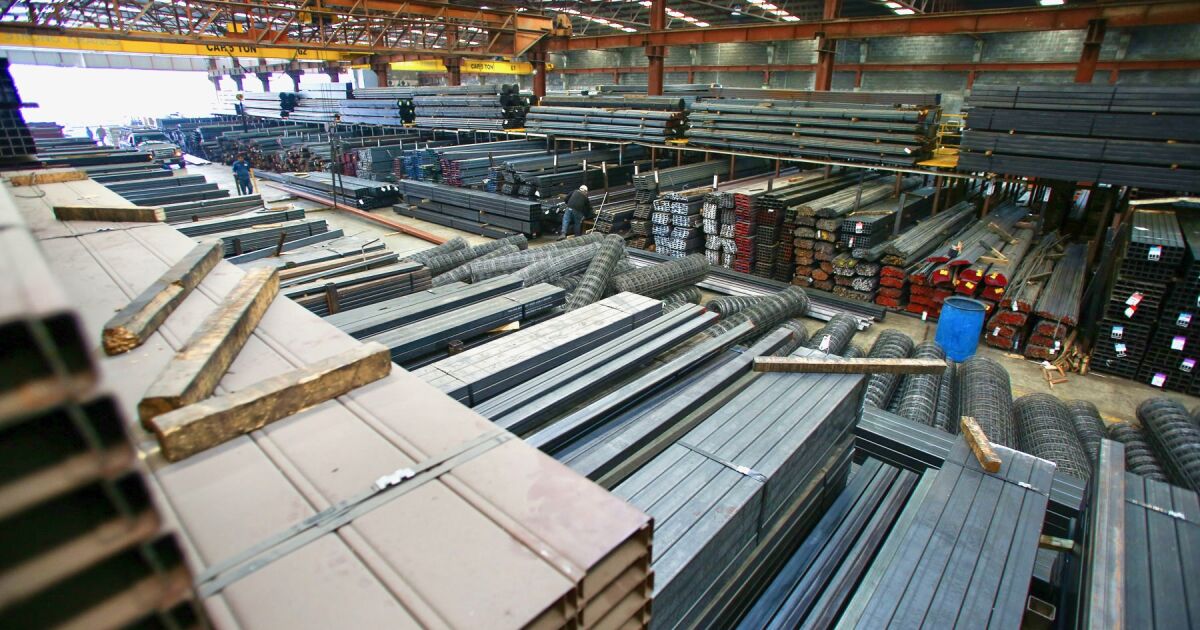
Most of this increase occurred in Mexico (around 16 million tons). The graph included in the report highlights that these imports already represent 45% of the Mexican market.
Mexico and Canada are yet to take adequate measures to curb the surge in global steel overcapacity, primarily from China, in their respective domestic markets.
He maintains that this flow of foreign product has direct effects on US industry. He argues that the steel imported by Mexico is used in intensive sectors such as the automotive industry, which reduces export opportunities for North American manufacturers and weakens the incentives created by the USMCA to strengthen regional content.
The AISI recalls that the treaty requires that 70% of the steel purchased by each assembler be of North American origin, but warns that this rule has not been fully implemented, especially the part related to the melt and pour rule.
He explains that the actual origin of steel is determined at the point where it is first melted and poured into its solid form, a stage that concentrates most of the sector’s economic value, investment and employment. Without this rule, steel melted and cast outside of North America can be superficially processed in Mexico or Canada and obtain preferential treatment under the USMCA, which opens up space for trade diversion.
It also warns that some of this material arrives in Mexico, receives minimal processing and then crosses the border as Mexican or Canadian merchandise to evade US tariffs established under Section 232.
To correct these distortions, AISI proposes that Mexico adopt a trade policy identical to that of the United States under Section 232. The recommendation consists of establishing a 50% tariff on all imports of steel of non-North American origin, without exceptions for trade agreements. This measure would allow the creation of a common “tariff wall” that stops trade diversion and prevents external steel from entering through the most open link in the region.
It also requests internal changes in Mexico. He points out that programs such as IMMEX, PROSEC and Rule 8 facilitate the temporary entry or at reduced rates of inputs that can then be sent to the United States without facing the tariff burden that was designed to protect the regional industry. AISI requests that these mechanisms be reviewed to prevent them from becoming evasion routes.
Transparency is another central point. The institute states that Mexico does not always publish complete data on steel imports and urges the country to release detailed information on all flows, including origin. melt and pourin order to detect transshipments, undervaluation and classification errors.
The United States and Canada already collect this information, so AISI considers that Mexico should match its practices. With the USMCA review on the horizon, the US steel industry is pushing for the region to adopt a common front in the face of the global overcapacity crisis.
The vision of Mexico
The National Steel Chamber (Canacero) in Mexico also sent its comments to the USTR. In 2024, North America produced 106 million tons of steel, well below the 130 million it consumed.
The gap shows that the United States, Mexico and Canada do not have sufficient capacity to supply their own market. The organization states that, in an emergency, Mexico and Canada would be the only reliable suppliers for the United States. For this reason, he points out, the application of tariffs under Section 232 to Mexican products weakens regional capacity instead of strengthening it.
In March of this year, Donald Trump imposed a 25% tariff on steel and months later raised it to 50%. The Secretary of Economy, Marcelo Ebrard, affirms that one of his priorities is to achieve an advantage for the sector before the review of the T-MEC in 2026.
Canacero indicates that, to close the deficit, North America needs massive investments and a transition that allows temporarily importing semi-finished steel without affecting trade within the region. This flexibility, he affirms, should serve to guarantee inputs while increasing productive capacity.
He proposes a concept that he places at the center of the debate: Fortress North America. The idea seeks for the three countries to act as a block, align their industrial policies and adopt a common defense against trade distortions from third countries. The principle includes equal treatment in measures against unfair practices, strict customs coordination, complete digitalization of trade and elimination of internal barriers that slow down regional exchange.