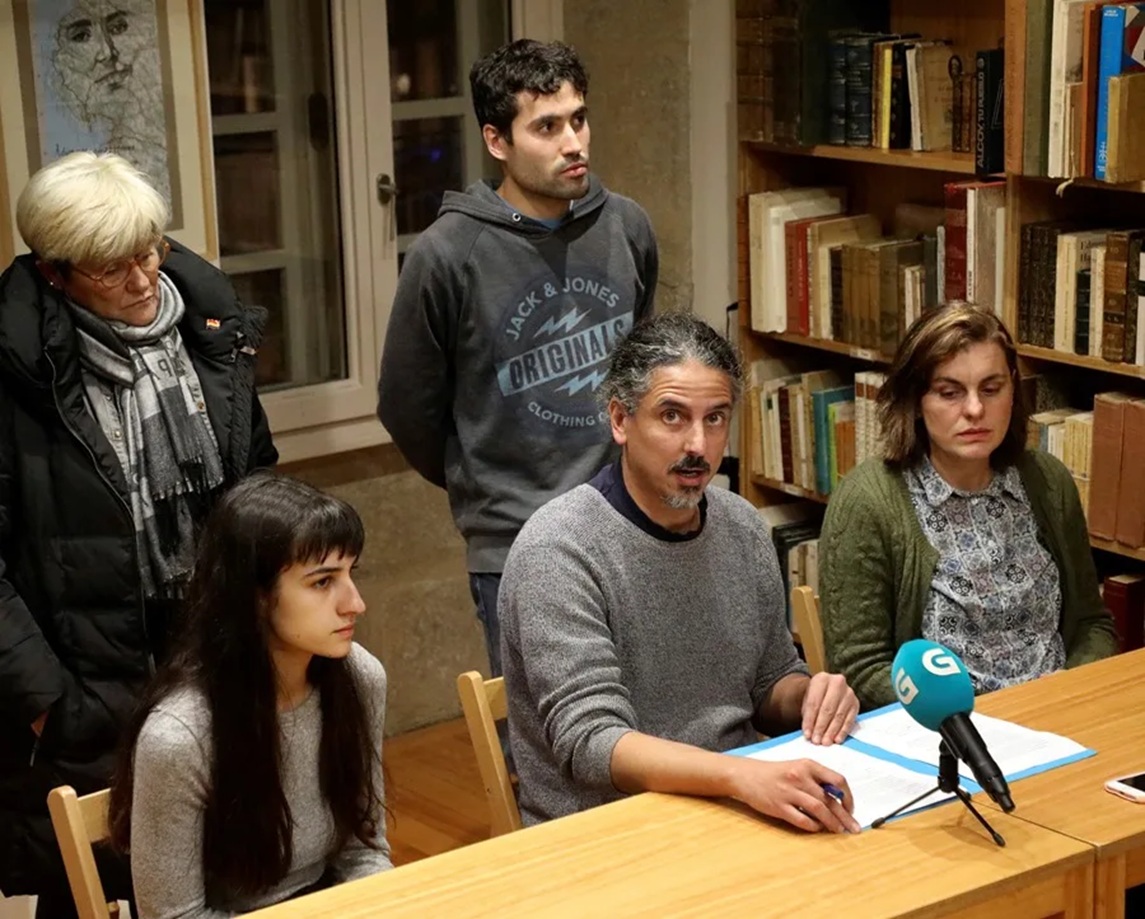
The Spaniard Martiño Ramos Soto, detained in Cuba where he had escaped after being sentenced to 13 and a half years in prison for raping a minor, led a normal life in Havana and attended cultural events in which he presented himself as a photographer named Martín Soto. His presence had already been detected months ago by the police.
The former Galician politician and former professor, who gained relevance for his activism in the extinct En Marea, wanted to make a space for himself among the young art circles in the Cuban capital, agrees in highlighting a handful of testimonies collected by EFE.
But in his last days as a fugitive with this second life in Havana, one of the people who knew him, and who had uploaded a photograph on Instagram in which he tagged him, received a wave of comments that revealed Ramos’ true identity.
“I didn’t understand what was happening. Shortly after I found out that they arrested him and that it was true. I was in shock: I couldn’t leave my house for three days. How safely can you meet someone and not know that they are capable of doing those things?” he asks.
A second life as a photographer
Shortly after landing in Havana, at the end of summer, Martiño Ramos began to create his character, presenting himself as Martín Soto, a Spanish amateur photographer, whenever he was able to attend a cultural event.
There he offered to take images of the event and its participants, and then offered to send the photos for free via WhatsApp to its protagonists, especially young women. He also did sessions for Cuban models.
According to the sources consulted, the Cuban police had been aware of Ramos’ presence in Cuba for months – after a flight that had taken him through Portugal, Brazil and Peru – and since then, aware of his sentence, he had been under observation, but had not been arrested, an arrest that was announced on the 24th.
In addition, there is a willingness on the part of the two countries to facilitate his transfer to Spain, as EFE has learned. At the moment he has not requested consular help, but he has requested a list of lawyers.
hidden life
His Instagram profile serves as a digital trail of part of his months in Havana.
A young Cuban cultural promoter who asked to remain anonymous remembers that she saw him for the first time in September, during a presentation by the Spanish singer-songwriter Pedro Pastor at the end of a poetic improvisation event.
His affable attitude earned him the trust of artists and models, with whom he quickly sought to establish a professional relationship.
“His letter of introduction was the same: he would take a photo or film you, he would approach you and ask for your email to send you the material. Other times he would ask for your Instagram. With me it was like that (…) He had good treatment, he spoke like an intellectual, but he never told you about his life or what he was doing in Cuba,” a young poet who met him several times told EFE.
She saw him three more times. Two of them at events and one on a night out with her group of friends.
As he remembers, he always saw Ramos accompanied by at least one young girl and he got the impression that he was a person who was very worried about not being included in circles.
“I feel like he needed his contacts to not only be professional,” she says and remembers, for example, that the second time she saw him he invited her to an event to listen to Rosalía’s new album. “I didn’t want to and I noticed something in him, a very childish attitude of: ‘Come on, please, you have to go, come on, come on…’.
Little is known about his life outside Havana culture. According to testimonies, he lived in the central neighborhood of Vedado, a place that is the heart of the artistic life of the capital.
The worker at a restaurant in the area, where Ramos frequented, agrees with the story of the “foreigner who wanted to be part of a group.”
Martiño Ramos, the Spanish teacher convicted of raping a girl, is arrested in Havana
“I was alone (when I went to eat there), yes; always looking for someone to talk to, chat with, get into a group. But I was always alone,” he remembers.
Ramos was one of the ten names claimed by the Spanish justice system whose location and arrest was a priority for the Fugitive Section of the National Police, which requested citizen collaboration to gather possible clues.
As reported by the Fugitive Section, Ramos is a native of Ourense, is 50 years old and was sentenced to 13 and a half years in prison for sexual abuse of a minor student, through sadistic practices, when the victim was between 12 and 16 years old.