
Brazilian expectations reached 76.6 years in 2024. It is the highest value ever recorded since 1940, when the historical series of the Brazilian Institute of Geography and Statistics began (IBGE). In 2023, the indicator was 76.4 years.
Life expectancy at birth represents how many years a person will live, on average, if current mortality patterns are maintained.
Compared to the beginning of the 40s, there was an increase of 31.1 years. At the time, Brazilians who were born were expected to live only 45.5 years.
Data is part of the call Mortality Tablereleased this Friday (28) by the institute.
In the world, the places with the highest life expectancies are Monaco (86.5 years), San Marino (85.8), Hong Kong (85.6), Japan (84.9) and South Korea (84.4).
Pandemic effect
The IBGE points out that, in general, Brazilian expectations are on a growth trajectory. The exception was during the covid-19 pandemic. In 2019, those born expected to live 76.2 years, a level that was reduced to 72.8 years in 2021.
Check out the evolution of life expectancy at birth in recent years:
- 2000: 71.1 years
- 2010: 74.4 years
- 2019: 76.2 years
- 2020: 74.8 years
- 2021: 72.8 years
- 2022: 75.4 years
- 2023: 76.4 years
- 2024: 76.6 years
Women live longer
The IBGE projection shows that women, historically, have a longer life expectancy than men. In 2024, their hope was 79.9 years, while theirs was 73.3 years. This means that women have an average of 6.6 more years to live than men.
In 1940, this difference was 5.4 years, the smallest ever recorded. The biggest disparity was in the year 2000, when it was 7.8 years.
The Mortality Table also presents the male excess mortality indicator, which analyzes the relationship between the mortality rates of men and women. The data shows that, in 2024, in the age group of 20 to 24 years, male excess mortality was 4.1 times that of women.
This means that, in this age group, a 20-year-old man was 4.1 times more likely to not reach 25 than a woman.
In the group aged 15 to 19, the rate was 3.4; in the group aged 25 to 29, 3.5.
By pointing out that in the 1940s there was no such high difference between the sexes, the IBGE explains that the fact that more men died is related to the process of urbanization and metropolization in Brazil.
“From the 1980s onwards, deaths associated with external or unnatural causes (homicides, suicides, traffic accidents, etc.) began to increase the population’s mortality rates, particularly among young male adults”, cites the IBGE.
Effect on Social Security
The Mortality Table is one of the government’s sources of information to adjust the so-called social security factor, which is part of the calculation of pension values by the National Social Security Institute (INSS).
The study points out the life expectancy of Brazilians at certain ages. For example, in 2024, the country’s population who reach 60 years of age will live, on average, another 22.6 years (20.8 years for men and 24.2 years more for women).
In 1940, this extra period of life for a 60-year-old person was 13.2 years.
An 80-year-old person was expected to live another 9.5 years (women) and 8.3 years (men). In 1940, these values were 4.5 years for women and 4 years for men.
Infant mortality
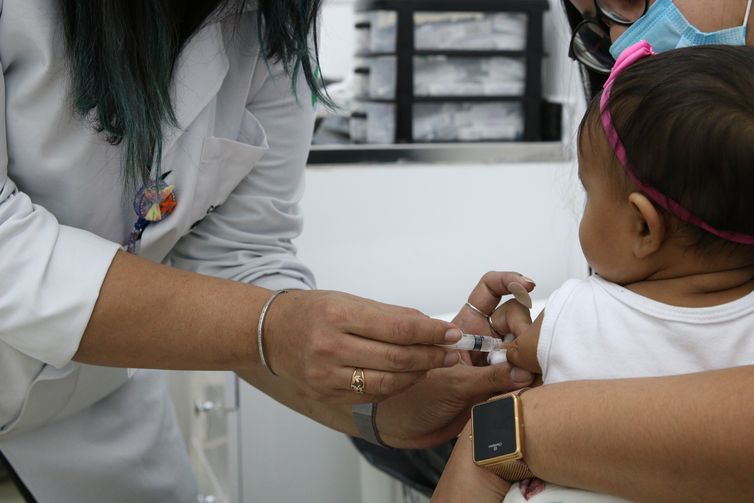
Babies receive vaccines from the SUS basic calendar – Rovena Rosa/Agência Brasil
The survey shows that infant mortality, which considers babies under 1 year of age for the calculation, was 12.3 for every thousand children in 2024. The figure represents an improvement compared to 2023 (12.5), but is still above 2000, when the rate was 11.4 for every thousand children.
In a longer comparison, evolution is explicit. In 1940, of every thousand children born, 146.6 died under 1 year of age.
Check the evolution of infant mortality in Brazil (per thousand children born):
- 1940: 146.6
- 1960: 117.7
- 1980: 69.1
- 2000: 28.1
- 2020: 11.4
- 2023: 12.5
- 2024: 12.3
The IBGE associates the evolution with factors such as mass vaccination campaigns, prenatal care, breastfeeding, action by community health agents and child nutrition programs, among other factors.
“The increases in income, education and the number of households with access to adequate sanitation services also contributed to the reduction in this fateful indicator”, adds the institute.