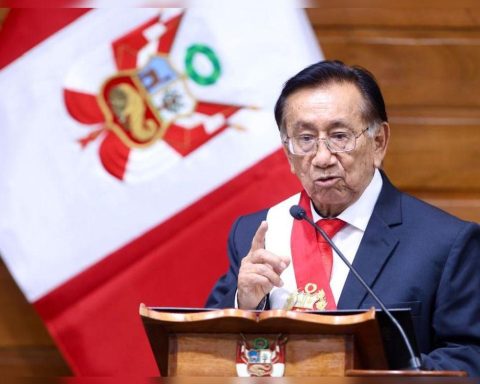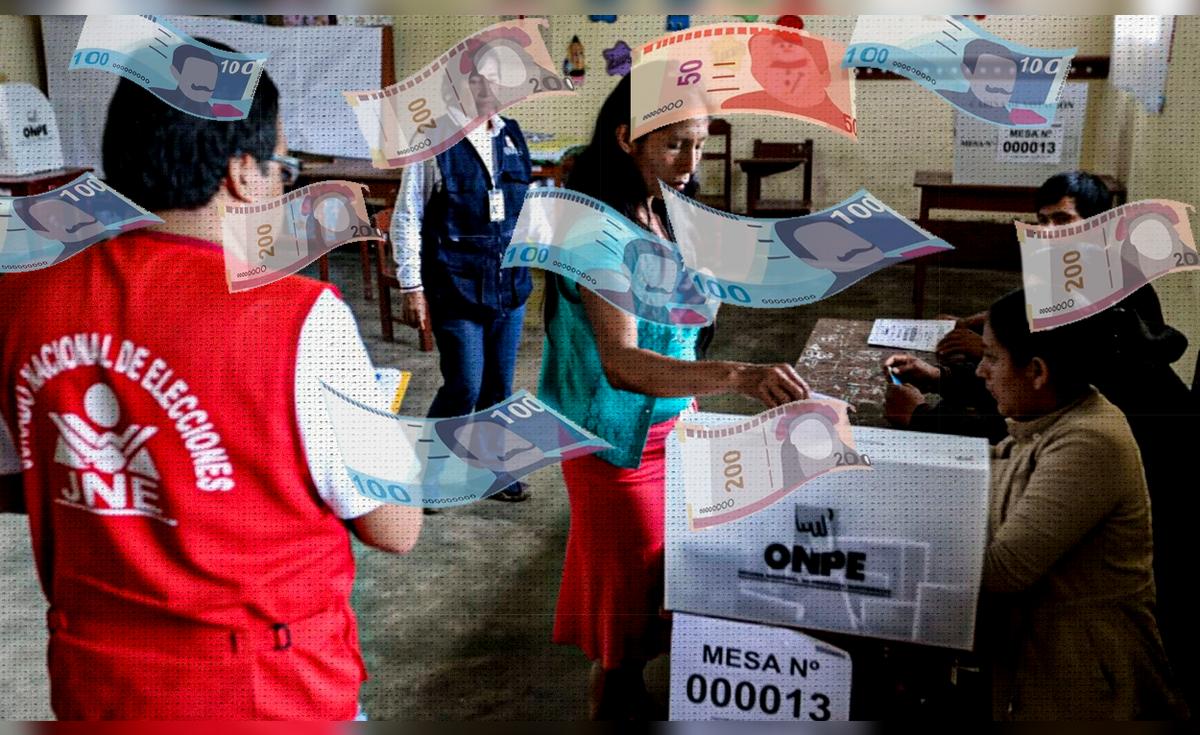
Less than 5 months from General Elections The electoral system does not have the necessary budget for its execution. This was announced by the president of the National Election Jury (JNE), Roberto Burneo Bermejoduring his presentation before the Plenary Session of Congress on November 26, in which the budget for fiscal year 2026 for the Electoral System organizations (JNE, ONPE and RENIEC) was debated.
listen to the newsText converted to audio
Artificial intelligence
In his words, we are facing a “huge budget deficit around the electoral system.” The total budget necessary to guarantee the 2026 electoral processes amounts to S/ 4,390 million. The initially approved amount is S/ 2,123 million and covers only 48% of the needs, which generates a gap of S/ 2,267 million (52%), corresponding to the additional demand required.
WE RECOMMEND YOU
VIZCARRA CONVICTED AND PEDRO CASTILLO WAITS FOR SENTENCE | WITHOUT SCRIPT WITH ROSA MARÍA PALACIOS
Burneo Bermejo specified that the S/ 2,267 million are needed from next January, which is why it must be considered in the 2026 Institutional Opening Budget (PIA).
“We are going to implement a command center, decentralized offices, we have to implement 91 special juries. Everything has to be in parallel because it has worked from day one,” he highlighted.
He added that the digital audit is not only reduced to digital voting, but is being implemented to all systems. “We want to have an inspector of the JNE on each table. Before there were one for eight tables. This year 2026, we are going to keep the votes and the JNE can recount them. “This is unprecedented,” he said.
Budget required by each entity
In addition to referring to the resources required by the electoral system, Burneo specified the figure demanded by each institution.
In the case of National Election Jury (JNE)the additional resource requirement amounts to S/ 546.4 million. Of that total, S/ 26 million are needed for institutional functioning, while more than S/ 519 million are allocated to strictly electoral tasks, distributed as follows:
- General Elections 2026: S/ 142 million
- Regional and Municipal Elections 2026: S/ 375 million
- Election of municipal authorities in populated centers 2026: S/ 1 million 533 thousand
For its part, the National Office of Electoral Processes (ONPE) estimates that it requires an additional budget of S/ 1,460 million to carry out its functions in 2026. Of that amount, S/ 3 million would cover its internal operations and the remaining S/ 1,457 million would be used to organize and execute electoral processes, including:
- S/ 535 million for the General Elections of April 2026
- S/ 922 million for the Regional and Municipal Elections of October 2026
Finally, the National Registry of Identification and Civil Status (Reniec) estimates that it needs an additional S/ 259 million to fulfill its role in the 2026 elections. Of that figure, S/ 159 million are allocated to its usual institutional activity and S/ 100 million to support the electoral organization.
| TYPE OF BUDGET | JNE | ONPE | RENIEC | TOTAL | % |
| Approved budget | S/390,503,716 | S/1,188,750,399 | S/544,134,473 | S/2,123,388,588 | 48% |
| Additional Demand | S/546,397,667 | S/1,460,808,589 | S/259,993,767 | S/2,267,200,023 | 52% |
| TOTAL | S/936,901,383 | S/2,649,558,988 | S/804,128,240 | S/4,390,588,611 | 100% |
| % | 21% | 60% | 18% | 100% |
If the demand is not met, the transition of power is put at risk.
In that sense, he indicated that, if this gap is not addressed, the normal development of the elections is put at risk, the transparency and legitimacy of the electoral processes would be compromised, and with it citizen confidence in the democratic system.
Above all, taking into account that a chain of custody for votes is imperative to protect them against possible incentives or attacks against them “on the way.”
“Investing in the electoral process must be a priority in a transitional government. The political stability of the next 5 years is at stake and the trust of the electorate is basic. The electoral schedule cannot vary due to lack of resources. I do not want additional resources to be requested only in January because the negotiation process takes time so we would only have the money in February and the elections are in April. If that is not understood we are putting the transition of power at risk,” Burneo declared, highlighting that he needs the budget for the beginning of next year.
“Democracy requires care, it does not stand on its own”
He stated that the JNE has made important progress thanks to several strategic axes—among them technological modernization, strengthening electoral justice, promoting informed voting, transparency and citizen participation—but warned that this progress could be slowed if the corresponding financing is not guaranteed.
For 2026, he explained, the institution projects ambitious goals: process around one million 173 thousand files, process nine million data to feed the intelligent jurisprudence search engine, put into operation the Special Electoral Juries (60 for General Elections and 91 for Regional and Municipal Elections) and adapt them for the counting of votes, in addition to ensuring the presence of an inspector at each voting table.
Before the congressmen, he also expressed his concern about the Elections of Authorities in Populated Centers (ECP 2026), since this electoral process does not have any type of budget allocation for next year.
“Democracy requires constant care; it does not stand on its own. We must invest in the elections and the democratic system. It is essential to have these resources from the beginning of 2026,” he stressed.