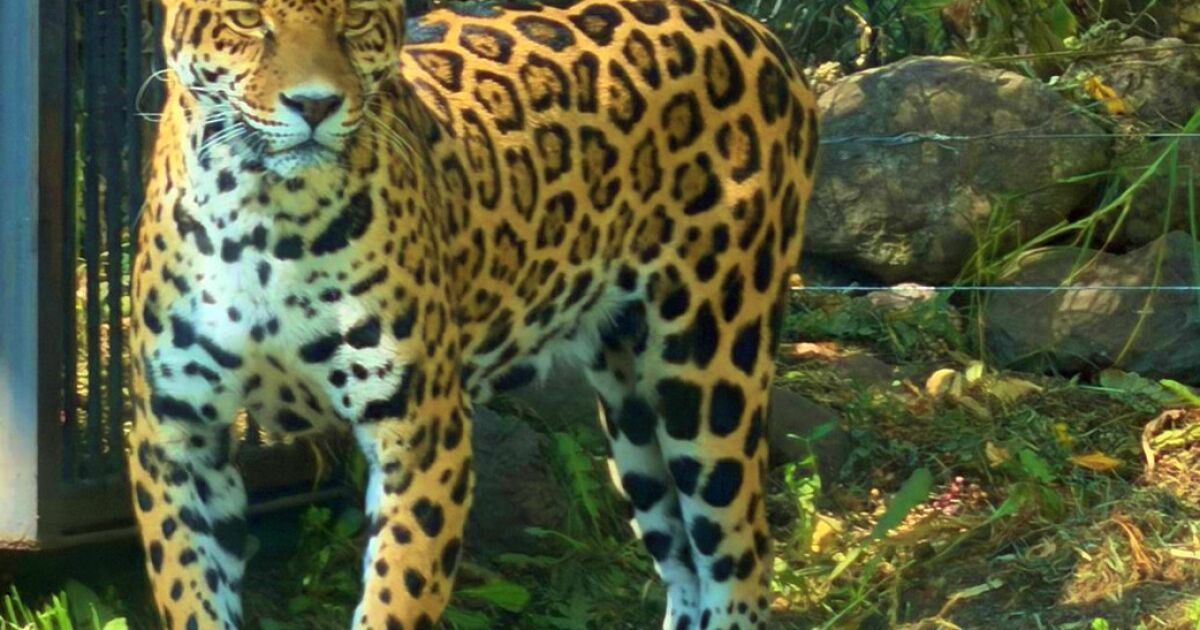
This project is part of the third phase of “Refugio Jaguar”, an initiative promoted by Ferrero México and the Reino Animal conservation center, located in Teotihuacán, State of Mexico.
During the presentation, Solange Massimi, vice president of institutional affairs and corporate communication at Ferrero Mexico, highlighted that this new stage represents a watershed for the conservation of the jaguar, whose future depends on preserving its genetic diversity and restoring the ecosystems where it lives.
(Photo: Brenda Yañez)
Genetic testing, a bet to strengthen jaguar conservation
In this third phase of the “Jaguar Shelter” project, scientists, biologists and veterinarians will work with next-generation sequencing (NGS) technology, applied for the first time in jaguars in Mexico, to analyze the DNA of each specimen and learn about its unique characteristics.
This study will identify small variations in the genetic code—known as SNPs—that function as a “fingerprint.”
In this way, with the markers obtained, the degree of kinship between jaguars will be determined, their genetic diversity will be measured and the risks associated with their consanguinity will be evaluated.
The basis of the study is because reproduction between closely related organisms reduces genetic variability and makes populations more vulnerable to diseases and environmental changes, explained Victoria Araiza, researcher at the National School of Biological Sciences of the IPN and leader of the project.
“When genetic variation decreases, we leave organisms unable to perpetuate the species; therefore, understanding that level of diversity is essential for their survival,” he said.
Araiza explained that 15 jaguars – nine from the complex itself and six from other centers and even the wild – will be subjected to DNA analysis to understand their genetic variability, avoid inbreeding and define the most viable combinations for their reproduction.

(Photo: Courtesy Animal Kingdom)
How will the analysis be carried out?
Researcher Araiza explained that in the first stage, samples will be taken from the jaguars selected at the “Jaguar Refuge” clinic, which will then be sent to the National School of Biological Sciences of the IPN for DNA extraction. Subsequently, the samples will be sent to Macrogen, a company specialized in precision medicine and bioengineering, for sequencing.
Preliminary results on genetic diversity are expected to be ready by April 2026. With this information, specialists will be able to identify which specimens are compatible for reproduction and prevent crosses between genetically similar organisms.
Ithiel Berrum, general director of Reino Animal, added that the offspring obtained from the selected individuals will be transferred to the shelter’s Wild Breeding Area, where they will remain without direct human contact to ensure that they develop natural behaviors and can be candidates for eventual reintroduction to wildlife.
“Where there are jaguars, there is health in the ecosystem… if the jaguar can return, we are restoring our way of living,” he commented.
Meanwhile, researcher Araiza added that this project marks a milestone for conservation in Mexico, as it is the first time that this technology is applied to a species within a preservation program, so she trusted that the results can serve as a guide for future efforts with other species at risk.

(Photo: Brenda Yañez)