The crusade continues.
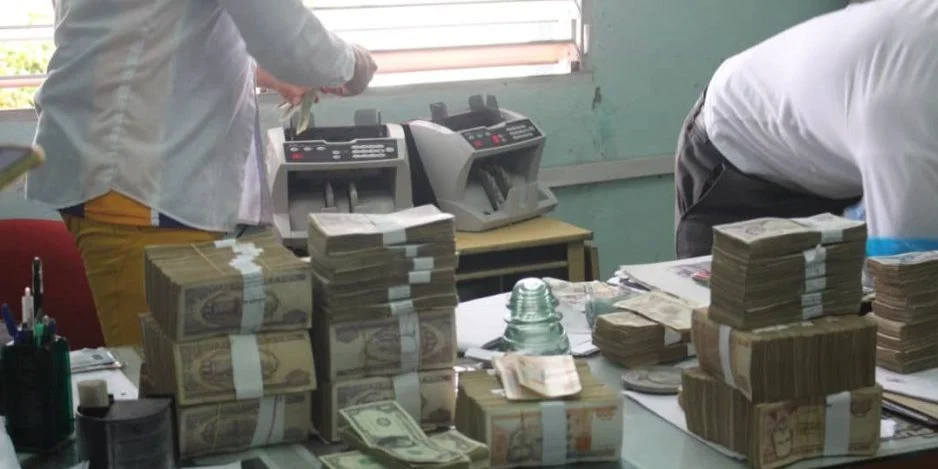
MIAMI, United States. – Authorities from the Ministry of the Interior (MININT) reported this Thursday on the dismantling of a “currency trafficking” network that operated in Villa Clara, Sancti Spíritus and Las Tunas, with financiers based in the United States and Spain, and money flows that, according to the official version, reached “hundreds of millions of pesos” weekly outside the banking system.
In parallel, the Cuban News Agency (ACN) and Rebel Radio They disclosed that the country is developing around a hundred investigative processes linked to the informal currency market, which confirms a coordinated offensive against these financial circuits.
According to information from the National Revolutionary Police (PNR)the alleged organizer of the network in Villa Clara had been managing “weekly flows of between 20 and 30 million pesos” since 2023 and had wholesale recipients in the three provinces involved.
The scheme described by the official media is that of a classic financial compensation: financiers abroad captured remittances from Cubans outside the country and used those funds to pay, from the United States and Spain, imports from non-state actors based on the Island; In turn, these importers settled in national currency and dollars to the organizer and his couriers, who delivered the cash to the final recipients of the remittances within Cuba.
Lieutenant Colonel Yisnel Rivero Crespo, head of the Department of Economic Crimes of the MININT Instruction Body, told Radio Rebelde that it is a “criminal international financial compensation scheme” conceived in Villa Clara, whose financiers are located in the United States and Spain, and who work with forms of non-state management that demand imports.
According to the official, “the profit margins of said financing operation are between 6 and 8%,” which, in his opinion, would reflect the instability of the informal foreign exchange market and the struggles between the actors that compete in that space.
In the structure described, the main manager in Villa Clara functioned as an intermediary for foreign financiers and worked with two operators in Santa Clara, in addition to two others responsible for the distribution of remittances to Sancti Spíritus —particularly the municipality of Trinidad— and the province of Las Tunas.
Rivero Crespo indicated that, as a result of the investigations, “money flows of hundreds of millions of Cuban pesos per week” were confirmed, with collections twice a week (Monday and Friday), and that so far there are five people charged and at least four forms of non-state management linked to the investigated chain.
The case is not presented as an isolated event. Both ACN and Radio Rebelde point out that the MININT maintains two other similar investigative processes: one in Pinar del Río and another in Havana, both “with million-dollar figures” in their activity. In these cases, a figure appears that the official narrative itself baptizes as a “currency trafficker”: individuals who, “from their home,” offer exchange and re-exchange services for significant volumes of cash, in pesos and freely convertible currency, to satisfy the demand of various clients.
In the case of Pinar del Río, Radio Rebelde reports that a messaging system was also used with two other parties involved and a “certain presence on social networks” to increase the visibility of the business. In Havana, the operation focused on a citizen without a formal employment relationship, resident in the Diez de Octubre municipality, who operated on his own account and “met the demands of MSMEs that required large volumes of money for operations within the national territory or for the financing of their imports.”
Rivero Crespo assured that “the country is advancing in the development of a hundred investigative processes at the national level” related to illegal currency trafficking and associated conduct, and stressed that the volumes of money seized represent only a fraction of the profits generated by these networks. The operation released this Thursday is therefore part of a broader offensive against the informal circuits of financing, exchange and compensation that have proliferated in the Cuban economy in recent years.
From the PNR profile on Facebook, Heroes in Blue in Cubait is argued that “these flows of hundreds of millions of pesos outside the national banking system generate inflationary pressures, reduce the State’s collection capacity and affect economic actors that operate legally.”
In its current crusade against the informal currency market, the island’s regime has blamed the medium theTouch for, supposedly, influencing the exchange rate of the US dollar on the Island, and has warned of ongoing investigations against 18 journalists linked to that platform.
Despite the abundance of qualifiers—“criminal scheme,” “illegal currency trafficking,” “currency trafficker”—the official notes omit key information to evaluate the real impact of these operations. No specific data is provided on how much money has actually been seized, what amounts correspond to family remittances already committed, nor what mechanisms are planned, if any, to guarantee that these funds reach the original recipients.
Nor is the exact type of crimes charged to the five people arrested or to the others involved in Pinar del Río and Havana specified, beyond the general reference to “illegal currency trafficking” and “other associated conduct.” The coverage does not offer details about the judicial treatment of the cases, the procedural situation of those investigated, nor the population’s access to independent information about these processes, which are presented closed on themselves and supported almost exclusively by police sources and the MININT itself.
The insistence on presenting these schemes as a macroeconomic threat contrasts with the absence of a substantive analysis of the policies that have pushed a large part of remittances, family savings and import operations towards the informal market. The official narrative blames private networks, exchange reference portals and “currency traffickers”, but does not dwell on the accumulated effects of devaluations, creation of multiple exchange rates, banking restrictions and failures in state supply, which are mentioned only tangentially in the text on the “fragility” of the informal market.