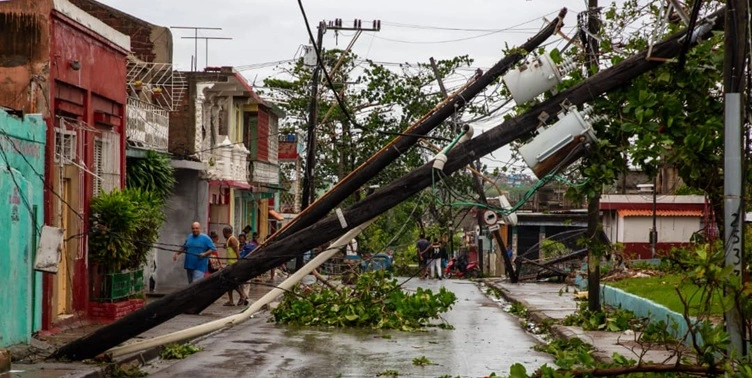
Some 2,900 tons of food and logistical resources will begin to be distributed in the most affected provinces, although complaints persist of a lack of transparency and that previous aid never reached the affected families.
MADRID, Spain.- The World Food Program (WFP) will deploy an emergency operation to assist more than 900,000 people affected by Hurricane Melissa in eastern Cuba, according to the official press. The plan includes the delivery of nutritional modules – with rice, grains and oil – and essential items for the recovery of the hardest hit communities, distributed in 33 municipalities of Guantánamo, Santiago de Cuba, Granma and Holguín for an initial six months, with the possibility of extending up to a year in the areas of greatest devastation.
According to Granma, The operation starts with more than 2,900 tons of food already positioned, mobilizing all available reserves for emergencies. In Holguín, assistance will begin in the entire Urbano Noris municipality, while in the other affected territories, priority will be given to children under five years of age, pregnant women and the elderly.
The WFP also plans to distribute non-food aid, such as mobile warehouses, lighting towers and tents for distribution and storage points, several of which have already begun to be installed in towns such as Frank País, Banes and Urbano Noris.
Although the announcement represents a crucial injection of resources amid the devastation left by Melissa, it comes in a context marked by citizen distrust. In recent weeks, numerous residents and independent organizations have denounced that much of the international aid promised since the first days after the hurricane has not reached the affected families.
In areas of Santiago de Cuba, for example, inhabitants They reported the sale of expired cans of fish as part of the “assistance” distributed locally, a situation that generated outrage among those facing food shortages, long blackouts and severe damage to homes.
Also in the municipalities of Holguín and Granma, residents assured that what they have received so far has been minimal or non-existent, questioning the destination of the funds and donations announced by the international community. Testimonies indicate that many families continue without basic resources such as drinking water, enough food or materials to protect supplies, while they wonder “where are the millions sent to eastern Cuba.”
Faced with this scenario of opacity and delays, the new WFP intervention raises expectations, but also doubts about the capacity and true intention of the authorities to guarantee that aid really reaches those who need it.
The organization insists that its operation follows a plan in two phases: a first of preventive positioning, already “completed” before the impact of the cyclone, and a second of active response, currently underway. However, its effectiveness will depend on distribution on the ground, where complaints of mismanagement, inequality in delivery and lack of independent oversight persist.
Meanwhile, in the territories most affected by Melissa, the population continues to deal with damage to agri-food production, crop losses, food shortages, and a recovery process that is progressing slowly. For thousands of Cubans, the arrival of the WFP represents an urgent, but still uncertain, opportunity for relief.