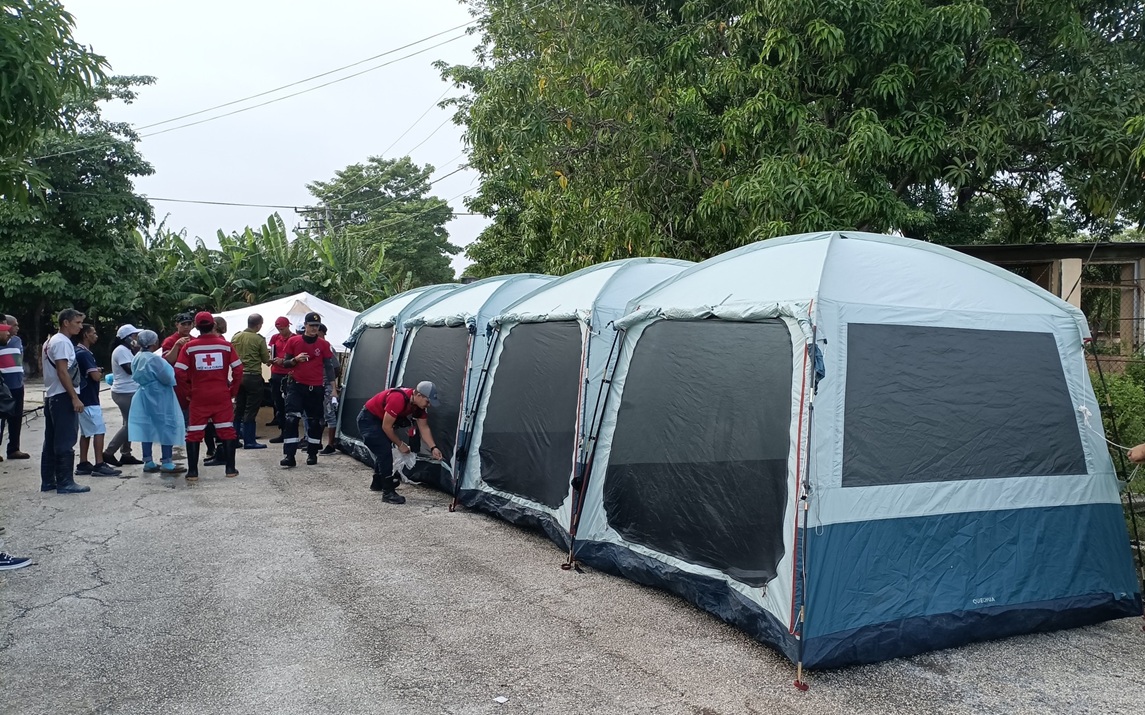
In Cayamas, one of the hardest hit communities in the Granma municipality of Río Cauto, the field hospital donated by the India.
It is the largest facility of this type that has ever arrived in Cuba and a key piece in the health response after the passage of the Hurricane Melissaaccording to official media.
The center was built next to the Máximo Gómez Báez teaching polyclinic and serves both the municipal seat and nearby rural towns such as Guamo, Guamo Viejo and El Mango, the newspaper reports. Granma.
Its main task is to receive patients, classify them, stabilize them, care for them, and, when necessary, refer them to other hospitals in the territory.
Complete treatment close to home
Within its six tents, patient classification, imaging diagnosis with ultrasound and
A team of 18 specialists, including pediatricians and gynecologists, anesthesiologists and laboratory technicians, rotates on 24-hour shifts, trained by the International Red Cross with Indian instructors, the report states.
The hospital allows, for example, to obtain 25 biochemical results in fifteen minutes with a single blood sample or to detect dengue complications on the spot. Likewise, it has the capacity to care for about 300 patients in a range of 24 to 48 hours, as reported by Radio Bayamo after its donation by India.
For neighbors like Jorge Luis García Ávila, who arrived with a severe mycosis, or Marisela Montero Soto, with neuralgia and kidney problems, it means receiving complete treatment without having to travel far from their homes, many of them still homeless due to the ravages of the cyclone.
“Home remedies didn’t work, that’s why I came to this hospital,” he told Granma García Ávila, where, he claims, they gave him antibiotics and sent him to a bed to administer them. “They treated me well. I think it comes at a good time,” he considered.
India sends humanitarian aid to Cuba and Jamaica after Melissa devastation
From India and other aid
The provincial director of Health, Yelenis Elías Montes, explained that the National Defense Council chose Río Cauto to install the hospital due to the magnitude of the damage.
“Its installation expands the resolution of our institutions,” said the specialist about the building designed to be deployed in six hours, even from a helicopter, and which operates with its own energy and remains open day and night between roads still full of mud and half-collapsed homes.
Days before the hospital’s arrival, India sent 20 tons of humanitarian aid and disaster relief materials to Cuba and Jamaica. The shipment, transported by an Indian Air Force (IAF) aircraft, included medical equipment, rehabilitation support items, food, medicines, power generators, shelter materials and hygiene kits.
Also in that area, several affected families Days ago they began receiving emergency kits from the Cuban Red Cross. At least 16 households in the rural community El Mango, in Guamo, obtained packages with tools, food, kitchen utensils and toiletries.
Added to this is the contribution to the recovery of access to safe water and basic items thanks to the response of international organizations and institutions on the island, particularly in the Granma municipalities of Cauto and Cauto Cristo.
After the serious floods, which contaminated wells, destroyed supply networks and left homes without electricity or food, at least 21 thousand people were able to access treated drinking water thanks to three portable water treatment plants activated by Unicef and the National Institute of Hydraulic Resources (INRH), with financing from the United Nations CERF Fund.
Melissa hit eastern Cuba hard at the end of October and left severe damage to nearly 500 health facilities, as well as homes and state entities, electrical and telecommunications infrastructure, the agricultural sector, and the road and railway network, according to evaluations by Cuban authorities and the United Nations.