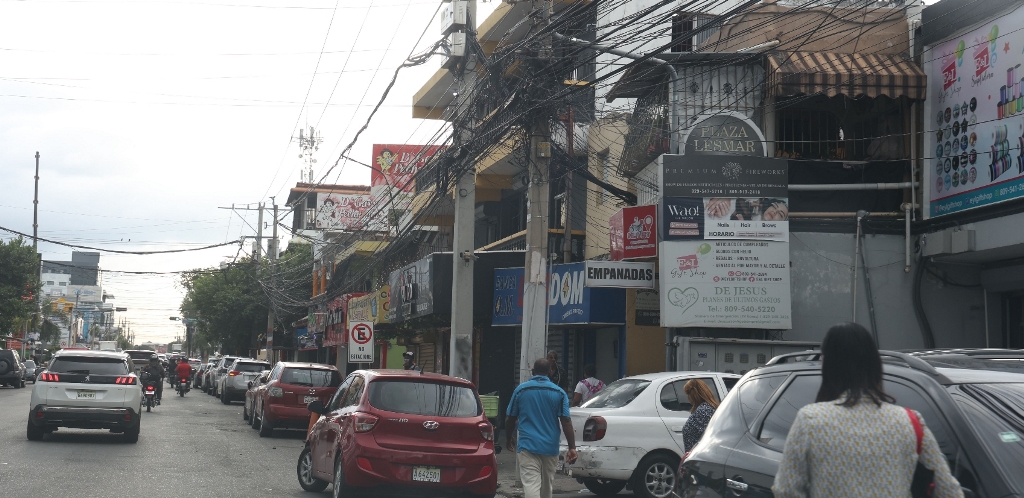
Santo Domingo.-Given the change in land use in the Los Prados sector, where a large part of the homes have gone from single-family to commercial, this area of the National District is turning into chaos, especially in relation to traffic.
With the transformation of the sector, delimited by Núñez de Cáceres, John F. Kennedy and Gustavo Mejía Ricart avenues, it is not respected which secondary roads are residential or business, which breaks in many cases with the tranquility found by those who initially arrived there with the idea of a healthy family coexistence.
It is enough to take a look at the place to see how the identity of the sector is lost in terms of what were the homes today transformed into squares and buildings that exceed permitted levels.
In many cases, the type of soil that characterizes the environment is not taken into account, where in the past there have even been sinkholes in areas of buildings.
As a result of growth, complete streets such as Charles Summer, Lorenzo Despradel and Font Bernard are thriving commercial arteries, even with renowned chains and banks, which in the latter case, created structures that meet the rigorous requirements.
Dilemma
However, the dilemma is that in most cases they do not have parking for the number of customer vehicles that come in search of services.
This situation implies the occupation of sidewalks and roads that are reduced to one lane, forming long blockages at different intersections.
Among the businesses that are built in the surroundings are industries that should be on the outskirts of the city; vehicle dealers, supermarkets, restaurants, spare parts stores, fabric stores, clinics, nurseries, grocery stores and informal kiosks, which indiscriminately occupy the sidewalks, forcing people to walk on the road.
The place also has important media outlets, the Sagrado Corazón de Jesús Church, schools such as Nuestra Señora de la Altagracia, the Los Prados Club and green areas.
“What happens in Los Prados is what is happening throughout the city. Lack of management and everyone does what suits them,” said urban architect Cristóbal Valdez.
The reverse: Los Praditos
The central area of the Capital also has as its “reverse”: Los Praditos, a populous neighborhood marked by overcrowding that affects many other peripheral quadrants of the city with numerous informal businesses, street sales, proliferation of motorcycles, among other situations.
Here, as in other similar places, people live dealing with service deficiencies such as blackouts. Marginality contrasts as it happens in Naco with La Yuca, and in El Millón, El Milloncito.
Geologist warns of high altitude risk
Land. “The soil of Los Prados is clay, and in a seismically active area, such as the Dominican Republic, with two large regional faults capable of generating earthquakes of magnitude greater than 7.0, due care must be taken when designing and building elevated structures on clay, because clays, such as those of Los Prados, amplify seismic forces in a so-called seismic site effect, as occurred in Santiago de los Caballeros and La Vega in December 1562,” warned the geologist Osiris de León.
He said that the construction sector authorities must be very strict and rigorous when reviewing and approving applications and plans for tall buildings on clay, sand, silt, caliche and alluvium.