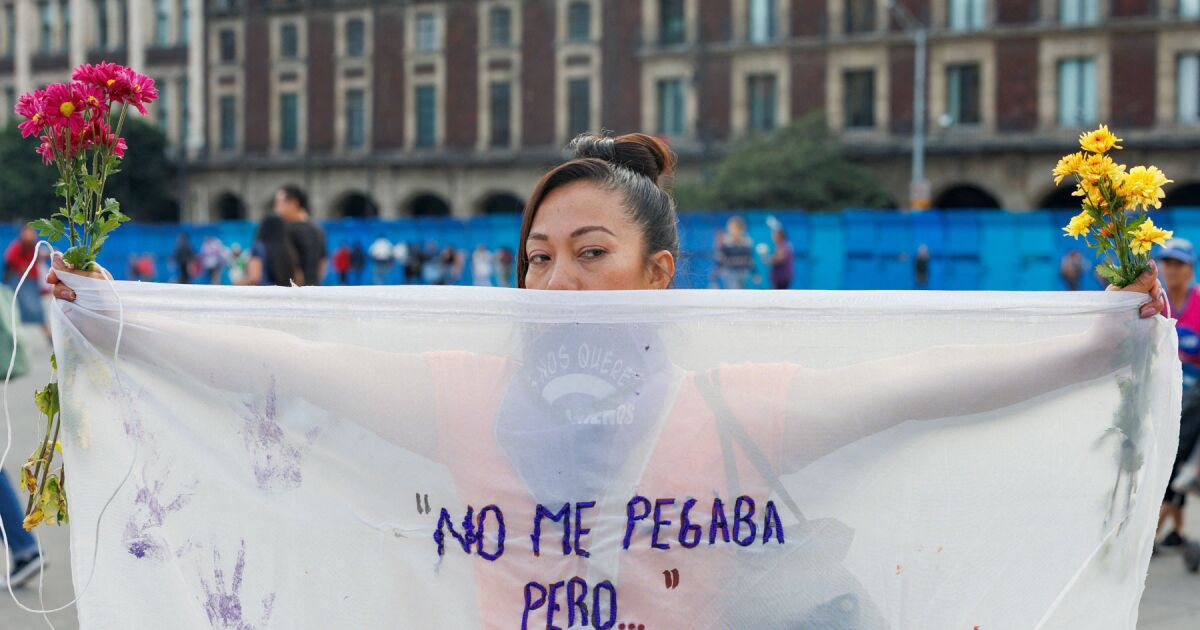
Ana Amelí García, UNAM student missing since July 2025 in Ajusco; Yeritza Bautista, survivor of an attempted feminicide, and Lesvy Berlin Osorio, a UNAM student who was a victim of feminicide in 2017 and who was revictimized by the authorities of the capital’s government when it was initially stated that it was a suicide, were the names and faces that were shown at the forefront of the march on tarps held by their loved ones.
Different causes were found in the 2025 demonstration, despite having fewer attendees than in previous years: families asking for justice in cases of feminicide as well as the location of their daughters or sisters alive; women who publicly denounced vicarious violence in which, using the judicial system, they are separated from their daughters and sons; groups that ask for inclusion for women with disabilities, who report workplace violence and lack of access to housing.
As they passed through Avenida Juárez, the contingent paused in front of the Museum of Memory and Tolerance to protest against Israel’s armed attacks against Palestine.
Shouting “we are not all here, we are missing them!”, the march begins with the main contingent from the Glorieta de las Mujeres que Luchan, led by relatives of missing women and victims of feminicide.
🎥: @shelmanz / Political Expansion pic.twitter.com/N5kiRQY9ge
— Political Expansion (@ExpPolitica)
November 25, 2025
“The children of Gaza are not a threat,” the protesters chanted.
On the fences installed around the Palace of Fine Arts, posters were placed with the faces of Cuauhtémoc Blanco, deputy for Morena and former governor of Morelos who was accused of attempted sexual abuse by one of his relatives, as well as Felix Salgado Macedonio, senator for Morena, accused of rape and sexual abuse by several women in 2021.
“It is not right to have violators in power,” the posters claimed. Accompanied only by members of the Dialogue and Coexistence Group of the Government of Mexico City, the CDMX Human Rights Commission and the Marabunta Brigade, the protesters managed to reach the Zócalo without setbacks or attempts at violence, although elements from the Secretariat of Citizen Security were waiting in the surrounding streets.
With barely a dozen members of the black bloc present and the National Palace surrounded by metal fences, some of whom carried hammers and mallets, these protesters limited themselves to painting.
“We are not one, we are not 10, the government tells us well,” shout protesters at the forefront of the 25N march before reaching the Zócalo.
🎥: @shelmanz / Political Expansion pic.twitter.com/nxhphoiWxa
— Political Expansion (@ExpPolitica)
November 25, 2025
“We are not all there,” was the claim addressed to the president, Claudia Sheinbaum, in the second march for the International Day for the Elimination of Violence against Women since she became the first woman to govern Mexico.
The coordination of the 25N march affirmed that there is still impunity in cases of gender violence in the country during their statement in the Zócalo.
“In Mexico we continue to experience structural violence: every day 10 women die violently and seven of those murders go unpunished; in addition, 92.5% of the sexual violations that occurred during 2024 are not punished. “In Mexico, femicides are counted but those women who cling to life are not yet quantified. (…) Today we tell the system and society that survivors also count,” they took a stand.