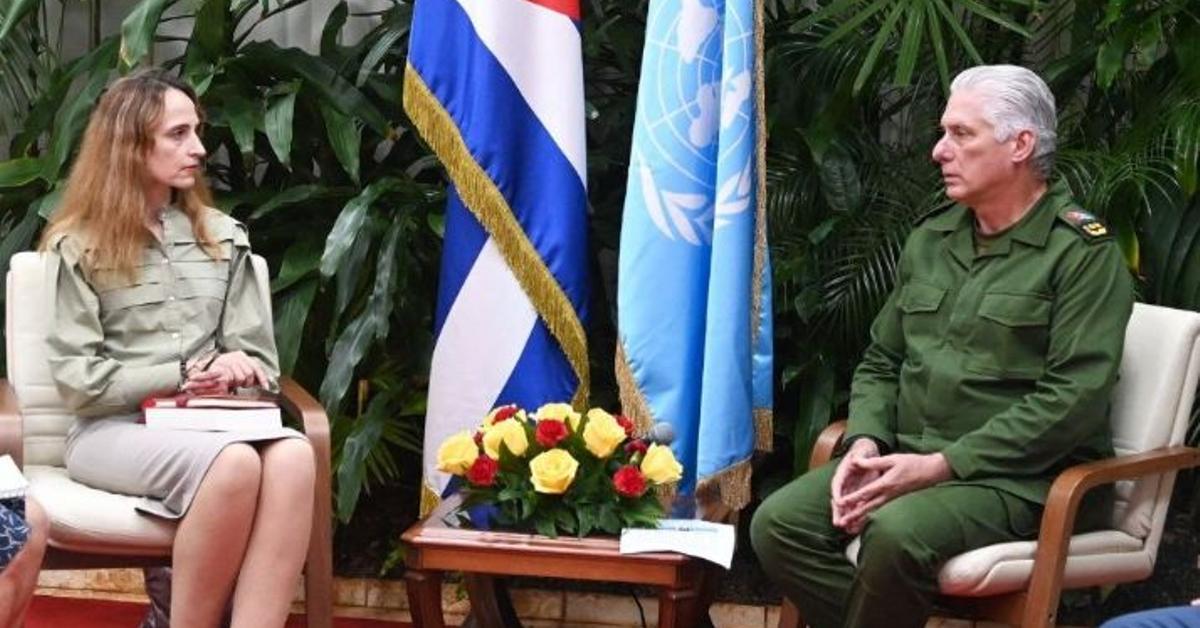
Madrid/The Cuban Observatory for Human Rights (OCDH) reacted to the statements of the UN rapporteur, Alena Douhan, who left Havana repeating, word for word, the regime’s rhetoric. The Belarusian jurist sees the United States sanctions as the main cause of the crisis suffered by the island. “The misery that Cuba is experiencing today is due to the failure of the communist political and economic system, and not to the measures of other countries,” the Ocdh responded in a letter published this Tuesday.
The organization affirms that only 3% of Cubans attribute their problems to the US embargo and that disapproval of the Government’s management reaches 92%, thus rejecting Douhan’s central approach. The rapporteur, for her part, alleged that the US sanctions “have substantially exacerbated the humanitarian situation” and that “they have been designed to prevent Cuba from receiving economic income, especially in foreign currency.” His words, broadcast by EFE, offered the Cuban Government the headline it expected and international endorsement of its narrative that the “blockade” is the root of all national problems. It is no coincidence that the rapporteur was received with a carefully controlled agenda that kept her within the margins of the ruling party.
This attitude is not new in Douhan’s career either. His previous missions in Venezuela and Iran followed the same route supervised by the authorities, identical statements that place the greatest responsibility on external sanctions, as well as a notable omission of internal human rights violations. In Caracas, for example, her opinions were celebrated by the Nicolás Maduro regime, while independent organizations denounced that the rapporteur ignored the repression, the humanitarian crisis and systematic corruption. The same story was repeated in Iran, so his statements about Cuba did not come as a surprise.
Why doesn’t the embargo affect the accelerated construction of hotels?
During his visit, which began on November 11, Douhan met with officials, academics and representatives of organizations aligned with the Government. Any independent interlocutor with the capacity to question the official version was out of reach. In its preliminary report there is no mention of the deterioration of basic freedoms, the imprisonment of peaceful protesters, the recent corruption scandals in high places, or the absolute political control that has kept the Island stagnant for decades.
The contrast with the Ocdh data is blatant. Their recent study reveals a reality that completely refutes the state narrative, with 89% of the population surviving in extreme poverty, while the official management receives an almost unanimous level of disapproval; and the majority of Cubans consider that the embargo is just the usual rhetoric to hide the true internal blockade. The Ocdh goes further and asks an uncomfortable question that Douhan avoided: if the embargo were really the central root of the crisis, why does it not affect the accelerated construction of hotels, while it is used as an excuse to justify the shortage of food, medicine and medical equipment? In fact, these last products are exempt from the sanctions of the United States, which has become Cuba’s leading food supplier.
Douhan’s omissions are also not surprising in the health field. While the Ocdh recalls that the Cuban health system is collapsed due to internal decisions – such as prioritizing exports of medical services and international propaganda over primary care – the rapporteur repeated the idea that sanctions limit access to medicines. He did not mention the thousands of professionals sent abroad under conditions reported as coercive, nor the negative impact that policy has on local care.
In his conference, Douhan tried to qualify by stating that sanctions are not “the only cause” of the crisis, citing covid-19 and other factors. But that mention was diluted by Washington’s prominence in his statements. The rapporteur urged the United States to renounce the “rhetoric of sanctions,” to remove Cuba from the list of countries sponsoring terrorism and to stop denouncing forced labor in medical missions. This last point was particularly celebrated by the Havana regime, which maintains a lucrative international business based on the labor exploitation of health personnel.
Its recommendations omit another aspect that the Ocdh highlighted: the Cuban Government has for years prevented the entry of UN rapporteurs dedicated to issues such as freedom of expression, arbitrary detentions, extrajudicial executions, modern slavery or human rights defenders. Those experts – those who could document the daily repression – Havana never invites. To Douhan yes, and we already know why.