A part of the Latin American left is beginning to withdraw, although still timidly, its admiration for the island’s regime.
MIAMI, United States. – The deep economic, social and political crisis that Cuba is going through has turned the country into an uncomfortable and “anachronistic” symbol for a good part of the Latin American left, which has been relaxing its former devotion to Cuban Revolutionaccording to academic Iván Witker, professor at the Central University of Chile.
“Cuba is an emblem of an anachronistic ideology. It stopped winning hearts a long time ago. Admiration has necessarily become lax,” the professor writes at the beginning of a column published in the media The Libero. Likewise, he maintains that the “creepy news” about the current situation on the Island has left “a rather bitter taste” among those who once admired the revolutionary process and, above all, within the “new left” that aspire to distance themselves from the burdens of the past.
According to the academic, trying to “defend, explain and justify the favelization of the entire country became impossible” and current Cuba is experiencing “absolute decline,” which links with the reality described by the writer. Leonardo Padura In his most recent novel, die in the sand. As a result, admiration for the revolutionary experiment would have transformed into a distant relationship, full of discomfort and nuances.
Cuba as “new Haiti” and an indefensible humanitarian crisis
The first axis of the column focuses on the internal deterioration of the Island. Witker describes recent reports about “an almost total lack of electricity and water” and affirms that the lack of these supplies “for 15 or more hours a day” is not uncommon. Added to this is the disappearance of “essential foods” and “the most recent, the outbreaks of dengue (48,000 hospitalized) and chikungunya (700 infected daily), as a terrible expression of the serious viral diseases that harass practically 40% of the population.”
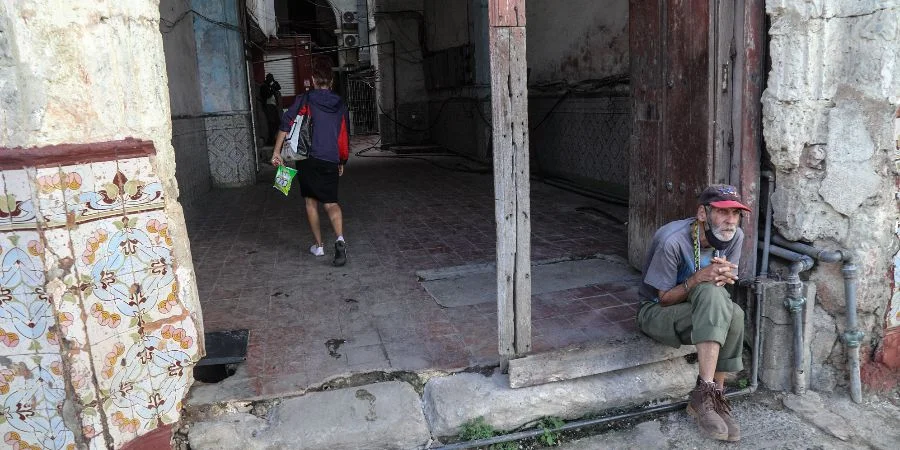
In his text, the academic summarizes the visual and social impact of this scenario: “Havana and all Cuban cities resemble gigantic marginal neighborhoods.” From this image, he maintains that, in the democratic contexts where the new left moves, “defending, explaining and justifying this new Haiti” is “impossible.”
To reinforce the comparison, remember that “neither the Duvaliers nor any of the other satraps who have governed Haiti have done so in the name of social justice, much less have they wanted to set themselves up as examples of a ‘new’ society, especially in redistributive matters.” Unlike the Haitian regime, he points out, Castroism has sought to embody a “salvific mission,” in line with what was analyzed by historian Loris Zanatta, and it is precisely that moral pretension that makes the contrast with Cuban reality even more uncomfortable today.
Witker maintains that the Latin American left today views Cuba as “an uncomfortable alliance” and “a burden when it comes to thinking about how to reinvent itself.” In his opinion, “the island experiences contain too many annoying things,” among them “the despotism of the ruling gerontocracy,” “the lack of renewal of elites (even among those aligned with the Revolution),” “the annulment of civil life” and “the elimination of the intermediate layers of society.”
Added to these structural issues, according to the author, are other “more uncomfortable” ones, in reference to violations of rights and basic humanitarian deficiencies. This group poses a fundamental dilemma for the regional left: “How can we reconstruct in the future a left inserted in the democratic game without breaking old nostalgia or provoking ideological suicide?”
The response he observes in the present is a kind of defensive withdrawal: “The way, for now, is to make his worship lax.” That is, preserve nostalgia and certain symbols, but distance ourselves from what Cuba represents today in terms of political practice, economic model and social situation.
The wear and tear of the “blockade” argument
The second major argument of the column refers to the loss of credibility of the US embargo as an almost total explanation of the Cuban crisis. Witker affirms that “the lack of credibility into which the famous blockade argument has fallen” is a key factor in the deterioration of the Island’s image among its former allies.
The author recalls that the embargo originated “in a presidential decree and [fue] transformed in the 90s into an act of Congress”, and that it is “a law that allows Cuban purchases in the US. In fact, the regime makes some.” He also adds that “that law does not prevent trade with other countries either.”
From that premise, he rejects that the embargo alone explains the “shipwreck” of the Cuban economy. He insists that the central problem is that the country “does not produce anything exportable.” He lists, among other factors, that “tourism has declined,” that “no one requests their ‘medical’ services in other countries anymore,” that “the sugar harvest collapsed (it reached barely a tenth of the famous 10 million in 1970)” and that “remittances from exiles are not enough,” a list that ends with “a long and uncomfortable etcetera.”
For Witker, “the country’s economic reality speaks not only of chronic incompetence, but of an indecipherable inability to adapt to new realities; just as Vietnam, Laos and several other countries with nationalized economies did.”
At this point he also addresses the fuel crisis and denies that it can be attributed solely to the embargo. He remembers that “many countries – friends of Cuba – are large oil producers: Angola, Iran and others” and concludes that, for some “unfathomable reason”, the Cuban elite “refuses to accept the obvious; nobody gives anything away in international trade.”
Symbolic break with progressive agendas
A third block of the column explores the gap between the Cuban regime and the so-called “new left”, associated by Witker with the so-called “woke” (progressive) discourses. In his opinion, it is “a whole incomprehensible for the elite of the Castro brothers.”
The author points out that these new lefts perceive that the Government of Havana “accepts only small intrusions in matters of feminism or sexual diversity (from the hand of a daughter of Raúl Castro).” They also “capture that concerns about ecology are only temporary and superficial,” arising when Fidel Castro, “in his terminally ill bed,” wrote columns on these topics in the newspaper Granma. He adds that “indigenism was never of interest to the Cuban Revolution.”
The general unrest has led, he affirms, to some sectors beginning to “murmur, timidly, that the Cuban experiment ‘is not a democracy’ or that it responds to ‘a special democracy.’” Given the real panorama on the Island, Witker considers that these sectors have been forced “to clarify, to discover subtle arguments, to de-dramatize. But that is tiring,” he notes.
The Alejandro Gil case
The column closes with the tensions within the Cuban ruling elite itself, personified in Alejandro Gil Fernandezformer Minister of Economy and former Deputy Prime Minister. Witker presents him as “the until very recently all-powerful Minister of the Economy” and highlights that he has become the protagonist of “new frictions within the ruling elite; all with a good dose of mystery.”
According to the academic, Gil “is accused of corruption, treason and various crimes” and “in exile they accuse him of being responsible for the tremendous economic disaster.” Beyond the specific content of the accusations, he emphasizes that neither the accused himself nor those interested in the case “expect a fairly fair trial and the inevitable is assumed, ending up before a firing squad.”
Witker defines this outcome as “a cavernous destiny that is not very compatible with today’s public opinion in Latin America.” He recognizes that this opinion can be “opaque and biased,” but maintains that “it tends to require a minimum of explanations,” something that the Cuban system would not be willing to grant. “Given this, the new left can do little or nothing,” he concludes.
With all these elements, Witker’s column presents Cuba as a country trapped in a comprehensive crisis, which is no longer possible to defend without incurring serious contradictions with the democratic values and rights agendas that the new left claims to represent.