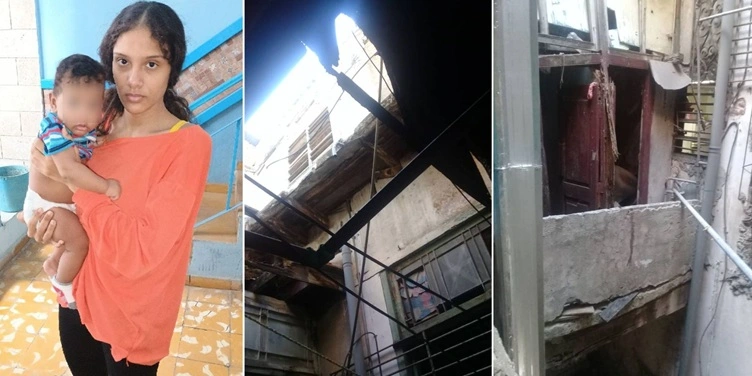
Her three-month-old baby has already gotten sick from the humidity of the premises, but the young woman assures that it is safer than her home, where walls and beams have given way and part of the structure has collapsed.
MADRID, Spain.- The young Cuban mother Elianet García Rodríguez, 19, denounced CubaNet who is experiencing an extreme situation after occupying a state premises in Old Havana with her three-month-old baby. She claims that her home is at imminent risk of collapse and that the authorities, far from providing support, have threatened to take away custody of the child and take her to prison.
In her house (236 Bernaza Street) a group of six people live together: her blind grandfather, her parents, her brother, her baby and her. “My home is in very bad condition and I have a 3-month-old baby and I am afraid for my son’s life because at any moment the building could collapse,” she said. For this reason, for a few weeks he occupied an abandoned Youth Club.
A building on the verge of collapse
As he explains, the deterioration of the building has progressed for years without any repair: “My building was practically a collapse.” Recently, he says, the floor of the staircase to the roof collapsed “completely and part of a neighbor’s hallway.” One of the walls of his home “is completely peeling off” and his kitchen is directly adjacent to a collapse.
Fear increased after learning of the death of a mother and her son in a recent collapse in Old Havana: “A few days ago a mother and her child died here and I am not going to be the next.”
Faced with this risk, Elianet decided to occupy a Young Computer Club in Muralla, between Havana and Compostela, at night, a place closed for months and used as a warehouse. “I’ve been living here for almost a month now with my baby,” he said.
Officials threaten to take away her son
Shortly after settling in, pressure from local workers and officials began: “They came to threaten me, to want to take me away, saying that they were going to take my baby away from me, that they were going to hand him over to other people to take me prisoner.”
A few days later, representatives from Housing, the delegate, the delegate and a social worker arrived: “She told me that I had to leave and I told her that I was not going to leave until my housing problem was resolved,” she says.
But he assures that none of the promises have been fulfilled: “They gave me a period of one week… but that response has never arrived, for more than 20 days.”
The police sector chief, whose unit is right in front of the occupied premises, also pressured her: “He came… to tell me things too, to threaten me, to tell me that I had to leave.”
A precarious place, but safer than his old house
The space, although habitable compared to her home, is in poor condition: “There is tremendous humidity here… my baby has gotten sick twice while being here,” she explains. And she adds that she herself had to clean the place, which had not been used for months. Even so, he insists that it is a less dangerous option: “This place is a thousand times better… I can’t allow anything to happen to my son.”

An adolescence cut short by precariousness
Elianet also shared her educational career interrupted by the country’s crisis and family responsibilities. He tried to study accounting and library science, but had to abandon both careers. Later he worked at the Simón Bolívar Museum and at the Havana Workshop School, until he had to leave everything again.
During her pregnancy she lived a period of extreme precariousness: “I barely ate… of the six meals I had to eat a day I ate between two or three.” He claims that he received no material or emotional support from the child’s father.
Hold the authorities responsible if something happens to you
The young mother assures that her complaint is a way to protect herself from any consequences that she or her baby may suffer: “If something happens to me or my baby, let those people who want to get me out of here be responsible.” And he makes a clear demand: “Either they leave me in this place or they give me another better place to be.”
Meanwhile, she continues to live with her three-month-old baby in an abandoned state facility, with no institutional response and under the constant threat of eviction.














