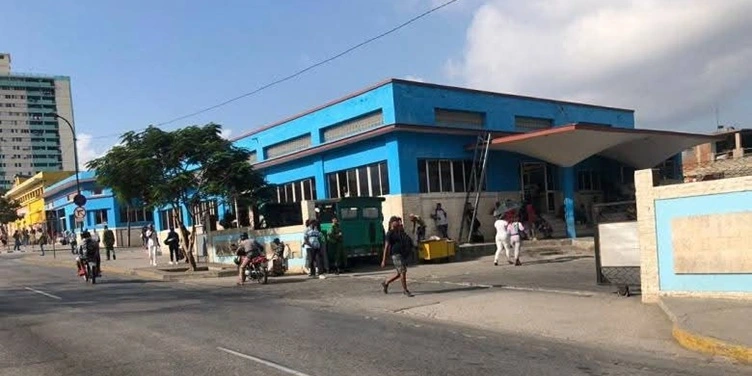
The intermunicipal terminal on Calle 4 has become one of the most dangerous points in Santiago de Cuba, with frequent robberies in the midst of crowds and police in complicity with the thieves.
SANTIAGO DE CUBA, Cuba.- A Mexican tourist was recently the victim of an assault in Havana, a fact reported by CubaNet which has once again brought to the table the persistent insecurity in several cities in the country. The episode reflects a phenomenon that is not exclusive to the capital: violence in the streets spreads to other provinces, where citizens face the same vulnerability.
The foreigner in question suffered an assault in Old Havana during a blackout that left the streets in darkness. Upon returning to his accommodation, he managed to escape the first attack, but others took advantage of the confusion to snatch his mobile phone. On this occasion, some factors, such as the lack of lighting or the nationality of the victim, surely led to the attack, but this does not mean that the nationals are safe or that daylight exempts them.
In Santiago de Cuba, for example, this reality is concentrated in places such as the intermunicipal terminal of Calle 4, in the Sueño neighborhood, which connects the main municipality with towns such as Songo-La Maya, Palma Soriano, Contramaestre and San Luis. There, the scenario is different: the attacks occur in broad daylight. The lines of passengers waiting for transportation, increasingly limited, create crowds where criminals select their victims.
Stories that reveal the pattern
Migdalia López was stripped of her belongings at the beginning of October while trying to board a truck bound for Palma Soriano, where she lives. It was almost two in the afternoon when he arrived at the terminal and, immediately, some suspicious faces caught his attention. “I grabbed the wallet tightly, but first I put the phone in a pocket that was difficult to access, but in order to protect the phone, I neglected the purse,” he says.
“When a car finally arrived, it was brutal to get in. People pushing each other, climbing through the window, in short, total chaos. Trying to sneak in, I was distracted for a few seconds. I only know that when I managed to sit down, which I checked, I no longer had my wallet. Thank God the phone was there,” he described. “What hurt me the most were my documents, my license, my self-employment license and the cards that I quickly blocked. Needless to say, I had almost no cash,” he said.
During those days, two residents of the El Cristo town, a man and a woman, were also attacked almost simultaneously. Our Songo-La Maya collaborator, Yadira Serrano Díaz, witnessed the event.
“After more than two hours of waiting, a truck finally arrived. I’m not in the habit of rushing to get on because I know what it entails. There are many reports of assaults in this terminal. People are already bristling, but the moment a car arrives, they lose their temper, and it’s understandable: everyone wants to leave. Those people got on first, but it cost them dearly. When the man touched his pockets to pay, he realized that he didn’t have his wallet or his phone. Immediately everyone began to check themselves and it was then that the woman did not find her phone in her bag,” explains our reporter. “They were both assaulted in the melee,” he concluded.
In this context, another factor fuels the feeling of impunity and turns the terminal into an even more dangerous space. The scarce police presence and reports of possible bribes to agents amplify the feeling of impunity.
The testimony of a worker from the same terminal describes the dynamic crudely: “The police hardly appear, because many work with the thieves, they even receive money from them. I have been a visual witness of that. That is why they are not afraid to be here hanging around. They are authorized,” the woman denounced anonymously.
This institutional indifference forces victims to report through informal channels, such as social networks, which, although they serve to publicize the cases and make the problem visible, unfortunately have no legal impact.
Yurisel Pérez Cedeño was assaulted while riding the Baconao bus, also in the first days of October. “There were many people and I took care of my purse, but I also wanted to get on, because I was full and I was afraid to stay. I had people all around me, but in front of me there was a boy with a purse who looked at me and ran from one side to the other. Maybe it was at that moment that happened, that he took my purse,” she explained to CubaNet.
The girl asked for help in several Revolico Santiago de Cuba groups so that if someone found her identity card, they could return it to her, since in many cases the assailants throw away the documents once they steal the money.

It is worth noting that losing official documents in Cuba represents a bureaucratic odyssey that consumes entire days, queues since dawn in offices that open late or close early, missing papers and requirements that change without prior notice. This is why some assault victims, like Migdalia and Yurisel, are even more worried about the papers than about the money itself.
Returning to the assaults: in each episode some particularities stand out that reveal alleged suspects: strange attitude, men who do not wait for transportation, who do not sell anything and remain stationed at the entrance of the terminal, with backpacks in front; very attentive to the movements of the crowd. Despite being visible, they continue there without sustained intervention.
Some assaults are violent
Some attacks on Calle 4 are particularly violentlike the one suffered by a medical student on September 1, the same day the school year began in the province. The girl was assaulted at knifepoint while trying to board a bus bound for La Maya, where she lives. In the middle of the afternoon and surrounded by people, the individual put his hand in her purse to steal her phone, while intimidating her by demanding silence. None of those present intervened.
This inaction of the people was probably marked by fear, because the snatcher was carrying a sharp object. In a context where police ineffectiveness is increasingly evident, many citizens have chosen to take justice into their own hands, restraining and even beating the assailants, while ensuring that they do not escape until the authorities arrive.
On that occasion, the university student’s father, Eminaldo Ramírez Muestelier, who was the first to denounce what happened on his Facebook profile, also openly questioned the authorities: “How long will impunity be allowed?”
His questioning draws a much more worrying social dilemma: on the one hand, the increase in street violence; on the other, the citizen reaction to the institutional inability to protect the population. In that sense, insecurity has ceased to be an isolated perception in Cuba and has become an everyday fear, a feeling of vulnerability that goes beyond material loss.
Data that reinforces that perception
In this regard, in his report 2024, the Cuban Observatory of Citizen Audit (OCAC) shows a sustained growth in common crime, a scenario that fuels collective fear and the feeling of helplessness. According to data collected, 432 crimes were documented in the first semester alone, including 91 murders and 260 robberies. This represents an average of 2.37 events per day.
However, in 2025the figure rose to 1,319 crimes between January and June, more than seven crimes a day and robberies are precisely the most frequent crime, with 721 cases reported. In addition, the OCAC also recorded 61 assaults and 38 assaults, affecting both men and women, minors and the elderly. In the analysis, Santiago de Cuba is one of the most affected provinces, along with Matanzas, Havana and Holguín.