By María Villarreal and Leonardo Magalhães/Latinoamérica21
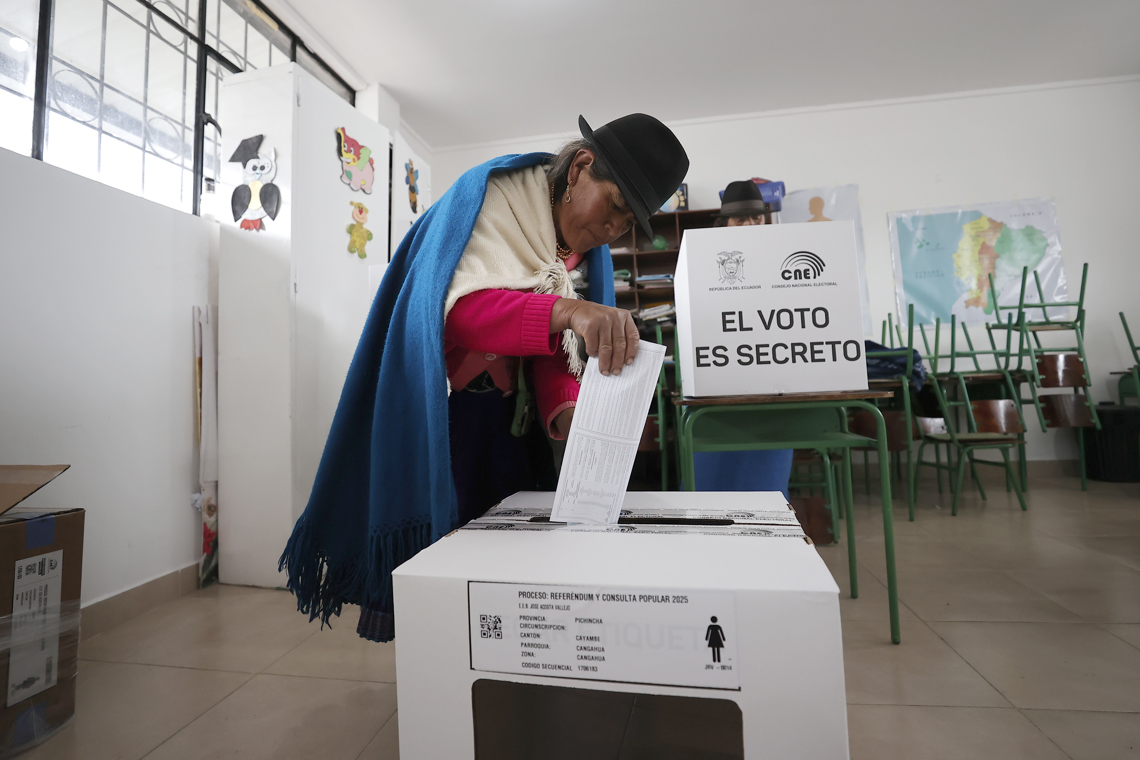
On Sunday, November 16, Ecuador held a popular consultation and constitutional referendum. It was the seventh vote in just two years, but not one more. In the country, today governed by Daniel Noboa, the reform package put to vote implied a 180-degree turn: convene a Constituent Assembly to draft a new Constitution, allow the installation of foreign military bases, reduce the number of assembly members and eliminate state financing for political parties. In all four questions, “No” won overwhelmingly, with percentages between 53% and 61%. The most rejected initiatives were the replacement of the current Constitution and the possibility of installing foreign military bases. But beyond the numbers, what message does this resounding victory of the “No” leave?
Ecuador says “No” in referendum for new constitution and Noboa accepts defeat
In a country, previously considered an oasis of calm, but which Today it has become the most violent in the regionthe victory of the “No” in the referendum and popular consultation last weekend surprised those who read the Ecuadorian scenario as a simple referendum on the popularity of Daniel Noboa. The president still has high approval ratings, but a deep analysis of public opinion data, such as the national poll of IPSE Global conducted in October, reveals that the result was the chronicle of a defeat foretold, and the outcome of an accumulated tension in an electorate divided between fear of crime and fear of unlimited power.
Noboa came to the presidency with a clear mandate: to restore order in a country besieged by drug trafficking. His response, declaring an “internal armed conflict” and applying a “iron fist” policy with massive militarization, resonated with a popular outcry. Although some achievements have been made, especially in drug seizures, the government’s growing authoritarianism and heavy-handed strategy have led to increasing human rights violations and they have not been able to resolve the structural problems of citizens. For this reason, although Ecuadorians support hard-line policies, they reject the bukelization of the country and, above all, they are not willing to sign a blank check and hand over total power to the president. The survey revealed, for example, that 61.5% of the general population already feels that the country is governed through “authoritarian decisions that violate the laws.” This latent fear of a way of doing politics based on power without counterweights was the driving force behind the “No.”
The Ecuadorian people, in an act of political sophistication, differentiated the action of the government from the power structure. He gave Noboa a sword to fight crime, but refused to give him the pen to rewrite the rules of the democratic game.
The virtual agenda of the government versus the real agenda of the citizen
The Noboa government made a fundamental miscalculation: it was excessively optimistic and believed that its agenda was the people’s agenda. Despite having enormous public resources and media support, he had a confusing communication strategy and explained that he would only offer the details of his constitutional project for the country in the near future. However, while the president proposed a constitutional debate to redesign the country’s political framework, citizens were anchored in much more immediate concerns. The survey conducted by IPSE Global revealed that 86.3% of Ecuadorians feel the impact of the increased cost of living, especially in food and transportation. The economy, and not the architecture of the State, was his main anguish.
Furthermore, the “Yes” campaign underestimated adherence to the current Ecuadorian Constitution, approved in 2008 with more than 63% of the votes. The Constitution guarantees rights and represents a framework in the environmental agenda, being the first in the world to incorporate the Rights of Nature. Support for the current Magna Carta was majority in various groups, especially among women. With a 70.1% positive evaluation of the Magna Carta among the female electorate, they emerged as the great guardians of the current institutional order. The “No” had a woman’s face, defending rights and a legal framework that they felt was their own.
Referendum in Ecuador: yes to the crusade against crime, but no to economic reforms
Even the president’s own electoral base was not a monolith. Our most revealing data was that almost half of its voters (48.1%) did not have a negative opinion of the current Constitution. They supported the president, but not necessarily his total reform project, demonstrating that loyalty to the leader did not imply blind adherence to his agenda. Furthermore, although in Ecuador the relevance of international cooperation to combat organized crime is accepted and recognized, citizens assume that this process has limits and mostly reject the installation of foreign bases in the country: the “No” to this question obtained 60.85% of the votes in the referendum and popular consultation.
Governance on the tightrope
The results of the recent vote leave Noboa in a position of extreme vulnerability in the medium term. Its legitimacy depends almost exclusively on its success in the fight against organized crime. But this is a war of attrition. as a sample a recent Crisis Group reportviolence in the country is still the majority and has been transformed, with the increase in extortion and kidnappings, while the fragmentation of large criminal gangs creates new and bloody disputes.
If the perception of security deteriorates, Noboa’s political capital will evaporate. Without the banner of security, and having failed in its attempt to accumulate more power, its government risks becoming an administration without purpose or tools.
The “No” has strengthened a diverse opposition and has provided new tools to the Legislative and Judicial powers to act as a firm counterweight. Any attempt to govern by decree or to challenge institutional limits—a high-risk path similar to the institutional crises seen in other countries in the region such as Peru—could activate the distrust of the majority of the Ecuadorian population and precipitate a governance crisis.
Despite the multiple crises that the country is going through, the victory of the “No” made it clear that ideas and concepts such as democracy, sovereignty, human rights and the environment continue to have a central value for Ecuadorians, who demand an effective government—beyond promises—capable of addressing their daily problems. The security crisis not only requires measures to combat organized crime, but also structural reforms in justice, the penitentiary system, social policies, international cooperation, arms control and crime financing. At the same time, challenges such as poverty, unemployment and the deterioration of health and education services cannot continue to be relegated.
This article was published in Latin America21 and is reproduced with the express permission of its publishers. Read the original.
Maria Villarreal is Political scientist and Professor of International Relations at the Federal Rural University of Rio de Janeiro (UFRRJ). Doctor in Political Science from the Complutense University of Madrid.
Leonardo Magalhães has a doctorate in communication from PUC-Rio de Janeiro. Founder and Executive Director of IPSE Global. Researcher specialized in public opinion, discursive framing in the media and computational social sciences.