Madrid/As if faced with the bite of a poisonous insect they refused to take the antidote that would prevent death, the Cuban Government blindly continues its flight forward with a reissued “program to correct distortions and re-boost the economy.” The plan, presented Thursday in the official press and the program Round Tablecame out the same week in which it became known that the accounts of all foreign companies they are frozen and three devastating documents have been published about the situation on the Island: a article in the prestigious weekly The Economista new 21st century Cuba report and the most recent data from the Economic Commission for America and the Caribbean (ECLAC).
These three go in the same direction, summarized by The Economist from its owner: Cuba is headed for disaster unless its regime changes drastically. For the British media – which does not usually dedicate much space to the Island –, given the very poor economic, energy, health and demographic conditions of the country, fully summarized in its long text, “a convulsion is coming.”
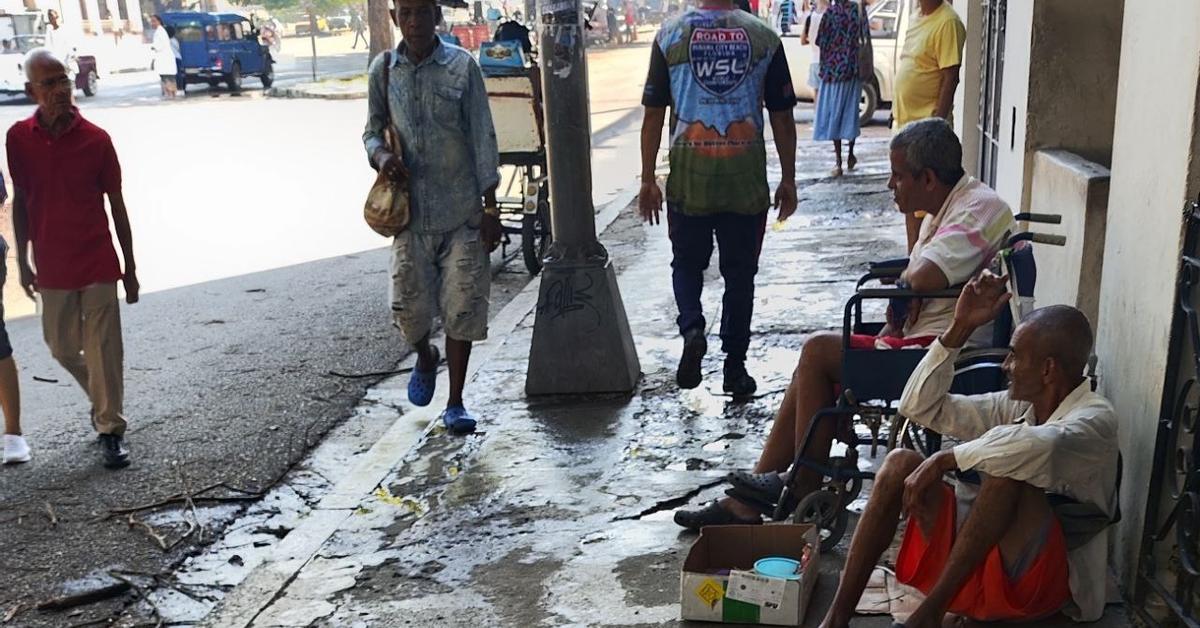
“It is difficult to understand how ordinary Cubans survive today,” the weekly is surprised at first, recalling that “basic needs cost much more than the official average monthly salary of 6,506 pesos (equivalent to $14.46 at the informal exchange rate, which is the one used).” The portrait he makes The Economist of the sufferings of daily life is recognizable to any citizen of the Island: “Under stifling heat, electricity is interrupted in most places for at least four hours a day, and in some areas, almost all the time. Fans and air conditioners are usually turned off. In many places there is also a lack of water, so drinking, cooking and washing, let alone showering or even using the toilet, is often impossible.”
“In stifling heat, electricity is interrupted in most places for at least four hours a day, and in some areas, almost all the time”
The data offered by the specialized media is known, such as that 89% of families live in extreme povertythat public transport “practically” has disappearedthat “millions of Cubans” depend on the remittances or that a quarter of the population has left the islandbut put all black on white, for an international audience, they impress. Particularly eloquent are two graphs on migration included in the article, with sources from the independent demographer Juan Carlos Albizu-Campos: along with the figures of Cubans who left their country are those of those who entered the United States, and they are, year by year, inversely proportional, like an inverted mirror.
The text pays the main attention to economic data, including the tourism collapsethe high inflationthe peso devaluation and that the production is the lowest in more than a centuryresulting in a contraction of 11% from 2019, a number recognized by the Government itself.
The latest ECLAC report, made public last Wednesday and commented by the Cuban economist living in Spain, Pedro Monreal, abounds in this disaster: it highlights that the Island appears as “one of the three countries without growth in the value of projected exports of goods (worse than Haiti although better than Venezuela).” For this expert, “the reduction in the estimated value of Cuban goods exports in 2025 would be explained by the terrible sugar harvest and the fall in the price of nickel.”
“Due to Cuba’s high import dependency, the contraction of imports must have negatively impacted economic growth”
Monreal also highlights the results for the first half of 2025, which indicate the simultaneous reduction of exports and imports, the negative balance of the balance of trade in goods (exports-imports) and the fact that the Government does not report its data on trade in services. And he asserts: “Due to Cuba’s high import dependency, the contraction of imports must have had a negative impact on economic growth.”
“The only ray of hope is the rise of private initiative,” he states. The Economistwhich then warns of the obstacles that small business owners encounter. “The government seems unable to decide whether to simply tolerate private activity or encourage it,” the article observes. The owners of private firms, they continue, “feel constantly frustrated by the Government’s lack of clarity in interpreting the law and its persistent distrust of free enterprise.”
In this regard, they quote a businesswoman interviewed, Marta Deus, who runs a tax consulting firm and the delivery company Mandao (with 200,000 users): “Everything is done in a roundabout way. There is no clarity. Nobody knows the rules. We expect a change. But it seems that the Government lives in another world.”
The fundamental reason for the regime’s reluctance is the fear that the system will collapse if the private sector expands. “They see private companies as a nest of worms that will infiltrate, destabilize the country and end up expelling the Party from the city,” says another of the interviewees. And a third: “When they see the first McDonald’s in the Plaza Vieja, they will know that the Revolution is over.”
The text of The Economistwhich regrets that “no Mikhail Gorbachev” is still visible within the regime, as there was in the Soviet Union, and that the opposition is “weak and fragmented,” concludes with the words of a taxi driver: “This system is so bad that it is irreparable. The only thing that can be done is get rid of it and start from scratch.”
The military conglomerate is “the true power in Cuba, which has led the country to the worst financial crisis in its history”
It is the same conclusion reached, with other words and through other means, by Emilio Morales in his most recent report for the organization Cuba Siglo 21, published last Wednesday. “The only way to abort this financial crisis that has practically paralyzed the country and has plunged the population into extreme poverty is to eliminate the governance system that has created it,” the consultant writes in his report.
For Morales, the fault lies with the Business Administration Group (Gaesa). The military conglomerate is “the true power in Cuba and has led the country to the worst financial crisis in its history.”
The specialist recalls various data such as the shortage of dollars, the generalized fall in national production and the increase in external debt, exposing them around an idea: “The Government led by Miguel Díaz-Canel in practice does not have control of the country’s finances. The Central Bank of Cuba, which is the institution that should govern the management of the nation’s finances, is completely subordinated and subject to the interests of Gaesa.”
Proof of this – which Morales does not mention – would be the process carried out against the former Minister of Economy and Díaz-Canel’s right-hand man, Alejandro Gil Fernandezaccused of spy for the CIA and other serious corruption crimes.
In any case, and given the new measures that it is publicizing these days, the regime will continue on the wrong path. Although the ruling party boasts that “the Government Program is made up of 10 general objectives, 106 specific objectives, 342 actions and 264 indicators and goals, all closely interrelated,” it does not, in reality, offer any new developments.
To begin with, for the reason to which they attribute the economic disaster, which they refer to as “the effects of permanent aggression derived from the economic blockade and internal insufficiencies.” From what emerges from the ton of words expressed by the officials, they will continue with the controls on private companies – the “distortion in the relations between economic actors today slows down the fundamental role of the state company,” declared Jorge Luis Broche Lorenzo, head of the Productive Economic Department of the Central Committee of the Communist Party (PCC) – and the campaign against The Touchwho is accused of being at the service of the United States to devalue the national currency.
Regarding the energy crisis, far from proposing an innovative approach, they return to the “classics” of the PCC. Word from Broche Lorenzo himself: “Let us remember that Lenin was clear about this: communism in those conditions translated as the power of the soviets plus the electrification of the country. If our electrical system is not reactivated to the level demanded by economic management, it will be difficult to advance in the process of socialist construction.”