There is a myth that the industrial fishing It is not compatible with protected natural areas. It is thought that the development of this activity could cause, for example, the extinction of species that are sought to be protected, when in reality the opposite is true.
Industrial fishing is an economic activity regulated by the State, whose families, companies and the State itself depend on the responsible use of resources, a practice that the sector performs very well and that has been endorsed by Peruvian authorities and specialized international organizations.
One of the problems in fishing operations is the incidental capture of any species not targeted by fishing, which can lead to its extinction. According to the World Wildlife Fund (WWF), this involuntary capture can represent 40% of the total resources that are extracted.
Aware of this impact, in 2017, the National Fisheries Society created the Salvamares Program, whose application consists of four pillars, which not only solve the problem, but also promote the conservation of resources.
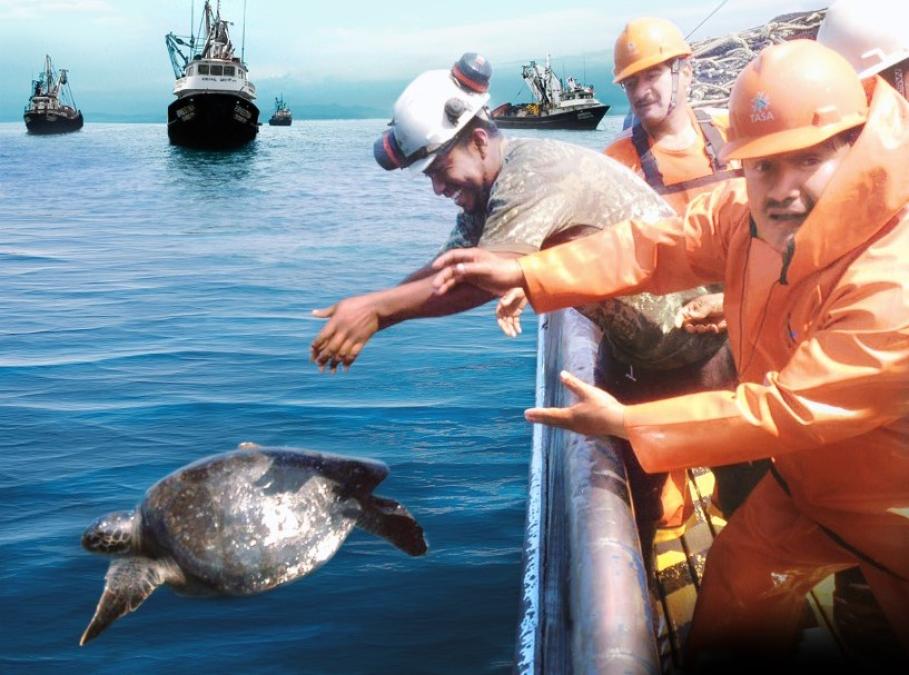
The initiative obliges companies in the sector to keep a record of marine fauna, sea temperature, and fishing characteristics during fishing activities, among other data in order to contribute to good fishing management. The other component is to immediately release the species that the nets have voluntarily captured.
According to official sources, for each season, industrial fishing has returned around 1,500 species to the sea, preventing their extinction.
Authorities adopt Salvamares
When the Nasca Dorsal National Reserve was created in 2021, the master plan that dictates what can and cannot be done within the protected territory adopted the Salvamares program as one of the three strategies for the conservation of threatened species.
“The first (strategy) is related to the generation of public-private alliances for the conservation and positioning of the protected natural area. In this framework, artisanal fishermen and the National Fisheries Society, through the Salvamares program, implement a record of sightings, interactions and release of species,” the master plan states.
The document was approved by authorities such as Sernanp, Produce, Imarpe, Ingemmet, as well as the technical contribution of the World Wildlife Fund Peru Program (WWFOPP), The Nature Conservancy (TNC), the Peruvian Society of Environmental Law (SPDA), Pro-Delphinus and Acorema.
With this, it is proven that industrial fishing can not only coexist in protected natural areas, but can contribute to their conservation.
In addition, the impact that the sector generates on the economy must be taken into account, such as the generation of more than 2,500 jobs.
“Anchovy fishing is sustainable and has not affected the Paracas Reserve; on the contrary, it is a source of employment that generates foreign currency for the country,” stressed Héctor Castro, an industrial fisherman.
Data:
The Salvamares program won the 2020 Antonio Brack Egg National Environmental Award
Yale and Columbia Universities have recognized Peru as the country with the best fishing performance in South America thanks to the sustainability of its anchovy fishery.
“They want to expel us from our activity”
The general secretary of the Single Union of Fishermen of New Vessels of Peru (Supnep) maintained that industrial fishing can coexist with protected natural areas without affecting their
conservation.
Is fishing compatible in protected natural areas?
First of all, we understand that protected natural areas are important for the development of the country. Thanks to them, species and the environment are cared for. As a Peruvian, I agree with protecting themselves; However, what the studies show is that industrial fishing can coexist with this management of
conservation.
What conservation practices do you carry out on a daily basis?
Industrial fishing has been developing for more than 70 years and we have never caused damage or harm to the environment or protected areas since its creation. On the contrary, industrial fishing, through crew members and their employers, has implemented programs to protect species. For example, there is Salvamares: when a companion species is found in a fishing operation, it is handled with due care to be safely released into its environment, allowing its development to continue. That is something that detractors or those who oppose industrial fishing do not mention.
Do you think that if fishing is prohibited in these areas, your rights will be affected?
In addition to being a constitutional right, work is also a customary right, because it is an activity that we have been carrying out for more than 70 years. Our concern is that the detractors of industrial fishing seek, through legal instruments in the Judiciary or Congress, to distance us or expel us from our fishing areas.
What would be the impact of a ban in these areas?
It would significantly affect the economy of thousands of fishermen and their families, as well as that of the entire fishing industry and its thousands of suppliers.
Receive your Perú21 by email or Whatsapp. Subscribe to our enriched digital newspaper. Take advantage of the discounts.
RECOMMENDED VIDEO