San José de las Lajas (Mayabeque)/At five in the afternoon, when a reddish light falls on the peeling buildings of the Military District in San José de las Lajas (Mayabeque), the same ritual occurs: the doors are closed, the windows are blocked with cardboard and the neighbors hurry to enter before the cloud of mosquitoes takes control of the neighborhood. No need to look at the clock. The buzz announces it.
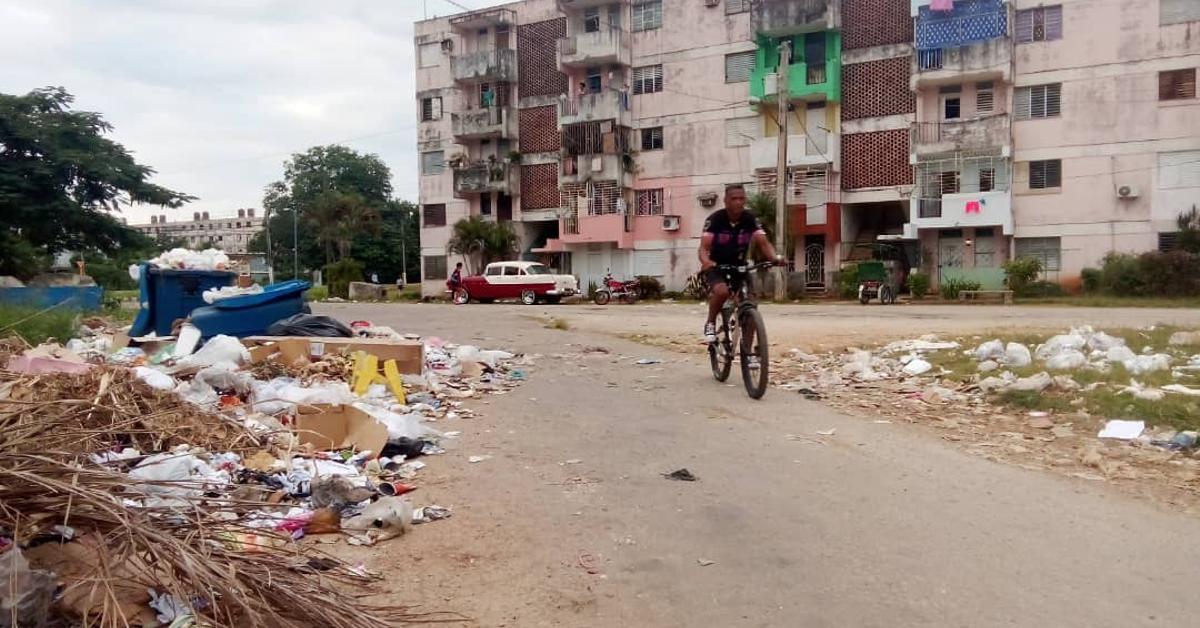
On the streets – if you can call these shreds of raised asphalt that – the garbage forms mountains that seem to have taken root. Nylon bags, used diapers, food scraps, pieces of wood and even broken furniture accumulate for days and weeks. A dog rummages through the rubbish as if looking for an unlikely treasure, while a neighbor passes by on a bicycle, avoiding green puddles where the stagnant water smells of feces and abandonment.
San José de las Lajas crosses one of its worst hygiene crises in decades, but in the Military District – an aging housing complex with deficient infrastructure – the situation has acquired unbearable dimensions. According to the official press of Mayabeque, the province is experiencing an increase in febrile cases associated with chikungunya and dengue, which has motivated “intensive fumigation actions” in several municipalities. But these “actions” have not happened in the area, according to the neighbors.
“The press says that they are with bazookas throughout the city, but they have not come to my building”
Orlando, a mechanical engineer and father of two children, speaks to 14ymedio with a fatigue that does not go away from his eyes. “The press says that they are with the bazookas throughout the city, but in my building they have not come. In my house we all fell: first the boys, then my wife and finally me. This virus finished us off.”
The neighborhood, built decades ago by microbrigades of low-ranking officers, has changed its face. “There is almost no one left from those times,” says Orlando. “The military left, and the civilians who remain give us a Comunales truck every three or four months. They come, empty a container – if it hasn’t been stolen – and leave. The rest of the garbage is left lying on the ground. Nobody picks up anything.”
The images tell it all: an improvised garbage dump that extends for meters, the overflowing container and the buildings that lost the color of their facades years ago. On the ground, the water forms puddles that look like ponds for cultivation. Aedes aegypti. The hatcheries, neighbors say, are not only outside. “Rotten pipes, cisterns without covers, rooftop tanks full of dirt… that’s where they breed,” explains Orlando.
The disease progresses like a shadow. “Five sick buildings, at least. In mine, almost all of them,” the engineer calculates. “It’s a fence that you can’t get out of.”
The old woman assures that the delegate of Popular Power “is painted on the wall”
Lucía, a retiree who lives alone, shows a mixture of annoyance and resignation. He has called the local headquarters of the Communist Party, the Government, municipal and provincial Public Health. “The answer is always the same: that when the fuel arrives, they fumigate. Since August I have been hearing that.” Finally, sick and without strength, she opted for a paid way out: hiring a fumigator on her own.
“I found him in Revolico, 600 pesos each visit. He came two days in a row with the bazooka. He himself told me that first he had to fumigate two blocks that belonged to him by the Policlinico del Este, and then he could come here. You see how we are. I spent 1,200 pesos of the 3,200 in my checkbook.”
The old woman assures that the delegate of People’s Power “is painted on the wall.” He says it without anger, with the voice of someone exhausted from waiting for official solutions that never arrive.
Meanwhile, life in the Military Division is a succession of fevers, joint pains, vomiting and sleepless nights. Every day we hear of someone else who has fallen into bed. Outside, the children no longer play. The adults walk as best they can, in an almost robotic step due to the joint pain caused by chikungunya, and looking at the ground.
“The country that boasts of medical power cannot handle a mosquito”
The authorities, for their part, report on television a decrease in cases and “greater vector control.” In practice, the epidemic remains overwhelming. The Ministry of Public Health of Cuba reported this Friday that the previous day 6,597 new patients with febrile symptoms were registered, in addition to confirming 847 cases of dengue and 753 of chikungunya in one day. For his part, Durán explained, in the television space that he once again has daily, that chikungunya, the main disease affecting the country, already has a cumulative of 31,513 cases, between confirmed and suspected.
“You feel ashamed of others,” says Lucía. “The country that boasts of medical power cannot handle a mosquito.”
In the distance, a woman takes a sheet out of the balcony to dry it. The wind raises a sour smell that comes from the waste. A truck passes without stopping. The dog goes back to rummaging through the trash. The neighborhood enters its survival routine.
In the Military Department, the only thing that moves constantly is illness.