Concern about insecurity
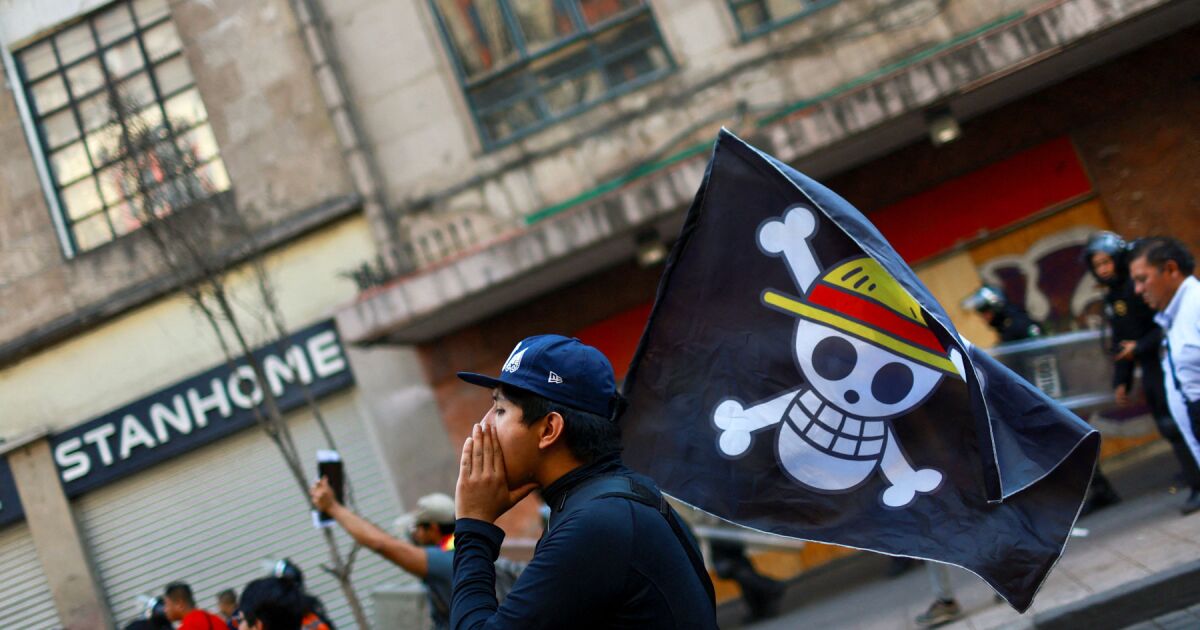
Ricardo, a 17-year-old student, participated in the protest against the insecurity experienced in the country due to the presence of drug trafficking organizations.
He stated that these groups increasingly have greater control over society. “I came to the march because we want a Mexico that is a little safer, that there is no longer so much repression and to seek true change,” he said in an interview with Political Expansion.
The young man remembers cases such as the discovery of Rancho Izaguirre, in Guadalajara, a site used by the Jalisco New Generation Cartel (CJNG) as a training camp; the murder of Irma Hernández Cruz, a retired teacher who worked as a taxi driver in Veracruz and publicly denounced the extortions she experienced; as well as the murder of Carlos Manzo, mayor of Uruapan, Michoacán, during a public event for the Day of the Dead.
(Photo: Yuri Cortez/AFP)
The security specialist, Andrés Sumano, pointed out in Policy and Other Data that talking about the march is precisely talking about the issue of security, since it is precisely linked to the fact that it is one of the concerns of Generation Z.
“Somehow both things have to be explained together and that means we have to analyze the march also in the context of how this generation reacts to the security issues that concern us today and in particular to the murder of Carlos Manzo,” he commented.
Researcher Esmeralda Correa explained that in surveys they have conducted, she realizes that young people grew up in a country marked by violence and they identify themselves as a “generation that was born in the drug war,” which is why they have developed protection skills when they go out, recreation and leisure, and are developing “a perception of being fed up with seeing that their peers are disappearing and we have an overwhelmed State.”
The issue of violence is an issue that the young people of this generation were born and raised with.
Esmeralda Correa, researcher at the UdeG.
Joshua, a 20-year-old student, also has security as his main demand for the authorities. He stated that people close to him make a living from commerce and are victims of extortion in Mexico City.
“(There is extortion) everywhere, there will always be people who take advantage of other people to enrich themselves (…) It is annoying that the authorities do nothing today and even more so because they already have them, so to speak, located, they know who they are, they don’t really do anything,” he claimed.
For the young man, security problems in Mexico City and in the country are not a problem that began a year ago with the government of President Claudia Sheinbaum, but a crisis that has dragged on for years.
“In the end we are all tired of this government, I am not saying this for this government, we know that we have had years where they do not contribute anything but in the end I think that we are all already tired of this,” he criticized.
Mental health and worry about the future
The study “ Generation Z and their job expectations “, prepared by the Tecnológico de Monterrey, recognizes that among the concerns in the social sphere of these young people are crime, corruption and inequality. It also showed that one of the main personal concerns of Generation Z is their mental health.
“The mental health of an entire generation faces a silent emergency… but it is also a generation that raises its voice and is ready to reimagine its reality,” said Aurore Brossault, UNICEF Mexico specialist, in the study “ Understanding how global challenges affect the mental health of Generation Z ”, presented by UNICEF, Z Zurich Foundation, Pinterest and Spotify.
This report confirmed that this generation is among the most concerned about the future of their community, their country and the world, although they are also one of the most hopeful and willing to act.
He explained that despite the emotional overload, 64% of young people feel responsibility and ability to play an active role in their present and future. Thus, this generation is more willing to participate in mobilizations.
After participating in the march on November 15, Ricardo – who covered half of his face with a bandana for this interview – acknowledged that he is afraid of being arrested or criminalized for his participation, however he considered that it is necessary to mobilize young people to create change.
“No way, if we have to raise our voices so that others join over the years, I think there is no better reward for people to open their eyes,” he said.
Axel, a resident of Iztapalapa and member of generation Z, joined the mobilization called on social networks due to his concern about insecurity in the country, corruption at different levels of government and impunity in cases of disappearances, murders and kidnappings.
The 20-year-old, who defines himself as independent and without party affiliation, asked that the demonstration not be used for political purposes. “Everyone comes of their own free will, they are not carried, and I come voluntarily,” he stated.

(Photo: Raquel Cunha/Reuters)
That was one of the reasons why Ricardo was disappointed, because he assured that among the attendees there were people from generations previous to his.
“It is a Generation Z march, it is assumed, and as we see there are more adults. I am not saying that adults should not join, of course, at the end of the day this march is for all the people who are already tired, but that there are few young people who care about Mexico, that I think is the most worrying thing,” said Ricardo.