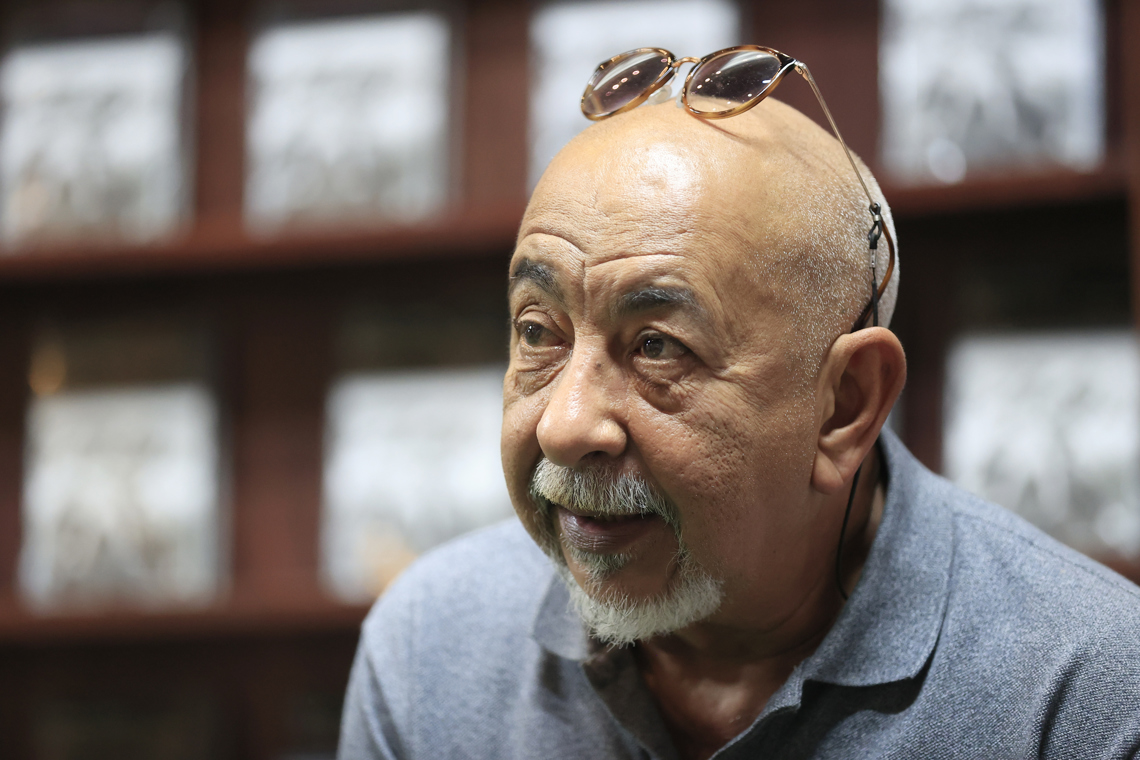
die in the sandthe latest novel by Leonardo Padura (Havana, 1955), shows a Cuba hit by electricity outages or inflation, a crisis that for the writer can only be solved if a “deep surgery” is chosen for the economy, instead of superficial “band-aids.”
One of the narrators expresses it emphatically: “There was no solution in sight, and that is why so many people had left and, as things looked, they would not stop doing so.”
For the writer, however, there is a solution to Cuba’s “most acute problem.”
“I think that a profound surgery is needed in the Cuban economy and that will cause, of course, changes in society and changes in politics. Until that happens, I don’t know how there can be important changes in that society that envision a different way of living everyday life,” he told EFE.
The writer, who traveled to Panama this week to present the novel, remembers that economists describe the situation in Cuba as a “multicrisis,” something that has led the island to increasingly resemble Haiti. Not because of the levels of violence, although there are more and more robberies, but because of the “street panorama”, where, for example, people sell in a “not only disorganized, but also desperate” way.
Criticize and continue living in Cuba
Padura, Princess of Asturias award winner in 2015, speaks and writes about Cuban reality without detours or euphemisms, despite the fact that he lives in Havana, while other critical voices have had to suffer imprisonment or exile.
Is there then a certain freedom of expression in Cuba? How is it that writers like him or Pedro Juan Gutiérrez, author of the Dirty Havana Trilogy, Can they continue living in the country?
“I don’t know if there is all the freedom of expression that there should be, I think not,” Padura responds, “but I exploit all the freedom I need to express myself,” and he also links that “freedom” to the fact that “the Cuban publishing industry is practically stopped” as part of the “polycrisis,” so there is hardly any distribution of its books on the island.
And the fact is that for “four novels” his books have not been published in Cuba, and before, although he published, it was with very small print runs, up to 1,500 copies.
Thus, it tries to use “all the independence and all the freedom” that allows it to have a publishing house outside of Cuba for almost three decades, the Spanish Tusquets Editores.
But although his books are not distributed in Cuba – “they say that due to lack of paper and it is true that there is no paper, but I also believe that there is not much will to publish them” – his compatriots read his work through physical books sent to them from abroad or in “digital pirated copies”, the majority option.
Migrate or stay
Furthermore, for the novelist, there is no other option to continue writing than to remain on the island.
“I believe that the solution is not always to leave. I do not believe that the solution for many is to stay, but for me it has been to stay to be able to be close to that reality, to be able to feel it,” reflects Padura, who needs to tell “the frustrations, the hopes, the desperations, the desires, the loves, the hates of the people.”
Because although “the perception that one may have of Cuba and Cuban society is one of immobility”, because the political-economic structure has been more or less the same for decades, “society does change”, and he gave as an example of recent drastic changes the arrival of the Internet with the consequent increase in access to information or the fact that one is allowed to leave the country if one has a valid passport.
This caused, he said, an estimated 1.2 million Cubans to leave the country between 2022 and 2024, many of them through Nicaragua, which did not require a visa, and then continue their route to the United States. But the arrival of the Donald Trump Administration and the increase in immigration restrictions has led many to change their destination country to Brazil, attracted by the pull effect of other compatriots, he details.
In the midst of this situation, “the exercise that seemed to keep the country afloat” was sex, according to a character in the novel, a naturalness that is not so normal in other more conservative societies, and which Padura believes is due to the fact that, among other reasons, the “culture of the Caribbean is a culture of open doors.”
“People live outwardly and that is manifested in almost all sectors of people’s lives, even in their personal relationships, in their sexual and erotic behavior,” he says, but it also “has to do with a very deep cultural element that is miscegenation, which also has to do with the climate, with the way in which religions are understood.”
And in Cuba, he continues, a high percentage of the population practices the Afro-Cuban religion, “a religion that does not have the concept of sin, therefore, it leaves you much more freedom.”