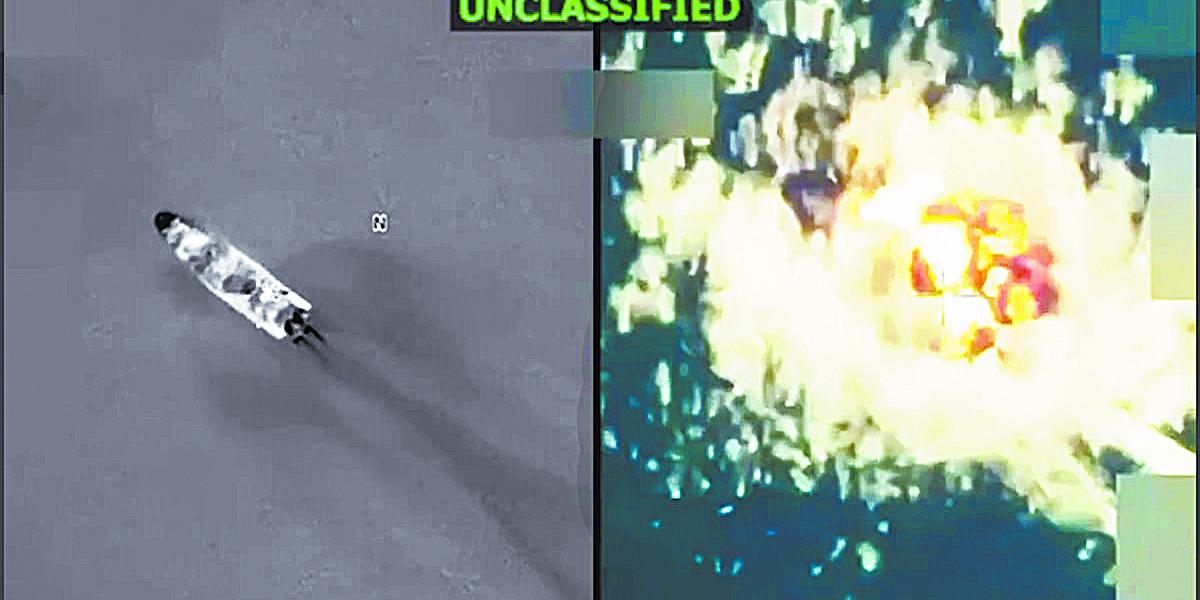
LISBON – US President Donald Trump recently told reporters at the White House: “We are going to kill those who bring drugs into our country.” This is what his government had already begun to do, with air attacks in the Caribbean Sea and the eastern Pacific that destroyed several suspected drug boats and killed their crew members (at least 64 people). Now Trump is threatening to carry out similar operations on land and the contours of a violent new American foreign policy doctrine are beginning to be drawn more clearly.
This new doctrine is reminiscent of that articulated by President James Monroe in 1823, which maintained that the United States would consider any foreign intervention in the Americas (specifically, European colonialism in Latin America) a hostile act. In 1905, President Theodore Roosevelt expanded on this idea with his “corollary to the Monroe Doctrine,” according to which the United States had a “responsibility to preserve order and protect life and property” in the countries of the Western Hemisphere.
In case this sounds innocuous, remember that in 1904 Roosevelt stated that the United States, as a “civilized nation,” could be “forced” to exercise “international police power” in response to unrest or “transgressions” in Latin American countries. In other words, the United States would determine what conduct by sovereign countries within its “sphere of interest” would be acceptable, reserving the full right to punish transgressors.
The similarities with Trump’s position are obvious. In addition to the recent bombings (often occurring near Venezuelan waters), the Trump administration has once again accused the government of Venezuelan President Nicolás Maduro of being a “narcoterrorist cartel.” If we add to this the buildup of US military forces in the Caribbean (including warships, surveillance and combat aircraft, and soldiers), everything would indicate that the United States is not only seeking to cut off drug trafficking, but is contemplating a regime change.
But between the Monroe Doctrine and Trump’s position there are key differences. First, the “moral duty” that the Monroe Doctrine was intended to reflect is now occupied by a more overtly coercive and narcissistic logic. Thus, the Panama Canal is a strategic node that the United States is “recovering.” Mexico does what the US government “tells it to do.” Brazil will be hit with a 50% tariff for prosecuting former President Jair Bolsonaro for his attempt (inspired by Trump) to overturn his 2022 election loss. And Canada (which should become the Union’s 51st state) is similarly punished, with trade talks suspended in response to a TV ad aired in Ontario that used a recording of President Ronald Reagan criticizing the tariffs.
Meanwhile, Trump has authorized a rescue package of up to $40 billion for Argentina to shore up his ideological ally, President Javier Milei (an agreement that US Treasury Secretary Scott Bessent has called central to a new “economic Monroe Doctrine”). Expressions of gratitude and admiration from Milei (who just scored a decisive victory in the midterm elections) feed Trump’s ego and reaffirm American leadership in the region, while highlighting the erosion of the autonomy of Latin American countries.
These actions reflect Trump’s view of inter-American relations as fundamentally hierarchical, where a country’s position in the order of importance depends on the benefits (and obedience) it offers to the dominant United States. Where previous American presidents attempted to reconcile the idealism of Woodrow Wilson with the realism of Roosevelt, Trump fuses both impulses into a unified, volatile creed: exceptionalism without responsibilities or restraints.
Another fundamental difference is that Trump’s actions are influenced by populist domestic politics. Just as he aims to eradicate the “enemy within” (with examples ranging from the deployment of the National Guard in American cities to lawfare wars against alleged enemies such as former FBI director James Comey), he claimed to protect the United States from an “enemy” that is at the gates. By bending the Western Hemisphere to his will, Trump hopes not only to assert his dominance over the outside world, but also to reinforce his internal authority. The Trump administration’s call for the U.S. military to adopt a “warrior ethos” and its decision to rename the Department of Defense the Department of War (the name it had before 1947) serve similar ends.
The implications far transcend Latin America. For Trump, meeting with Chinese President Xi Jinping is not a dialogue between rivals seeking balance, but a transaction between the masters of their two respective domains. This helps explain why he sees provocations in China’s inclusion of Latin America in the Belt and Road Initiative, and its presence in Cuba and Panama.
China has no intention of respecting the limits imposed by Trump on its “sphere of influence,” and continues to expand its international presence, from Pacific sea lanes to African infrastructure. But in many ways, Xi’s “dual circulation” strategy, which seeks to balance self-reliance with selective opening, is a reflection of Trump’s isolationist assertiveness. In fact, on foreign policy, the differences between Trump and Xi are more one of style than substance. Both reject the old multilateral order and prefer power to process. Decades of institutional efforts to subordinate force to rules are crumbling.
This emerging world is not bipolar in the rigid Cold War sense. Rather, it has two gravitational centers, orbited by middle powers (such as Brazil, India, Indonesia and the Gulf States) that do not want to fall into either sphere of influence. The course that the 21st century takes may depend on the ability of these countries to cooperate with each other: degenerate into a kind of feudal system where the law of the strongest prevails or evolve towards a more pluralistic order subject to rules.
This transformation poses a formidable challenge to Europe. Its closest ally now considers that the rule of law is an obstacle that can be trampled, and that security commitments are a lever that can be used to promote its own objectives. But rather than lament this shift, Europe must adapt: investing in defence, deepening partnerships across the Atlantic, and working with “periphery” actors who share its commitment to a rules-based international order.
The author
Ana Palacio was Minister of Foreign Affairs of Spain and Senior Vice President and General Legal Counsel of the World Bank Group; She is currently a visiting professor at Georgetown University.