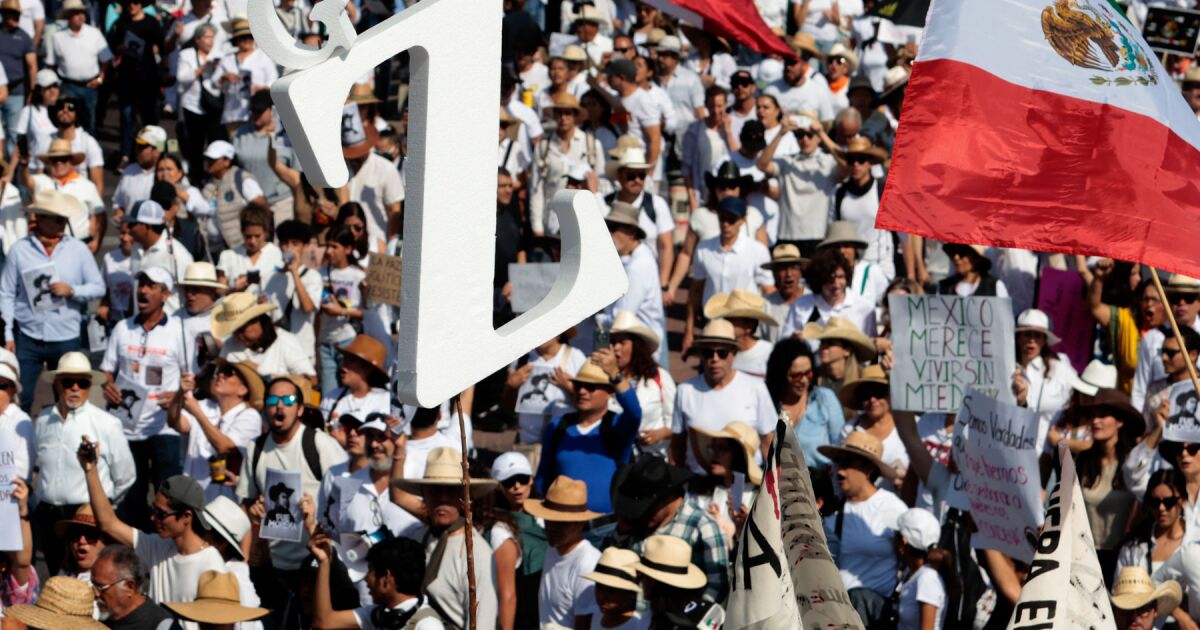
What time will the march be?
The call establishes that the mobilization will take place this Thursday, November 20 at 11:00 a.m. in Mexico City. The invitation is open to anyone who wishes to join, without age restriction.
What is the objective of the protest?
In the “Voz Generación” account of X, the call is organized in order to demand conditions that its promoters consider priority. Among the topics highlighted are:
– Peace and security
– Decent work
– Access to housing
– Improvement in public transportation
– Public policies focused on real needs of the population
The publications associated with the call use the phrase “Mexico does not surrender” as their main message.
What will the route be?
Although the publications do not mention a specific route, it is expected to be similar to the mobilization carried out on November 15, so it would be as follows:
– Angel of Independence
– Paseo de la Reforma Avenue
– Juarez Avenue
– Central Axis
– 5 de Mayo Street
– Capital Zócalo
Those who circulate or work in these areas must plan for partial or total closures, as well as modifications to the public transportation service.
Operational adjustments in public transport
Metro stations closed today
Authorities of the Collective Transportation System reported the temporary closure of the following stations until further notice:
Line 1:
-Isabel the Catholic
-Waterfall
-Balderas
Line 2:
– Revolution
– Gentleman
– Fine Arts
-Allende
– Zócalo/Tecnohtitlan
– Pino Suarez
– Saint Anthony Abbot
Line 3:
– Gentleman
– Balderas
Line 8:
– Saint John Lateran
– Fine Arts
– Garibaldi
Metrobus
On Metrobús Line 4, a temporary suspension of service is reported on the Buenavista – Bellas Artes section. The operation continues from Alameda Oriente and Pantitlán to Teatro Blanquita.
On Line 3, service between Mina and Balderas was suspended. The operation continues on the Tenayuca – Buenavista and Cuauhtémoc – Pueblo Santa Cruz Atoyac sections, without service on the route to Indios Verdes.
Who are Generation Z and why do they use the One Piece flag?
Generation Z is made up of people born between 1997 and 2012, after the Millennials. In 2025, its members are between 13 and 28 years old. According to Pew Research Center, it is characterized by having grown up in a totally connected world, where the Internet, social networks and mobile devices have been part of daily life since childhood.
Unlike Millennials, who experienced events such as the September 11 attacks or the 2008 economic crisis during their youth, members of Generation Z have limited memories of those events and have formed their opinions in a context of high ethnic and technological diversity. This has influenced their habits, forms of communication and expectations about society and politics.
Pew highlights that, although they are still young and their views may evolve, Generation Z already displays characteristics of its own: they value constant connectivity, immediate access to information and digital interaction, and will likely significantly influence politics, culture and the economy in the coming years.
Furthermore, this generation has found a point of identification and community in popular culture. In particular, they have adopted elements from the anime One Piece, about pirates, even going so far as to use its iconic logo as a symbol in some movements and calls, which reflects their taste for content that combines adventure, values and messages of personal improvement.
In short, Generation Z is defined both by its age range and by the way technology, diversity and social changes have shaped its worldview, differentiating it from previous generations.