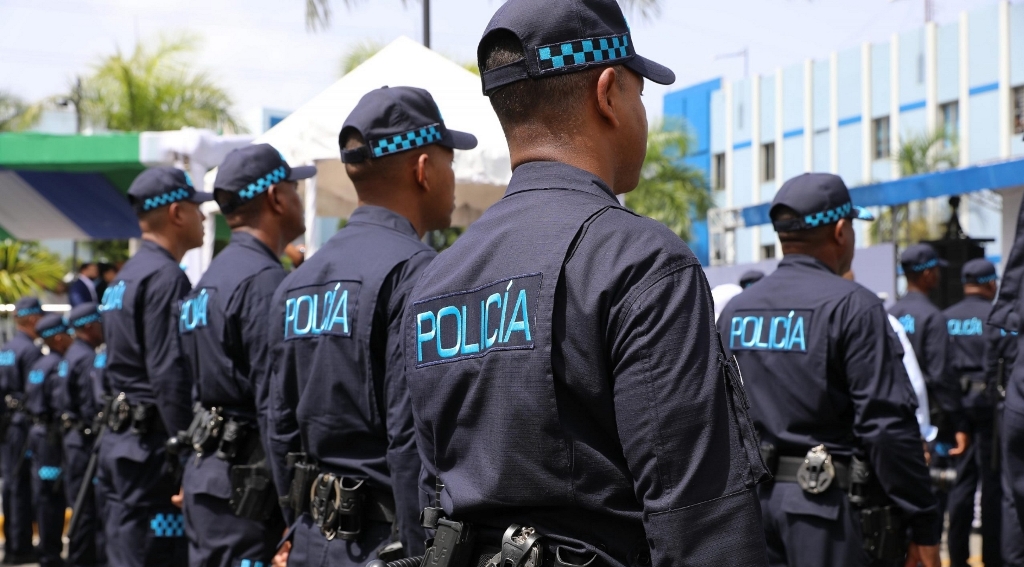
Santo Domingo.-like a bucket of cold water fell between Christian community of the Dominican Republic and other conservative sectors, Sentence 1225/25 of the Constitutional Court, that removes portions of a law that prohibited members of the National Police and the Armed Forces have homosexual relations.
The sentence in question arose as a result of a direct action of unconstitutionality filed by Anderson Javiel Dirocie de León and Patricia M. Santana Ninacontrary to article 210 of Law 285 of 1966.
Said text defined concubinage between people of the same sex as sodomy and sanctioned it, in the case of officers, with sentences of six months to two yearsand in the case of those enlisted, with sentences of two to six months in prison.
As well as 260 of Law 3483, which said something similar and penalized officers with up to one year in prison.
Read also: TC ends punishments to police and soldiers for homosexual relations
The outcome of TC came with a split decision and counted with the dissenting vote of judges Eunicis Vásquez Acosta and Army Ferreira.
In the case of the first, he indicated that, in the event that any part of the challenged articles, Its content had to be interpreted within the constitutional framework that recognizes the existence of a special disciplinary regime for the armed forces and police, in accordance with articles 252 to 257 of the Constitution.
Inadmissibility
He considered that the direct action of unconstitutionality filed should have been declared inadmissible due to lack of purpose, as it concerns regulatory provisions that have been repealed by the legislator through the Law no. 278-04, and, therefore, lack legal operation.
Omission
In the case of Judge Ferreira, she pointed out that the sentence incurred an important omission, since she did not specify how it is proven that the disciplinary powers still exist in the legal system.
“This omission means that the conclusion reached in the ruling regarding the validity of the questioned norms lacks veracity and leaves the decision adopted by the Constitutional Court without content, since it is not sufficient in itself,” Ferreira explained.
However, through a saved vote, judges José Alejandro Ayuso, Sonia Díaz Inoa and Amaury A. Reyes Torres asserted that, although they agreed with the sentence, its reasoning remained incomplete as it was not carried out under the prism of article 39 of the Constitution, which enshrines the right to equality.
The Constitution mandates treatment with equal consideration and respect for all people, so the public powers are obliged to provide this treatment to all Dominican men and women who wish to provide military services to the country that grants them that dignified treatment, which implies that there cannot be second-class or category people simply because they perform intimate acts with other adults in full capacity to consent,” these judges stated.
Codue reaction
In response to the ruling, the Dominican Council of Evangelical Unity (Codue)through its spokesperson and leader, the pastor Feliciano Lacen, expressed strong criticism against the aforementioned sentence and considers that it opens the door to allow homosexual relationships within the police and military forces of the Dominican Republic.
Lacen assured that the judicial decision constitutes “a direct attack against good customs, public morality and the traditional values that have historically guided Dominican society.” He stated that Codue views with great concern what he considers a “dangerous precedent” with the potential to impact discipline and internal order in armed institutions.
Moral authority
The religious leader stated that, with this ruling, the Constitutional Courtl “relegates the principle of moral authority that should prevail in bodies such as the National Police and the Armed Forces”while understanding that the decision could generate internal conflicts and contradictions with current military regulations.
Likewise, he indicated that the ruling represents, in his opinion, “a contrary imposition to the Christian and family values of the country”, calling on the social, religious and community sectors to remain vigilant in the face of what he describes as “a process of cultural erosion.”
Legislators consulted on the issue failed to respond directly, claiming that they needed to know the ruling.
Some of them, like the deputy Tobías Crespo, from the Fuerza del Puebl partyOr, he asserted that the rights of minorities must be respected, but that they, in turn, must respect the majorities.
Debates
— Interpretations
The Constitutional ruling has generated a wide debate since it was announced yesterday, with opinions for and against. Various interpretations have been given to the topic in question.