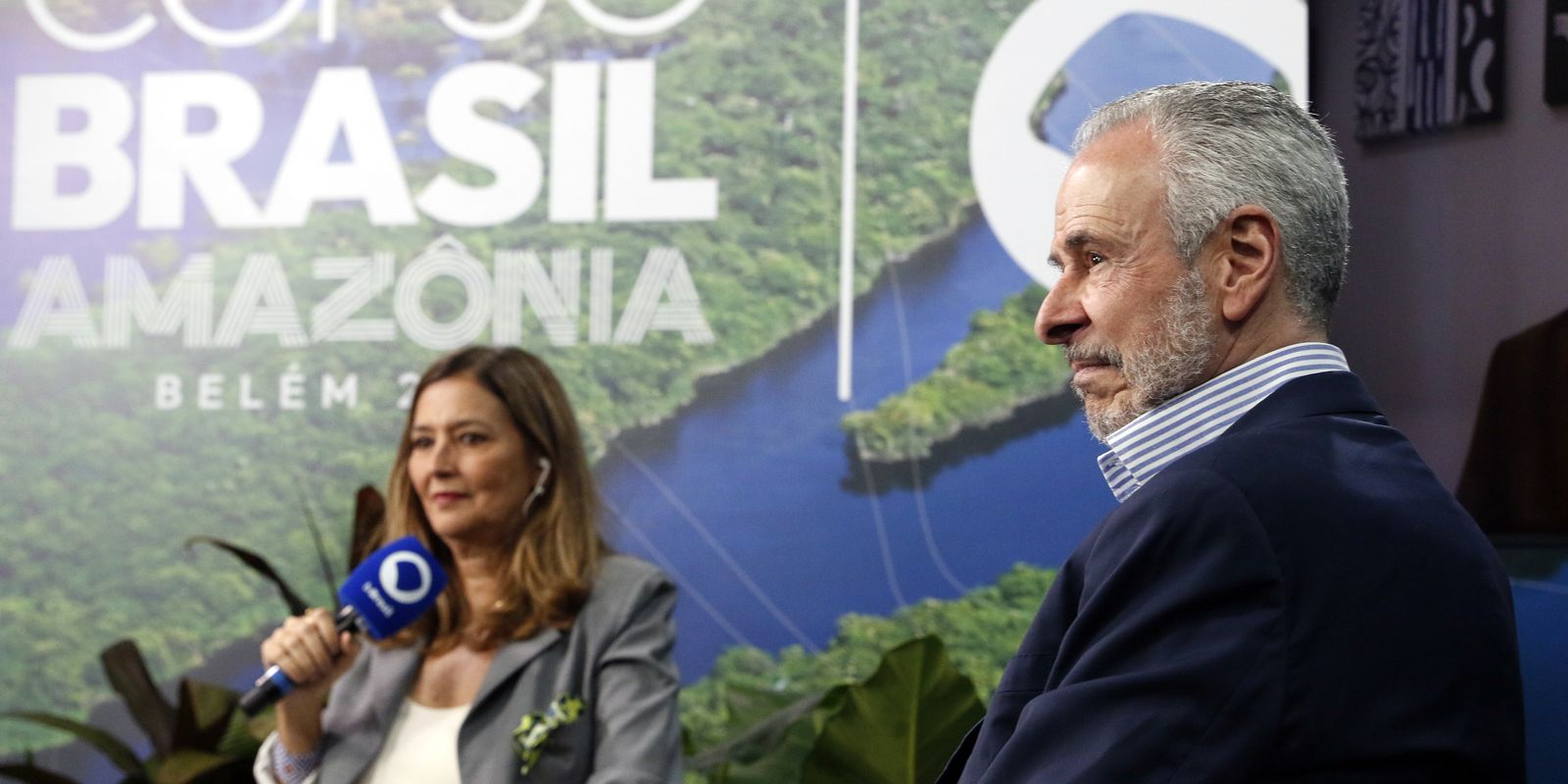
THE Ambassador André Corrêa do Lago sees a geopolitical dispute between the United States and China in the climate debate.
“One thing that is very clear at this COP is the very strong presence of China and this curious situation in which we have China as the great supporter of this new economy and the North American government defending a return to an old economy”, said Corrêa do Lago, in an interview with the program Brazil in the World which aired on TV Brasil this Sunday (16), at 7:30 pm.
“The country that the United States is looking at is China and China is fully supportive of this agenda to combat climate change. So it has almost become a geopolitical clash within this negotiation of which direction the world should take”, says the ambassador, who is the current president of the 30th United Nations Conference on Climate Change (COP30).
He considers that there is concern among certain economic and political sectors in the US that, by abandoning the energy transition, the country will lose technological leadership in this new phase of the global economy.
“This difference in paths is a very interesting thing to observe at this COP”, he states.
Corrêa do Lago He also warned of what he considers a new denialism, “economic denialism”.
“This is very much what the US Secretary of Energy defends [Chris Wright]which does not deny the impact of human activities on climate change. He considers that climate change is a consequence of something that is very positive, which is development, therefore, he believes that the solution is more linked to adaptation than to mitigation”, he states.
Corrêa do Lago highlights what he considers a tendency to impose the agenda also from an economic aspect, since in many sectors of the economy technologies that use fossil fuel substitutes are already cheaper. “It’s very difficult for you to deny this”, he comments.
When speaking about the absence of the United States, Corrêa highlighted the presence of governors, such as Californiawhich together represent 60% of North American GDP.
“The absence of the North American government means that the government does not participate, but the most notable absence of the USA is if it persists in its direction of returning to fossil fuels”, he assesses. “This would have a huge impact due to the weight of the US in the world economy.”
Forests Forever Fund
During the interview with journalists Cristina Serra, Jamil Chade and Yan Boechat, the ambassador also spoke about the new financing instrument launched by Brazil, the Tropical Forests Forever Fund (TFFF).
“The fund presented by Brazil is very innovative, at the same time it deals with the essential issue of forest preservation, and also deals with biodiversity and local populations”, he states.
The ambassador believes that it is a fund that, as it is outside the COP’s official mechanisms, is better able to receive resources from developing countries, such as Brazil and China.
“Because everything within the convention is based on the principle that developed countries must provide resources for developing countries”, he explains. “Therefore, it is innovative in several ways, including opening the door for countries like China to participate.”
Corrêa do Lago states that the TFFF’s focus is sovereign funds – investment funds managed by countries – that seek fixed income and should have new investment announcements after the COP. According to him, the fact that it is an innovative fund means that countries take time to understand the model.
The program Brazil in the World airs on TV Brasil every Sunday at 7:30 pm.