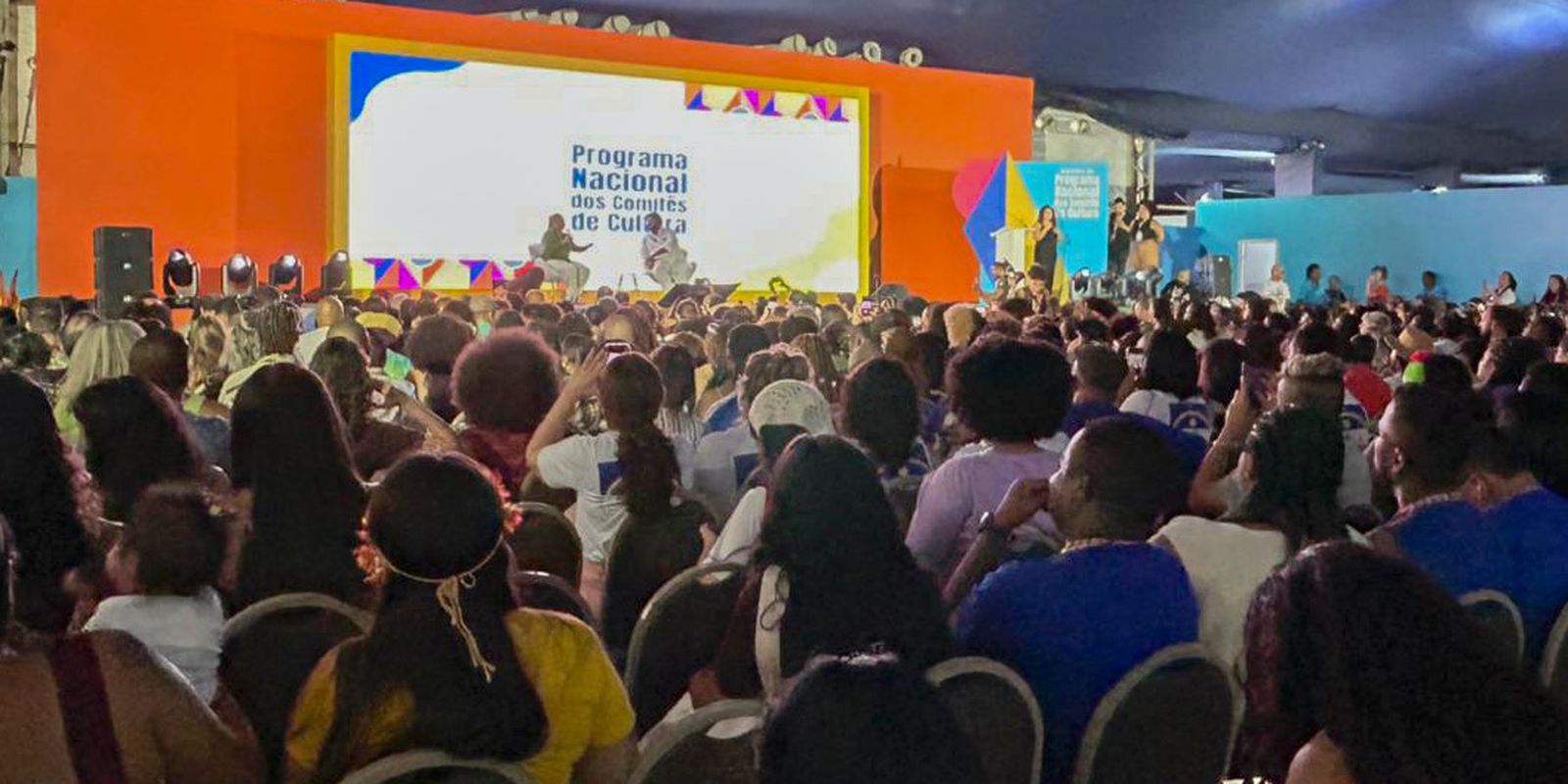
More than 600 territorial cultural agents from all over the country are expected in Brasília, where the Meeting of the National Program of Culture Committees (PNCC) will take place from this Sunday (16th) until next Wednesday (19th). 
In addition to the territorial agents, selected by the Federal Institutes of Education (IFs) from 23 states and the Federal District, the event will bring public managers, representatives of civil society and employees of the Ministry of Culture who work in each of the federative units.
According to the Ministry of Culture (MinC), the objective of the meeting is to enable the exchange of experiences between participants and the evaluation of the national program created to expand the population’s access to public cultural policies and allow the planning of next actions.
“Representatives from all over Brazil come. The people who are there, making it happen, bringing and bringing news about cultural policies; getting it to the ends”, said the Minister of Culture, Margareth Menezes, in a video posted on social media.
LGBTQIA+ representative and member of Distrito Drag, Ruth Venceremos participated in one of the workshops and highlighted the importance of the event showing the country’s cultural diversity. “The difference of the event is that in it we discuss culture in conjunction with other topics that are important and important to society, as is the case with the debate on democracy. There is no way for us to think about a democratic society if we don’t understand that culture is part of this construction”, he stated.
Established in September 2023, through the MinC Ordinance No. 64the PNCC is guided by the appreciation and promotion of cultural, ethnic-racial and regional diversity, among other principles, such as the strengthening of different cultural identities and participation and popular education as a method of implementing socio-cultural policies and the National Culture System.
The PNCC is structured into two strategies: the Culture Committees and the Territorial Culture Agents. Installed in 23 states and the Federal District, the committees seek to strengthen social participation, creating networks of collective agents and institutions dedicated to sociocultural actions.
The agents are individuals with social and cultural representation, spread throughout Brazil and selected through public notices with the task of mapping regional initiatives, mobilizing communities and expanding communication between society and public authorities.
According to Minc, of the 601 cultural agents expected at the meeting in Brasília, 203 come from the Southeast Region; 175, from the Northeast; 103, from the South; 64, from the North and 56 from the Central-West.
Communicators
This Saturday (15), also in Brasília, the Meeting of Popular Communicators was held, in partnership with the Digital Laboratory of the Federal University of Paraná.
The meeting sought to strengthen the so-called National Network of Popular Communicators – an initiative that seeks to expand community communication and give more visibility to cultural actions developed in the territories where communicators work.
In a statement, the executive secretary of MinC, Márcio Tavares, highlighted the network’s difference. “Our challenge is to transform our initiatives into stories that have concrete meaning for people. When we say that we are making the biggest investment in culture in the history of Brazil, what does that concretely mean? It means that, for the first time, we have a cinema in an indigenous village; a small town that had never had access to theater is guaranteeing this for its children, teenagers and parents”, he said.
“Technical knowledge, a lot of people teach it, there are thousands of colleges that teach it. But no one teaches this territorial knowledge, only those who are born into it have it. And we live in a country of continental extension, where each place has its own way of doing things”, stated the head of the MinC’s Special Communication Advisory (Ascom), Gabriella Gualberto.