Quilombola communities from the state of Rio de Janeiro met this Saturday (15), in Rio, in a meeting to debate the Quilombola Voices for Climate Summit. According to the Association of Quilombola Communities of the State of Rio de Janeiro (Acquilerj), of the 54 quilombola communities located in the state of Rio, only three have titles.
The president of Acquilerj, Bia Nunes, denounced the slowness and contradictions in the titling processes for quilombola territories. Of the 54 recognized communities in the state of Rio de Janeiro, only three have title deeds: Marambaia (Mangaratiba), Preto Forro (Cabo Frio) and Campinho (Paraty), two of which have legal errors that need to be reviewed.
“There is emotional and psychological blackmail when we are asked to give up large areas so that the title can advance. It is an unfair and inhumane situation”, highlighted Bia.
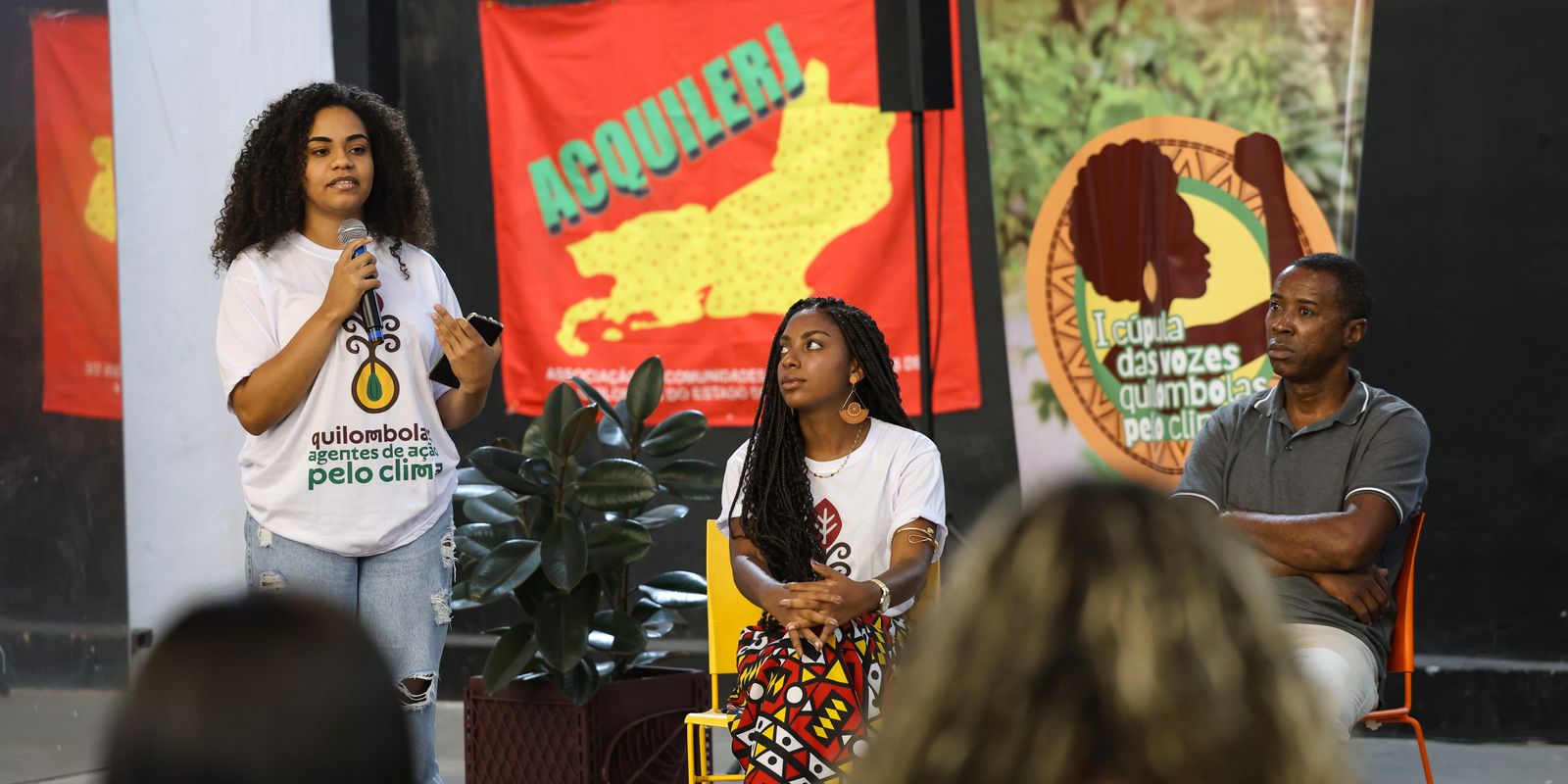
The first panel, entitled “Quilombola Voices”, brought together representatives from 16 territories to present their agendas, demands and resistance strategies. The proposal, according to Bia Nunes, was to create a space for speech where communities were not just a topic, but a subject of discussions.
“The Rio Summit has this difference: it is us discussing and talking about ourselves. Our voices, our pains, our solutions. This is the strength of our existence”, he stated.

Quilombola leaders speak during the Quilombola Voices for Climate Summit, at Fundição Progresso, in the center of Rio de Janeiro. Photo: Tomaz Silva/Agência Brasil – Tomaz Silva/Agência Brasil
Difficulties
Alessandra Rangel Oliveira, linked to environmental and climate issues at Acquilerj, and member of the Maria Joaquina quilombo, in Cabo Frio, in the Lagos Region, said that the municipality has seven quilombola communities and only one of them has land titles, “Preto Fogo”. The others are certified by the Palmares Foundation, but this does not guarantee land, it only recognizes them as remnants of quilombola communities.
Alessandra explained that Cabo Frio is a region that has beautiful tourist potential, where everyone wants to live and everyone wants to visit.
“The problem is the issue of very large real estate speculation. So we have territorial conflicts with land grabbers, farmers, with subdivisions and the land owners have to be compensated by the State.”
She further explained that when quilombo lands are overlapped with those of farmers “we begin to receive death threats, persecution and some quilombola leaders suffer threats when they report any type of environmental impact in the region”.
Alessandra also said that the State always says that there are no resources to finance the reimbursement of these families for these territories, which are large farms in the region. Recently, when the Institute for Colonization and Agrarian Reform (Incra) was in the region in three communities to negotiate the first phase of land titling, “there was resistance from community leaders due to fear of land grabbers’ monopolies, farmers and community leaders came to the conclusion that if they mess with this, they end up putting their lives at risk”, added Alessandra.
The community leader said that COP 30, which takes place in Belém, does not have much effect on quilombola communities.
“We were there with the National Coordination of Black Rural Quilombola Communities (Conac) together with the International Coalition of Afro-Descent Peoples for Climate Action (Citafro), but our participation was limited because the government only provided us with four credentials and we felt excluded, because we had no space in decision-making”, he explained.
The representative of the Chico Mendes Institute for Biodiversity Conservation (ICMBio) and manager of the Tijuca National Park, Viviane Lasmar Pacheco, said at the meeting that the Pedra Bonita quilombola community, which operates within the park, was certified three years ago and this changed the view “in the sense of recognizing that this community has the right to the territory, rights to their ways of life and we are establishing a term of commitment, up to land titling, with rights and duties between the parties”. Viviane said that registration is being completed, “but the community is small with 20 to 25 families”.