The arrival of the USS Gerald R Ford in waters near Latin America marks a milestone in growing tensions between the United States and Venezuela.
It represents the largest US military presence in Latin America since the invasion of Panama in 1989 and like Manuel Antonio Noriega more than 30 years ago, Nicolás Maduro has been accused of drug trafficking and rejects such accusations.
The US maintains ambiguity about its intentions by deploying the most modern and largest aircraft carrier in the world near the Venezuelan coast.
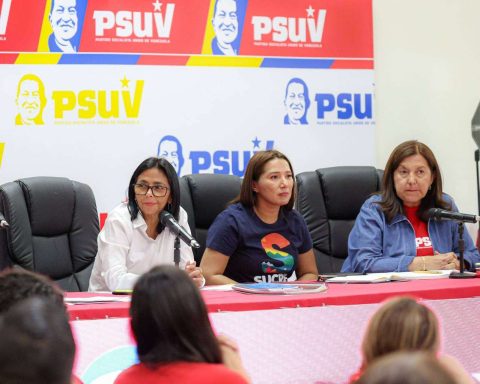
But Caracas already appears to be preparing for an attack.
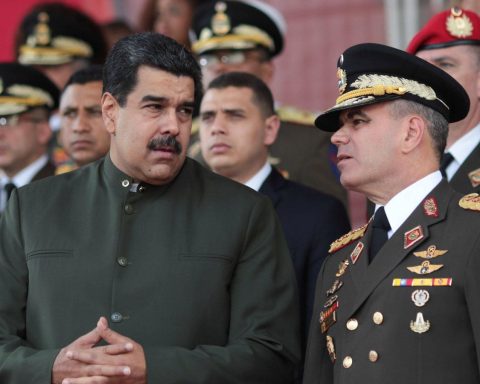
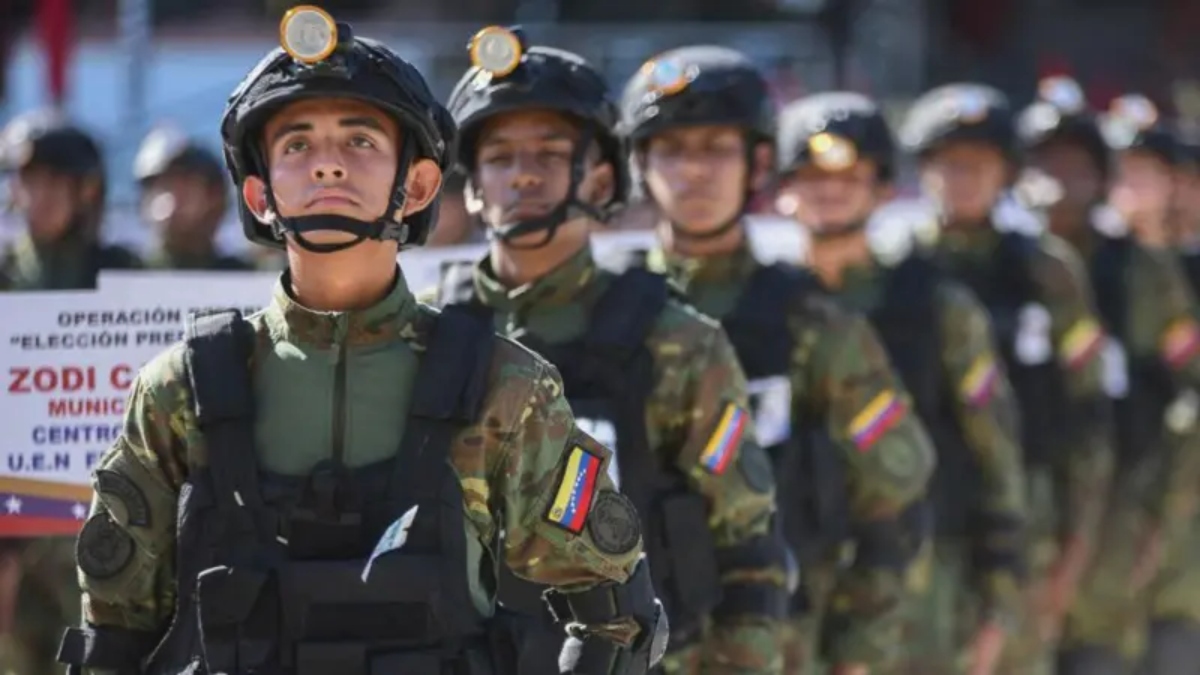
The Minister of Defense of Venezuela, Vladimir Padrino López, announced this Tuesday a “massive deployment” of land, maritime, air, river and missile forces, as well as civil militias throughout the country, to counter what he considers a threat to the government of Nicolás Maduro.
Padrino López added in a television message that Maduro ordered a deployment of “almost 200,000” soldiers as part of the operation.
The arrival of the American “super aircraft carrier” is perceived as an escalation of the military campaign promoted by President Donald Trump against alleged drug cartels operating in Venezuela and which has already claimed the lives of more than 75 people aboard boats and semi-submersible vessels.
However, some analysts say it could also be part of a broader strategy aimed at weakening or even overthrowing Nicolás Maduro, whose government is considered illegitimate by Washington, after last year’s presidential elections were described as fraudulent by the opposition and international organizations.
Could the Venezuelan army commanded by Nicolás Maduro resist an attack from the greatest military power in the world?
“The army is a shadow of what it once was”
Maduro assured in September that more than eight million people have enlisted to defend Venezuela and has suggested that he could build a militia of that size.
That number is widely questioned by experts.
“It is not true. The real figure is much lower. Maduro did not even collect four million votes last year,” James Story, former ambassador of the Venezuelan Affairs Unit, attached to the United States Embassy in Bogotá from 2020 to 2023, tells BBC Mundo. “And it is an army with a high desertion rate.”
A report from the International Institute for Strategic Studies (IISS) states that Venezuela has 123,000 active troops, plus 220,000 militiamen and 8,000 reservists.
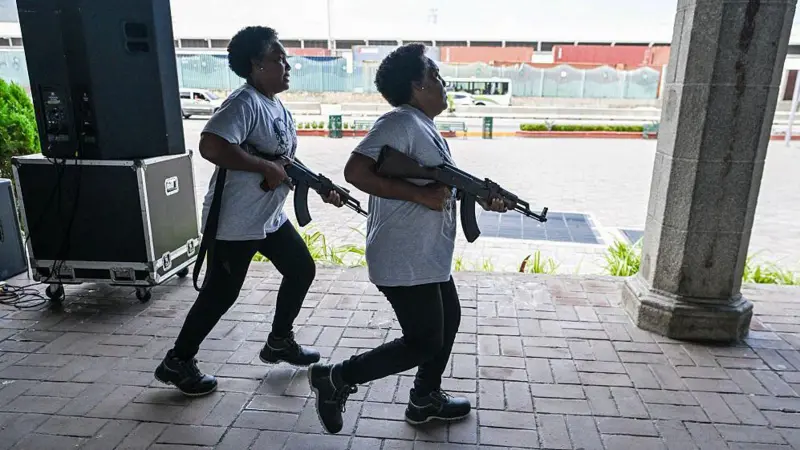
Story assures that the Venezuelan military does not usually train or perform maintenance and many members of the Chavista militia are not even armed: “There may be some units in the army capable (of combat), but as a combat force, they are not particularly competent.”
He adds that the Venezuelan army “is a shadow of what it once was,” but admits that it has “some unique resources in the region.”
Although the US army far surpasses the Venezuelan one, Caracas theoretically has advanced military equipment.
In addition to nearly 20 Sukhoi aircraft that former President Hugo Chávez bought from Russia in 2006, Venezuela acquired more than a dozen American F-16s in the 1980s, when Caracas was a major regional ally of Washington.
“The Sukhoi attack aircraft are superior to any other in the region and some are still operational. Of the F-16s, I believe one or two are still operational,” Story notes.
Anti-aircraft missiles and drones
Amid tensions with the United States, Maduro assured at the end of October that Venezuela had placed 5,000 Russian-made Igla-S anti-aircraft missiles in “key air defense positions.”
“Any military force in the world knows the power of the Igla-S,” Maduro added during a military event broadcast on television.
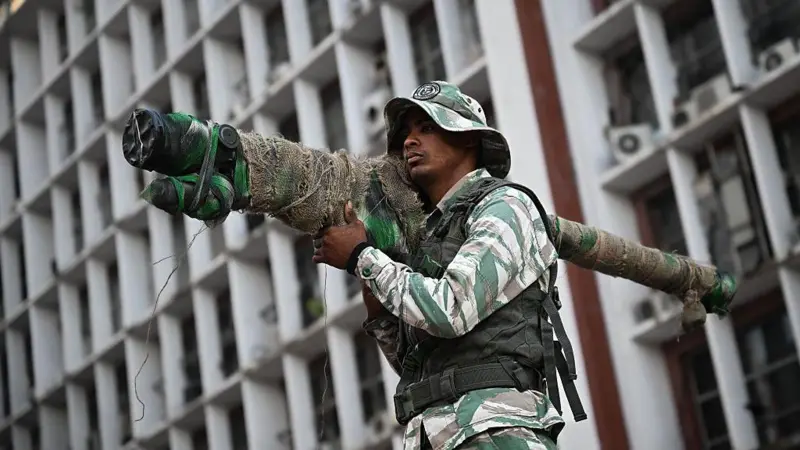
The Igla-S are short-range, low-altitude man-portable air defense systems with the ability to shoot down cruise missiles, drones, helicopters and low-flying aircraft.
Venezuela also has Chinese VN-4 armored vehicles and in recent years became the only South American country with armed drones with attack capabilities, which Nicolás Maduro displayed at a military parade in 2022.
The Antonio José de Sucre 100 and 200 (ANSU-100 and 200) are Venezuelan-made drones, which are derived from modernized versions of Iranian drones.
Venezuela has also received Peykaap-III fast attack boats equipped with anti-ship missile launchers from Iran.
Added to all this are Pantsir-S1 and Buk-M2E surface-to-air missile systems that, according to Russian deputy Alexei Zhuravlev, first deputy chairman of the State Duma Defense Committee, were recently transported to Caracas on Il-76 transport planes.
But much of this material only exists in theory, according to Andrei Serbin Pont, an international analyst specialized in foreign policy and defense and president of the Regional Coordinator of Economic and Social Research (CRIES).
“There is a great discrepancy between what Venezuela has in theory and the material that is actually operational,” he says in an interview with BBC Mundo.
A network that can be neutralized “easily”
Amid reports that have suggested that further escalation would include direct attacks inside Venezuela, the air defense systems operated by the South American country have gained greater interest.
Andrei Serbin Pont states, however, that much of the network is out of service or can be “easily neutralized” with American technology, as is the case with the Russian-made Pechora surface-to-air missile systems, whose technology dates back to the 1960s.
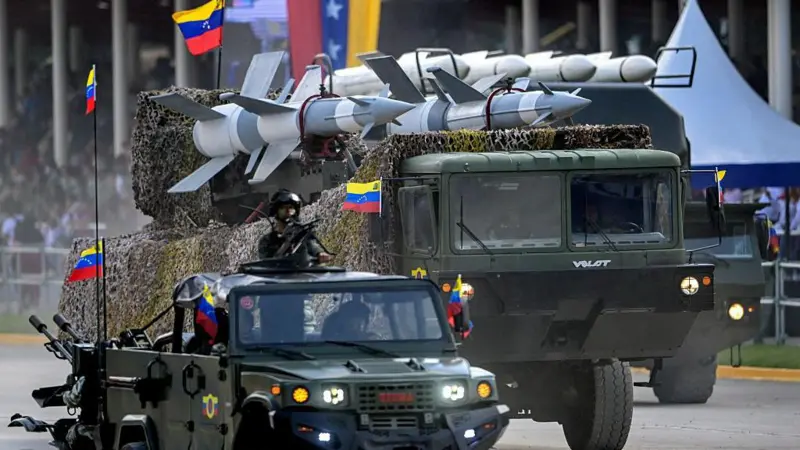
Venezuela also has Buk missile systems, which are deployed around Caracas and are more effective, but it would not be particularly difficult for the US to neutralize them, estimates Serbin Pont.
“In addition, its availability is very low due to the lack of spare parts,” he says.
As for the 5,000 Igla-S missiles that Maduro boasted about in late October, Serbin Pont says the figure is correct.
“But it only has about 700 Igla-S launchers, which is still a large number and something that should be worrying, because in the hands of state armed groups they could be very dangerous. Not necessarily for US operations, but for civil operations or any type of helicopter or aircraft that flies at low altitude.”
“prolonged war”
According to him, the current strategy of the Maduro government is to suggest that, after a possible US attack, all these army weapons could end up dispersed among the Venezuelan population.
Some are particularly concerned that they will end up in the hands of armed groups such as the National Liberation Army (ELN) or FARC dissidents.
The objective of such a strategy would be to threaten to create chaos or instability in Venezuela for any future transitional government.
Many analysts estimate that Maduro and his circle are preparing to fight a guerrilla war.
Venezuela’s Interior Minister Diosdado Cabello threatened in September that his country is prepared for a “prolonged war.”
Shortly after, the Maduro government ordered soldiers from the Bolivarian National Armed Forces (FANB) to teach the population of poor communities how to use weapons.
Former ambassador James Story rules out the possibility of people in Venezuela joining Maduro in such a campaign: “Maduro is not a very beloved figure either among the military or among the Venezuelan population, and that is why I do not think that people will follow him or support him in a guerrilla war.”
“He didn’t even get 4 million votes in the last elections!” he repeats.
According to the National Electoral Council, controlled by the Venezuelan government, Nicolas Maduro He received approximately 6.4 million votes, a figure that is questioned by the Venezuelan opposition and numerous international organizations.
How prepared is Venezuela for a conflict?
Although the Venezuelan government increasingly increases the tone of its warlike and anti-American discourse, analyst Andrei Serbin Pont affirms that its army is not prepared for a conflict.
He explains that the Bolivarian National Armed Forces (FANB) has operated in the last 25 years under the military concept of “periodization of war”, which assumes that a conflict would progressively evolve in manageable blocks or phases.
First would come a stage of internal instability, fostered by interference from a foreign country, then a second phase involving a neighboring country, creating a “peer conflict,” which could then result in US intervention.
“This would lead to a quarter of prolonged popular resistance, in which demobilized armed forces and other social movements are expected to keep their weapons and disperse among the population to fight a guerrilla war against the US occupation,” notes Serbin Pont.
“In a conflict with a neighboring country, Colombia or Brazil, the conventional weapons systems that Venezuela has would be very useful,” he continues.
But he insists that they do not represent a real threat to the United States.