Santo Domingo.-Dominican Republic and the United States Drug Enforcement Administration (DEA) announced new bilateral cooperation agreements aimed at strengthening intelligence, interdiction, combined operations and combating transnational organized crime capabilities in the Caribbean region.
The announcement came after a meeting at the National Palace between a high-level DEA mission and President Luis Abinader, a meeting in which US officials congratulated the president for Dominican leadership in regional security and for sustained support for US efforts to combat international drug trafficking.
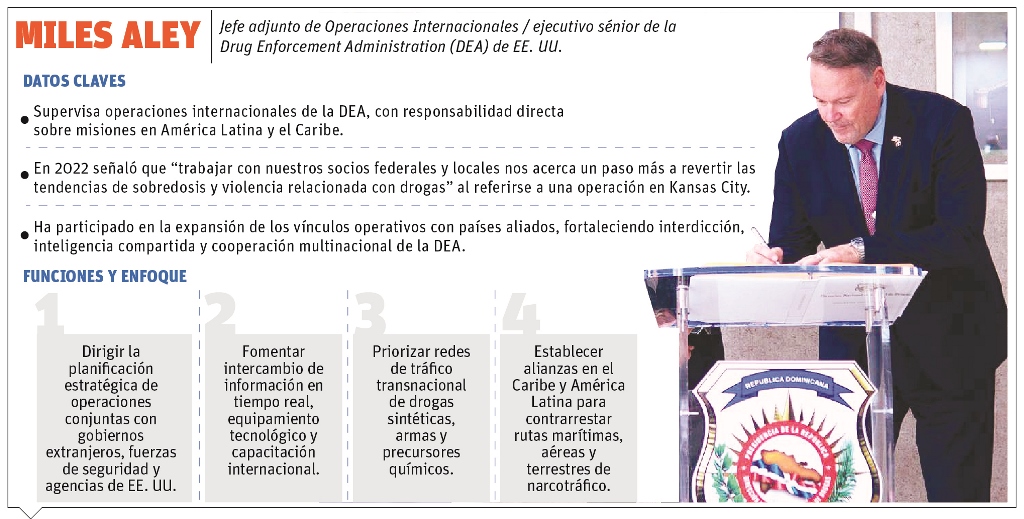
The mission was led by Daniel Salter, principal deputy administrator of the DEA, and Miles Aley, deputy chief of International Operations, who highlighted that the Dominican Republic has become the most reliable and strategic ally of the United States in the Caribbean.
This assessment occurs in the midst of a period in which President Donald Trump’s administration has intensified its interdiction strategy in the region due to the increase in cocaine shipments from South America and the expansion of the synthetic drug market, especially fentanyl.
Cooperation
In this context, Santo Domingo’s cooperation is considered key due to its geographical position, political stability and operational capacity in ports, airports and territorial sea.
President Abinader welcomed the congratulations with a message of reaffirmation of the bilateral alliance, ensuring that the Dominican Republic will continue to be a “firm partner in the fight against drug trafficking, narco-terrorism and other transnational threats.”
The meeting
The meeting included the participation of Michael A. Miranda, special agent of the Caribbean Division, Kaleb Sanderson, DEA attaché for the Dominican Republic and Haiti, and Vice Admiral José M. Cabrera Ulloa, president of the National Drug Control Directorate (DNCD), who has been a key player in the process of modernization and strengthening of interagency cooperation.
Visit to the DNCD headquarters
After the meeting at the National Palace, the US delegation moved to the DNCD headquarters, where the operational details of the new agreement were discussed, which includes exchange of information in real time to identify high-risk maritime and air routes; increase in technical equipment, especially in maritime surveillance, analysis of chemical precursors and traceability systems; and the execution of joint operations against cartels that operate in Venezuela, Colombia and Mexico, with emphasis on structures linked to the so-called Cartel of the Suns.
According to Salter, this expansion of cooperation responds to the “high level of commitment and effectiveness” shown by the Dominican authorities in the fight against organized crime.
The timing of this agreement is especially significant.
In recent months, the United States has reinforced its air and naval presence in the Caribbean, and has increased pressure on transit routes to Puerto Rico and Florida.
In this scenario, the Dominican Republic has emerged as the most stable and effective actor to contain the advance of criminal organizations.
France also selected the country to set up a regional academy against organized crime, while the United States backed it to present a candidate to the United Nations Office on Drugs and Crime (UNODC).
Additionally, the State Department chose the Dominican Republic to lead the Regional Coordination Center against Synthetic Drugs, a pilot project that seeks to confront the growing threat of fentanyl and other synthetic opioids.
The selection of the Dominican Republic to occupy these roles responds to factors such as a notable growth in seizures, a direct cooperation scheme with international agencies, a professionalized and equipped DNCD, and a state capacity to sustain operations without political interference.
Importance of DR
– Cooperation
United States authorities recognize that, without a cooperation network that includes the Dominican Republic, the Caribbean could become a critical storage and transit point for chemical precursors.
Cabrera Ulloa highlights confidence
Work. During the meeting at the DNCD, Cabrera Ulloa expressed that the international trust placed in the Dominican Republic “is not a product of chance, but of the sustained work of coordination, technological modernization and institutional consolidation.”
He noted that the country has managed to significantly reduce the transit of illicit shipments and has forced cartels to modify routes, increase costs and expose themselves to greater risks. For the DEA, this point is crucial: each deviation in traditional routes reduces the financial and logistical capacity of criminal groups that supply the US market.