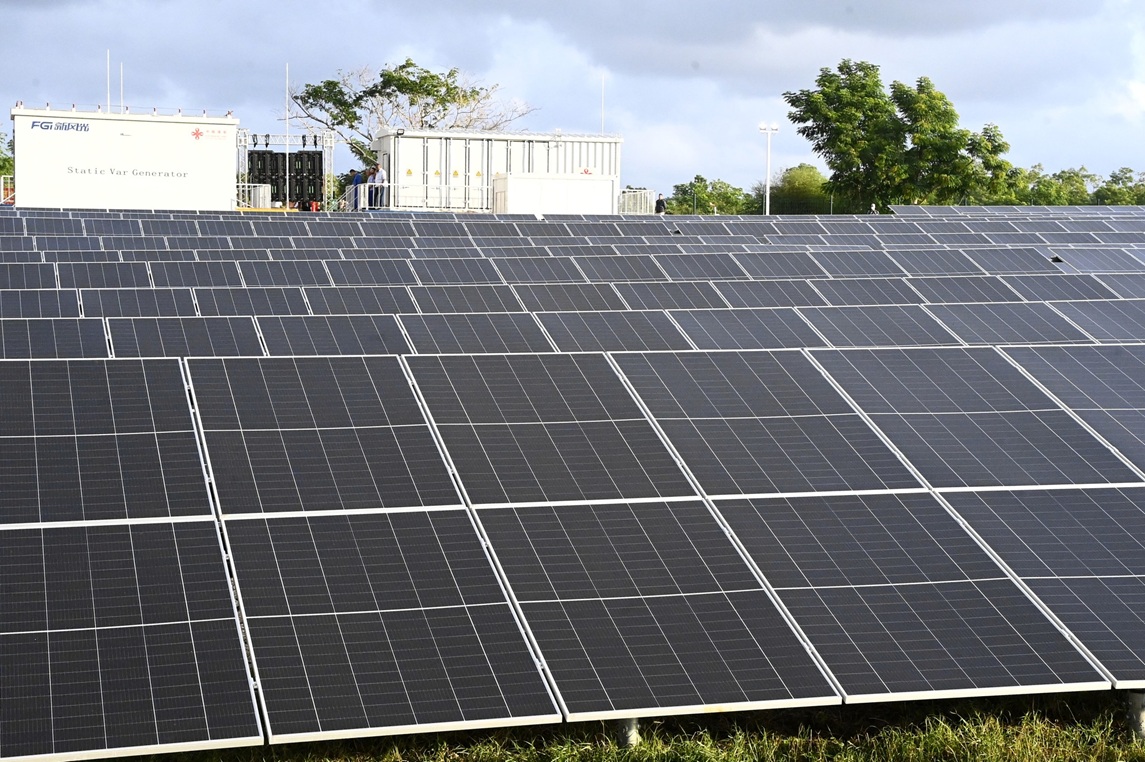
The Mártires de Barbados II solar park, with a capacity of 5 MW, was connected to the National Electric System, which closes the first phase of seven similar facilities donated by China that total 35 MW.
During the inauguration of the park in Artemisa, the Chinese ambassador in Havana, Hua Xin, celebrated the speed with which this process has been carried out. “From the arrival of the first batch of equipment to full connection to the grid, the efficient collaboration between Chinese and Cuban companies has achieved impressive speed, which marks a new stage in the collaboration between both countries in the field of clean energy.”
The seven photovoltaic parks of the Chinese Assistance “35MW Solar Park Installation” Project were fully connected to the grid, which will save 18,000 tons of fuel annually. Thanks to @DiazCanelB for your attendance at the event! pic.twitter.com/wsmLNVIGB0
— Hua Xin 华昕 (@EmbHuaXin) November 12, 2025
Each of these parks produces around 8 thousand MWh per year, bringing the total to 56 thousand MWh. This would save 18 thousand tons of imported fuel annually, according to a newspaper report Granma.
The second stage is already advancing with 13 parks of 5 MW and two of 10 MW, with the incorporation of batteries to store 20% of the production. The first components arrived, he points out Granmaand the rest will be received before the end of the year, with assembly scheduled for the first quarter of 2026.
China maintains continuous support in spare parts for distributed generation, 5 thousand panels for isolated homes and a future project of 200 additional MW along with another 5 thousand residential systems.
Cuba has 32 photovoltaic solar parks of 21.8 MW installed and operational since this year, and they are concentrated mainly in the eastern provinces, a region that has close to twenty in operation (18), which would be in the collision path of the eventual hurricane.
Experts estimate that, by the end of 2025, solar generation will represent about 10% of the national matrix. Currently, this source provides between 500 and 600 MW during the day, being key to mitigating daytime blackouts, according to sector authorities.
La Guiteras enters, but the deficit remains
With several days out, the Antonio Guiteras thermoelectric plant, from Matanzas, will have to come in this afternoon, after heating began in the boiler in the early morning.
It was due to start on Wednesday, but “some problems that arose during yesterday’s start-up in a valve and a situation in the generator prevented the start-up process from continuing as planned,” the Electrical Union explained in Facebook.
However, the Electrical Union calculates for the moment of maximum demand this Thursday a generation capacity of 1,750 MW compared to a peak demand of 2,850 MW. The above represents a deficit of 1100 MW and an estimated impact of 1170 MW.
Currently, six of the sixteen available thermoelectric production units are out of service due to breakdowns or maintenance. These plants are responsible for around 40% of the energy mix.
742 MW unavailable due to fuel and breakdowns
The Electrical Union reports 742 MW out of service due to lack of fuel, added to 388 MW in thermal limitations and multiple units in breakdown or maintenance, which aggravates the national energy deficit.
In its daily report, the entity detailed breakdowns in units 5 and 6 of CTE Antonio Maceo, as well as in unit 2 of CTE Felton. In addition, unit 2 of CTE Santa Cruz and unit 4 of CTE Carlos Manuel de Céspedes receive maintenance.
Added to this are the 82 distributed plants (647 MW) and 95 MW remain inoperative due to lack of lubricant.