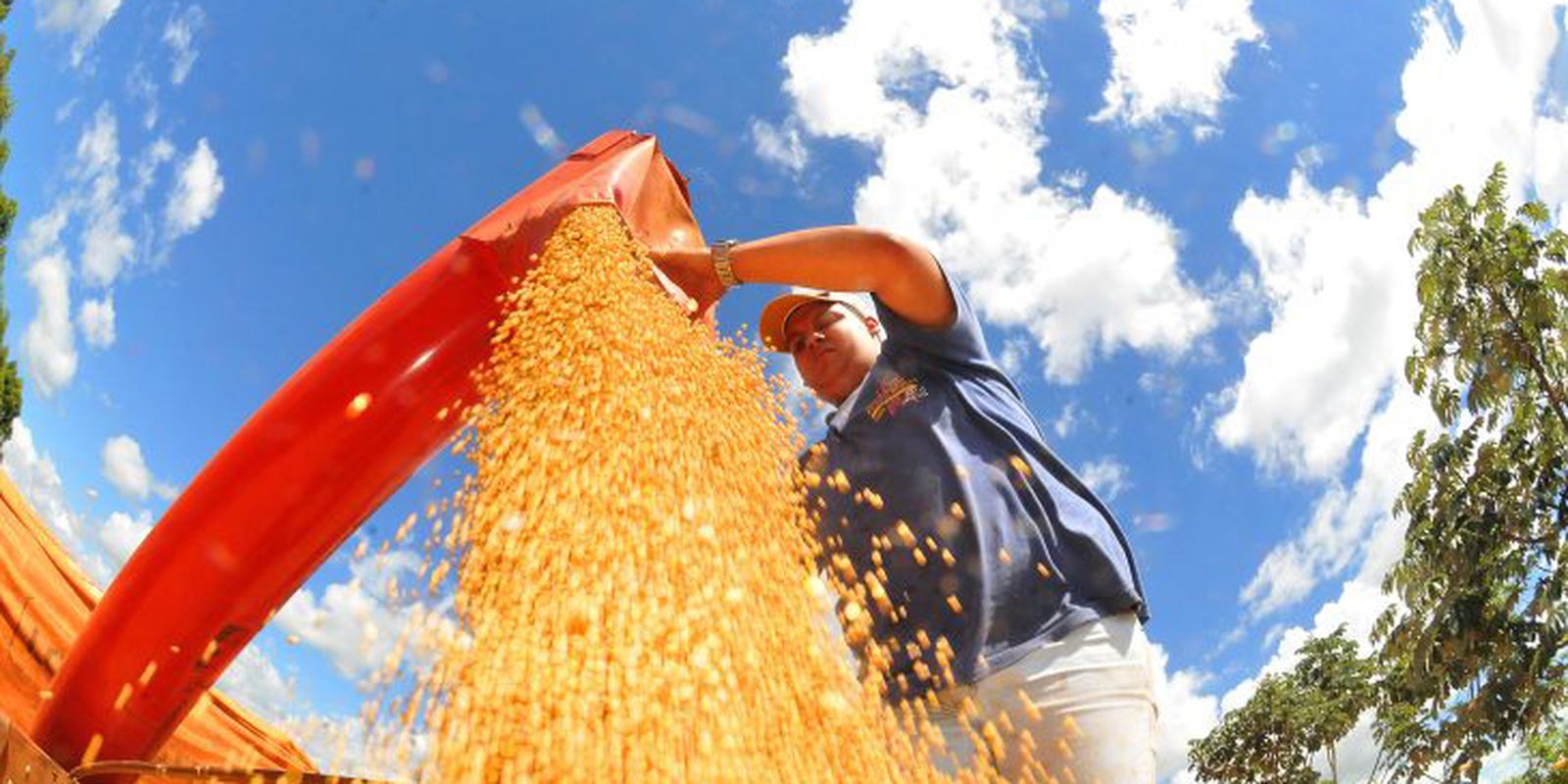
The Brazilian harvest of grains, cereals and legumes is expected to total 332.7 million tons in 2026. This result represents a decline of 3.7% compared to this year, which marks a record. 
The estimates were released this Thursday (13) by the Brazilian Institute of Geography and Statistics (IBGE), which, every month, presents the Systematic Survey of Agricultural Production. This is the first edition to bring data for 2026.
For this year, the IBGE estimate is for a harvest of 345.6 million tons, the largest ever observed in the country, being 18.1% larger than that of 2024.
When commenting on the passage from a year with a record harvest to another with a decline in the harvest, IBGE’s Agriculture manager, Carlos Alfredo Guedes, points out the influence of climatic factors.
“In 2025, we had a climate that greatly favored the development of crops, we have record production for several crops, such as soybeans, corn, sorghum [cereal]cotton,” he said.
“For 2026, we are still at the beginning of the harvest, so we often work with average yields from previous years, which is why there is also a slight drop in production and, probably, the climate will not be so favorable”, he adds.
Follow EBC’s complete coverage at COP30
Guedes describes that 2026 will be the year under the influence of the La Niña phenomenon, with abnormal cooling of the surface waters of the equatorial Pacific Ocean, which brings more intense rains to the Central-West Region and little rain to the South, which could affect crops.
Despite the lower production volume, IBGE points out that the area to be harvested should be larger in 2026. It is estimated at 81.5 million hectares, almost the size of Mato Grosso, an expansion of 1.1% compared to 2025.
Agricultural crops
The IBGE survey investigates 16 products: cotton (cotton seed), peanuts, rice, oats, rye, barley, beans, sunflower, castor beans, corn, soybeans, sorghum, wheat, triticale (originating from the cross between wheat and rye), canola and sesame. The last two appear for the first time in the search.
When comparing the forecasts for 2025 and 2026, Brazilian agriculture should see a reduction mainly in the following crops:
- corn (-9.3% or -13.2 million tons)
- sorghum (-11.6% or -604.4 thousand tons)
- rice (-6.5% or -815.0 thousand tons)
- cotton (-4.8% or -466.9 thousand tons)
- wheat (-3.7% or -294.8 thousand tons),
- beans (-1.3% or -38.6 thousand tons)
- peanuts in shell (-2.1% or -25.5 thousand tons)
When commenting on the drop in corn production, the IBGE researcher assesses that the climate is not expected to behave so favorably in 2026.
“Furthermore, there are still many doubts regarding the cereal planting window, since the summer harvest crops are still being developed in the field”, explains Guedes.
Price influence
According to the analyst, lower prices for cotton, rice and beans lead producers to reduce planted areas.
In the case of cotton, he explains that 3 years of growing harvests brought down the value of the harvest.
“It kept supply high and reduced prices, so margins are tight for producers and the trend is towards a reduction in planting area,” he said.
In agriculture, producers can choose which product to plant, based on profitability information.
Beans should see the harvest (3 million tons) reduce by 1.3%. “But still meeting Brazilian consumption”, highlights the IBGE.
Soy
In the opposite direction, IBGE estimates growth in the soybean harvest, which should expand 1.1% and reach 167.7 million tons. The country is the largest producer and largest global exporter of the oilseed.
“The planted area is expected to grow by 0.3% and productivity by 0.8%, largely due to the possible recovery of the Rio Grande do Sul harvest, which was severely damaged in 2025. Scarce and irregular rains have caused concern to producers in the Center-West,” explains IBGE.
IBGE also announced that agricultural storage capacity in the country grew 1.8% in the first half of this year compared to the second half of 2024, reaching 231.1 million tons.
Capacity of storage methods:
- silos: 123.2 million tons (53.3% of the country’s total useful capacity);
- bulk and bulk warehouses: 84.2 million tons (36.4%);
- conventional, structural and inflatable warehouses: 23.8 million tons (10.3%).
On June 30 of this year, Brazil had a total stock of 79.4 million tons. More than half was soybeans (48.8 million tons), followed by corn (18.1 million), rice (6.1 million), wheat (2.4 million) and coffee (600 thousand).
Storage capacity and inventory management are used in agriculture to seek greater profitability for the farmer, allowing the choice of the best time to sell production on the market.
Conab
Also this Thursday, the National Supply Company (Conab), a public company linked to the Ministry of Agrarian Development and Family Agriculture, announced that the 2025/2026 harvest should be 354.8 million tons of grains.