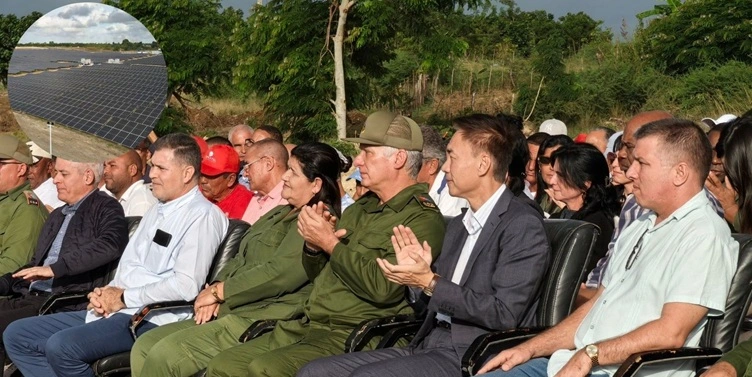
The first phase of the Chinese “donation” contributes 35 MW to the Cuban electrical system, in a project that plans to reach 120 MW once its second stage is completed.
MADRID, Spain.- The first phase of the photovoltaic project “donated” by China was formally concluded this Wednesday with the inauguration of the “Mártires de Barbados II” solar park, in Guanajay, Artemisa, an event attended by Miguel Díaz-Canel. The Presidency of Cuba He specified that this initial stage includes seven parks of 5 MW each – 35 MW in total – connected to the national electrical grid.
According to the Cuban dictator Miguel Díaz-Canel, present at the event, it is the closing of the first part of a Chinese donation that, added to its second phase, will reach 120 MW installed. The Presidency reported in X that the project is being carried out in two stages and is part of energy cooperation with Beijing.
For his part, the Chinese ambassador in Havana, Hua Xin, confirmed on the same social network that the seven photovoltaic parks of the “35 MW Solar Park Installation” project were “completely connected” to the grid. The diplomat assured that this infrastructure will save about 18,000 tons of fuel per year.
The Cuban official press He added that the second phase of the donation – currently under development – will add another 85 MW through the construction of thirteen 5 MW and two 10 MW parks, as well as storage systems. If completed, the program would provide the 120 MW announced by the authorities.
A Beijing-Havana strategic alliance that does not resolve the Cuban energy crisis
In September 2023, The Cuban regime announced the location in the province of Holguín of a photovoltaic park donated by the Government of China with a generating capacity of five megawatts (MW). On that occasion, the Cuban News Agency (ACN) indicated that the construction of the park, with a value of more than 114 million dollars, was part of the change in the energy matrix in Cuba, which depends 95% on fossil fuels.
Likewise, it was highlighted that the donation from China would benefit ten Cuban provinces with similar systems.
In April 2024, the governments of China and Cuba signed several cooperation agreements that would supposedly oxygenate the Island from food shortages and the energy crisis, two fronts affected by decades of failed economic policies and the incompetence of the Cuban regime.
In December of that year, the Chinese Government sent the first shipment of donations to the Island with parts and accessories for the generating sets of the deteriorated Cuban electrical system. The official press of the regime highlighted the project as part of the consensus reached between Díaz-Canel and Xi Jinping, which includes multi-sector cooperation.
However, no improvement is seen despite all these agreements. Both these commitments and the recent inauguration occur in the middle of one of the most critical periods of the electrical system in recent years. Deficits of more than 1,400 MW are reported daily, well above the capacity provided by the new infrastructure. On the day of the inauguration, the national demand for peak hours exceeded 2,800 MW.
Although the Government insists on presenting this project as a step towards “energy sovereignty”, the prolonged outages continue to affect the population. Both urban residents and rural communities report blackouts of more than 15 hours a day, a situation aggravated after the passage of Hurricane Melissa, and with no signs of immediate improvement. Currently, much of the eastern region remains blacked out.
The promotion of solar energy is framed in a context of prolonged crisis in which the lack of fuel, the obsolescence of thermoelectric plants and the dependence on political allies condition the stability of the Cuban electrical system. The contribution of the newly connected 35 MW is insufficient in the face of the structural collapse facing the country.
The energy crisis, which has been going on since mid-2024, responds to constant breakdowns in obsolete thermal power plants, scheduled maintenance and the paralysis of dozens of generation engines. In addition, the regime’s financial problems make it difficult to purchase fuel, further aggravating the situation.