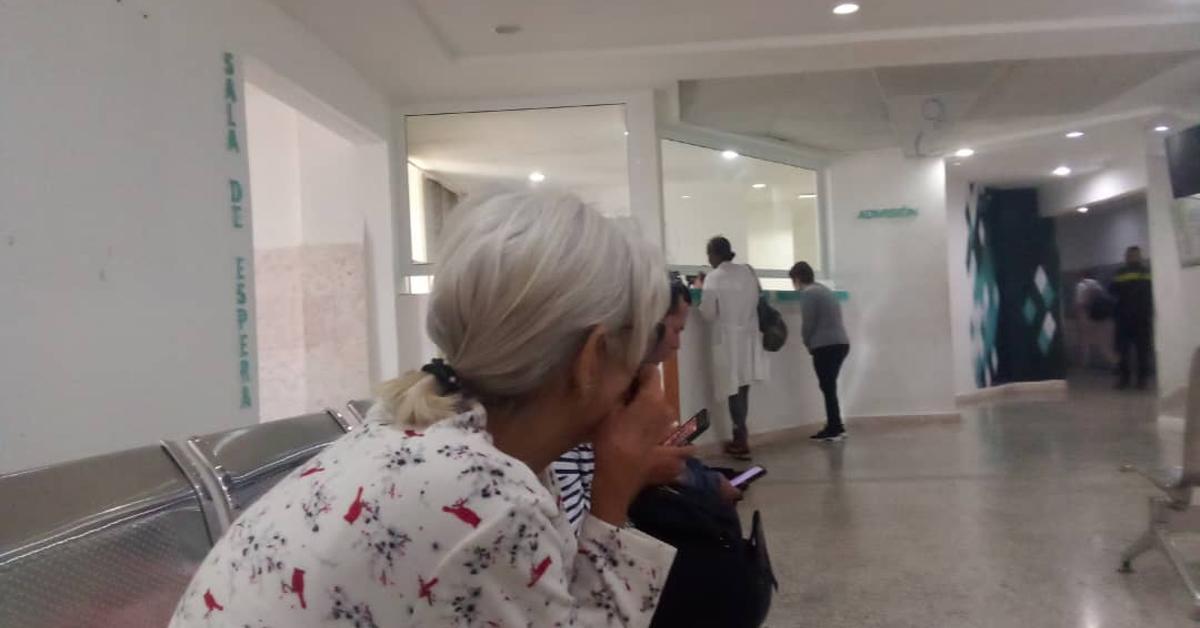
Matanzas/The corridor of the Faustino Pérez hospital seems to have no end. The white light reflects on the worn tiles, the air is still, saturated with disinfectant and resignation. It is eight in the morning and the line in front of the post-arbovirosis clinic already stretches to the end of the corridor. Among those waiting, a slow-walking woman, with bandaged knees and tired eyes, asks if this is where chikungunya cases are treated. Her name is Yolanda, she is 59 years old and for two months she has barely been able to walk.
“Since I got the virus I haven’t been able to leave my house,” she says, leaning against the wall. “The inflammation and pain in my knees are terrible. Nobody has explained to me if this has a cure or if I am going to stay like this forever.” Other patients listen to her and nod silently. They all share the same evil: the long aftermath of a fever that went away, but left a broken body.
Yolanda says that at the La Playa polyclinic the doctor could only refer her to the hospital: “She didn’t even have a prescription to give me.” In your neighborhood, Facebook groups and Google searches have become the new consulting rooms. “You learn on your own, because if you wait to be guided here, you will die of pain,” he laments. After a while he gets a seat on a metal bench. He sits up with difficulty, takes a deep breath, and watches as other patients advance slowly, shuffling their feet.
In front of the admission window, the scene repeats itself: tired faces, moans of pain and an employee who notices names on an endless list. The health system tries to maintain the protocol, but the deficiencies are visible. Doctors repeat the same recommendations over and over again – rest, painkillers, compresses – while patients search for answers.
/ 14ymedio
Tania, with swollen hands and red fingers, has been like this for five weeks. “I’ve rented a machine from Limonar to get here, only to be told to take paracetamol,” he says. Three doctors treated her, but none seemed to look beyond her file. “They kept talking to each other, about their things, and in the end they asked me if I had risk factors. They don’t even know what virus I had. I spent eight days in bed without being able to get up. And now I come and go the same: without diagnosis and without relief.”
In the waiting room, an older woman is wearing a white flower-printed robe and holding a phone in her hand. “Sometimes I think this is all an endurance test,” he says quietly. She is accompanied by a young man who barely looks up. “The only thing that works without interruptions here are the lines,” she adds with an attempt at humor.
Sergio, a 52-year-old carpenter, managed to get an appointment by calling the registration department directly. “Since the end of August I haven’t been able to pick up a hammer,” says this carpenter dedicated to making furniture and baby cribs, while rubbing his swollen hands. “I have spent more than 20,000 pesos on medications, and nothing. Neither paracetamol nor prednisone have had an effect on me.” The man speaks without anger, but with a resigned sadness. “I’ve tried ice, exercises, massages… the only thing I’m missing is acupuncture. I don’t know if it helps, but I no longer have any other option.”
The silence of the hallway is interrupted by a moan. Someone moves around in a wheelchair, another asks for help finding the office.
The silence of the hallway is interrupted by a moan. Someone moves in a wheelchair, another asks for help to find the consultation
The most frequently heard words are “rest” and “patience.” However, in the gestures of the sick there is more fatigue than hope. Arboviruses have ceased to be seasonal news and have become a chronic disease of Cuban life. Not only because of the viruses, but because of what they bring: the consequences and the limitations to returning to normal life.
Yolanda stands up again when she hears her name. “At least today they will see me,” he says, although he knows that there will hardly be a different treatment than the one he already knows. Before entering, he says goodbye to those who are still waiting. “Beware of the mosquito,” he recommends with a weak smile.
When he leaves, more than half an hour later, the hallway remains the same: the same faces along with others who have been arriving with similar symptoms. Only the time has changed. “They told me that I have to continue taking the same medications,” he summarizes. He walks slowly towards the exit, holding onto the wall. “Sometimes I think that this pain is forever.”
Outside the hospital, the noise of traffic reminds him that the day continues. “I’m going to take a machine to go back to my house. I already did what I had to do.” He adjusts his backpack, takes a deep breath and crosses the street with a slow, clumsy step.