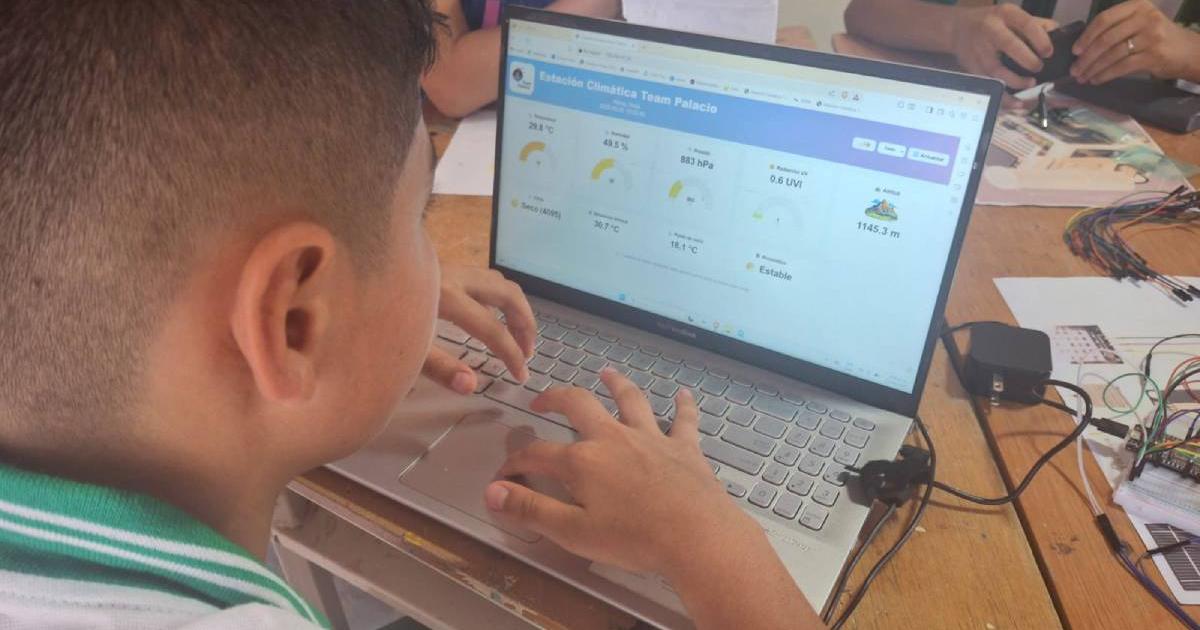
The automated climate prototype monitors the water in its territory.
For a decade, the headquarters Palace of the San Antonio de Anacona Educational Institutionin the town of Vegalarga, was a symbol of oblivion.
Its walls were deteriorated, the ceilings were in poor condition and the environment did not offer decent conditions for learning; However, what seemed like a story of abandonment became a example of hope and community cooperation.
With the joint effort between teachers, parents and residents of the township, the school was rebuilt with its own resources and donations, bringing life back to a space where today 74 students dream again of a future full of opportunities.
Read here: Financial Superintendency fines Bancolombia for failures in its digital platforms
“We inherited a school with infrastructure in poor condition, spaces that were closed due to risks, in very poor conditions and that was even going to be closed.”. We began to manage donations, resources, materials, with private companies. and with the community, with our families, with the community action boards, we began to meet to recover this infrastructure,” said teacher Walter Plazas.
In this way, together with the community, they undertook a work that went far beyond physical maintenance. With days of cleaning, painting and restoration, the residents managed to recover classrooms, adapt furniture and create more pleasant and functional spaces for boys and girls. But the transformation of the Palace headquarters was not limited to the structural.
From this renovation, an educational project emerged that has put the school on the national radar. The students, accompanied by their teacher, developed a station prototype automated climatology, an innovative system capable of measuring temperatureprecipitation and water balance of the local micro-basin.
“We put aside traditional methodologies and began to look for active methodologies that are in accordance with the context of our students, that can in one way or another contribute to the territory for them, to solve a question. When the boy leaves his house and crosses a ravine, he sees a problem, “He brings that question to school and we try to address it,” he added.
You may be interested in: Comptroller’s Office warns that investment in Catatumbo continues to be insufficient in the face of the crisis
This device collects information in real time and transmits it to a web platform, also generating automatic alerts through Telegram, which allows the community to know climate variations and make better decisions about water use.
“We started with a Kit Maker that was borrowed from the main headquarters of the educational institution, from there a center of interest in robotics was born, and taking into account the problem, the context of our students, The children began to make a prototype that acts as a weather station, “fully automated, electronic, that generates early warnings,” he pointed out.
With this proposal, the students not only strengthened their skills in natural sciences and technology, but also understood the importance of protect the water resources that supply their territory.
“These data allow the children to put this into a mathematical equation, along with participatory community monitoring, where families, action boards, go to the ravine.“They go to the drains, they go to the river and make measurements to know how much water there is in these drains.”he added.
Parents, who previously viewed the deterioration of the school with resignation, today actively participate in its activities. The classrooms, once silent, are now filled with laughter, experiments and projects that strengthen the sense of belonging and hope in education as an engine of change.
Furthermore, the environmental approach adopted by the institution has aroused the interest of other rural schools in the municipality, which seek to replicate this experience of integration between the community and scientific learning. The Palacio headquarters has thus become a benchmark of resilience and creativity.
“We are national finalists for the STEM Olympics of the Ministry of National Education. It will take place from November 26 to 28,” said teacher Plazas.
In a rural corner of Huila, where abandonment reigned for years, today an educational community flourishes that combines traditional knowledge with technology, and that has made science a path to take care of your environment and build a better future.
Source: Integrated Information System