The Minister of Energy and Mines, Joel Santosexplained this Wednesday that the national blackout registered on Tuesday in the Dominican Republic was caused by a breakdown in bus 100 of 138 kilovolts (KV) of the San Pedro substation I, which caused the automatic shutdown of the entire electrical system as a protective measure to prevent damage to the floors of generation.
During a morning interview, Santos reported that the operating system already with total normality and that since 2:20 in the morning today the entire national generation was restored. “Early this morning the distribution companies were providing 99% of energy with respect to their demand, a figure within normal standards,” he said.
The minister, in statements to Zol de la Mañana, indicated that the reactivation process was gradual and required the intervention of the hydroelectric plants to start the tension generation in the lines, which allowed the others floors were entering the system “in an orderly manner and without compromising general stability.”
Santos explained that the failure in the bar at the San Pedro substation caused an alteration in the frequency of the national electrical system interconnected, which forced its total disconnection to avoid major damage.
“These blackouts They occur when a breakdown of this type affects the frequency, and the system turns off automatically as a protection mechanism. It is a controlled reaction that seeks to avoid damage to the floors generators,” he explained.
![[object HTMLTextAreaElement]](https://resources.diariolibre.com/images/2025/11/12/whatsapp-image-2025-11-11-at-80844-pm-88b947b2.jpeg "Collapse of 138 KV bus in SPM caused general blackout")
The minister insisted that, although the blackout was general, there was no damage to the electrical infrastructure or the floorswhich allowed the restoration to be done in a few hours.
Reset process
According to Santos, the hard reset It began in the early morning, led by the hydroelectric. “One has to generate energy to create tension in the lines, and that was possible thanks to the coordinated work of the hydroelectric. From there, the floors “they came in concert,” he said.
He specified that not all floors can enter at the same time, since the process requires balance between generation and demand to avoid overloads.

![[object HTMLTextAreaElement]](https://resources.diariolibre.com/images/2025/11/12/whatsapp-image-2025-11-11-at-90954-pm-5ea63d59.jpeg "Collapse of 138 KV bus in SPM caused general blackout")
During the day on Tuesday, the Ministry of Energy and Minestogether with the Dominican Electric Transmission Company (ETED), the Unified Council of Distribution Companies (CUED) and the Superintendency of Electricity, remained in permanent session supervising the process from the Control Center of the National Electrical System.
Research and maintenance
The minister reported that at 10:00 in the morning of this Wednesday the Failure Committee of the Coordinating Body to carry out the technical research of the event and determine the exact causes of the breakdown.
“The first thing is that it is rigorous with maintenance. These situations can occur when the system frequency is compromised. I prefer to wait for it to complete the investigation because only a complete and rigorous review will allow us to reach conclusions and find a way to prevent it from happening again,” Santos said.
Asked about the former president’s criticism Leonel Fernandez regarding the suspension of the Santo Domingo Metro —which has a back of 40 megawatts—the minister pointed out that each system responds to a different scheme and that the blackout had a technical origin that affected the general frequency.
“It was not a matter of backbut of system stability. When the frequency is compromised, the systems back they cannot necessarily sustain the overall network without risk of damage,” he explained.
They rule out a relationship with a solar storm
When asked if the breakdown could have been related to the solar activity intense recorded in recent days—a geomagnetic storm G4 and one solar flare X5.1 reported by the Mexican Space Weather Service and UNAM—Santos clarified that at the moment there is no evidence of a connection between both phenomena.
“We have not yet established communication with the Haitian authorities, where a blackoutbut there is no confirmed relationship between both events. All approaches will be observed within the process of investigation“he pointed out.
“The priority was to restore the service“
The minister emphasized that, given the magnitude of the event, the Government’s priority was to restore the service as soon as possible and keep informed the population about progress.
“Our first obligation was to restore the power. That is what the protocolalong with keeping citizens informed. From today on Failure Committee will be in charge of determining the causes and establishing measures so that an event of this nature is not repeated,” Santos declared.
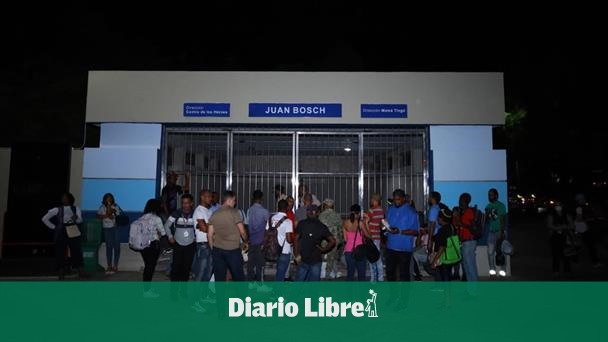
The official reiterated that the national electrical system operates with normal and that the generation covers the total demand of the country, after an event that temporarily paralyzed the network and affected public transportation, the Metro and the Santo Domingo Cable Car.