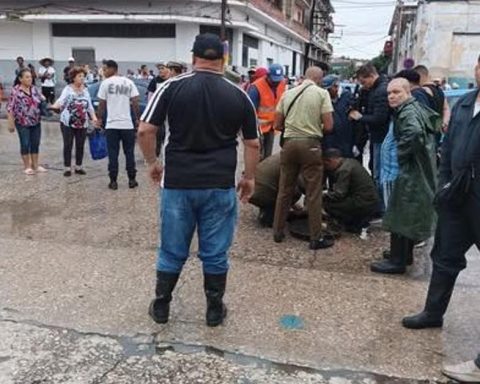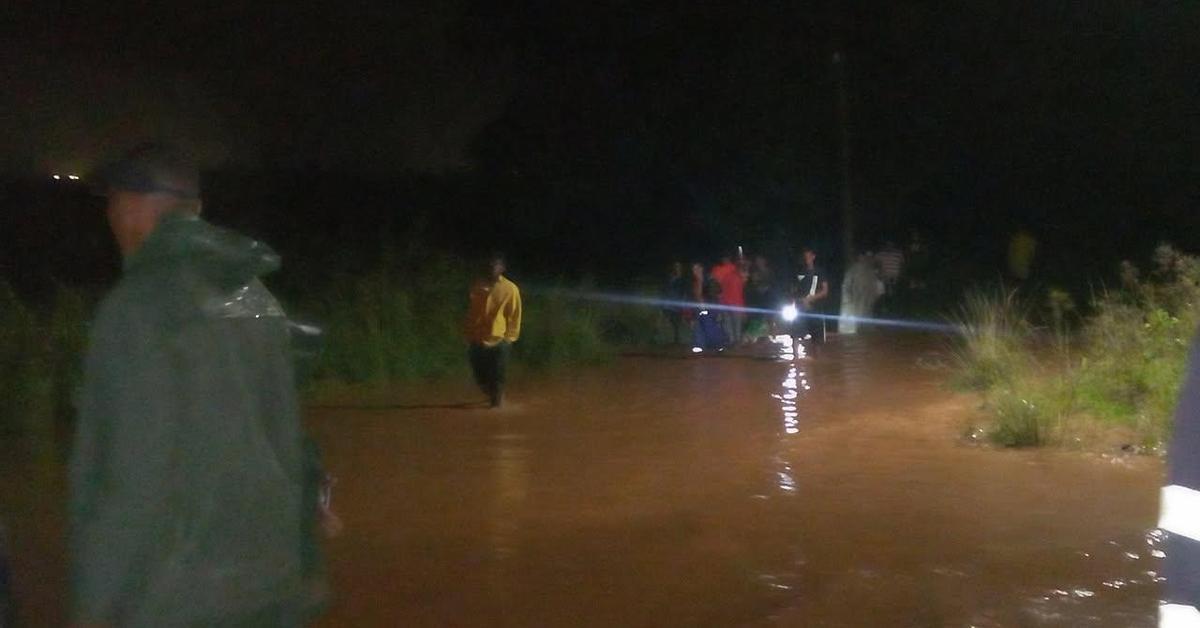
Madrid/Hundreds of residents were evacuated in Moa and Sagua de Tánamo, Holguín, this Tuesday, after the sudden flooding of nearby rivers due to the rains recorded in the last few hours. The first to break the news, with sources from local residents, was Mario J. Pentón, who stated that Sagua de Tánamo was on “high alert.”
The Cuban journalist living in the United States said that, given the sudden overflowing of the Sagua River, an “urgent house-to-house evacuation” was being carried out and residents were asked to “immediately leave the low areas” of the place, although hours later he reported that the water level in the homes was starting to go down.
The official Telecrystal confirmed a similar situation in Moa. In a note published by the provincial media, it is explained that in the Moa diversion dam, 116 millimeters of rain were recorded until 12 pm yesterday, “a significant volume that requires accelerated management of the gates, to release water and avoid accidents in the hydraulic work and downstream.” That, together with the rainfall itself, “caused the Cabaña River to rise by more than three meters above its usual channel and the flooding of the well-known Ecrin neighborhood.”
The forecast is that it will continue to rain, so the risk of flooding persists
In this town, which was alerted at four in the afternoon, more than one hundred people were evacuated between seven at night and the early hours of the morning. They are distributed, the text continues, in “safe family houses” and the Population Protection Center of the Ñico López Pre-University Institute.
The forecast is for it to continue raining, so the risk of flooding persists. Civil Defense has asked the inhabitants of Ecrin to “remain in safe places.”
These floods take place when eastern Cuba has not yet fully recovered from the passage of the Hurricane Melissaon October 29, which has left more than 90,000 homes damaged or destroyed and some 100,000 hectares of crops damaged. “Although the authorities have carried out an enormous mobilization, managing to save lives – so far no deaths have been reported – and managing to evacuate around 735,000 people, national institutions are overwhelmed with the need to respond and produce the conditions for an early recovery,” the UN coordinator in Cuba, Francisco Pichón, told the EFE agency yesterday.
The United Nations, after a visit to the east of the Island, believes that the catastrophe is much larger than initially expected and that it affects more than 3.5 million people. The regime does not stop broadcasting news alluding to “recovery,” but at the same time recognizes that “there is still a lot to do for people to return to everyday life.”
Nearly a million people in the country, the Ministry of Energy and Mines itself admitted this Tuesday, are still without electricity.
Nearly a million people in the country, the Ministry of Energy and Mines itself conceded this Tuesday, are still without electricity. The agency reported that the recovery would have reached 100% of the clients in the province of Las Tunas, while in Granma it is at 78.24%, Holguín at 81.66% and Guantánamo at 96.88%, so, according to data from the National Office of Information and Statistics, there are still close to a million people affected by the breakage of distribution lines caused by the hurricane. Of them, about 625,000 reside in Santiago de Cuba, 180,000 in Holguín, 165,000 in Granma and about 15,000 in Guantánamo. According to the part of the Cuban Electrical Union As of this Wednesday, 140 megawatts are still affected by Hurricane Melissa in the eastern provinces, from Holguín to Guantánamo.
Just this Tuesday, train services were restored between Holguín and Havana, another network affected by the cyclone.
To help recovery, the Island has received donations from several countries such as Spain, China, India and, above all, Venezuela. This Tuesday, the Ministry of Foreign Affairs of this country reported a new shipment of humanitarian aid, a total of 2,531 tons, which includes food, mattresses and electrical supplies.
This ship, which departed from the port of La Guaira, in the north, near Caracas, joins previous shipments, for example one sent last Saturday, with 5,000 tons of aid and an “electric brigade.” President Nicolás Maduro has sent 22 electricity and road specialists to the Island to reinforce the reconstruction and recovery work of electrical energy.