Havana/This year, if there is suckling pig on the Cuban Christmas Eve table, it will most likely have traveled hundreds or thousands of kilometers before reaching the stove. In the market on Tulipán Street, in Havana, this Tuesday the boards confirmed it: “Pork loin (imported), 1,200 pesos per pound.” The poster announces the undisputed reign of foreign pork on national stages.
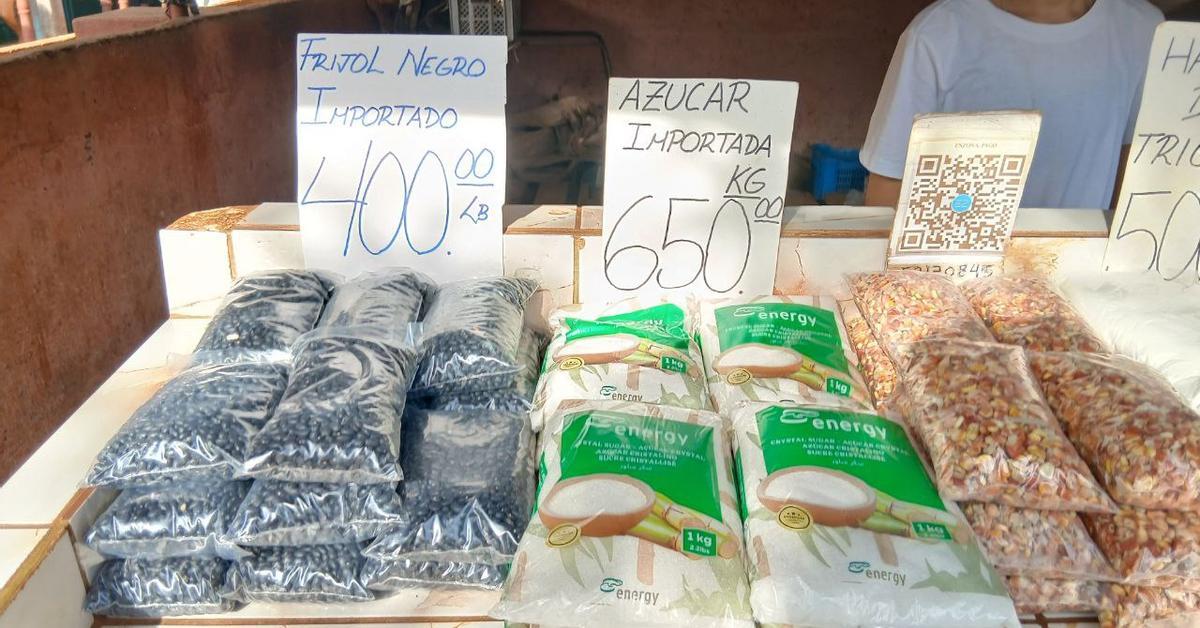
Among the bustle of shoppers and the heat that accumulates under the metal roofs, the word “imported” is repeated like an echo throughout the large premises that was once managed by the Youth Army of Labor (EJT) and is now full of private stalls. Imported rice: 275 pesos per pound. Imported black beans: 400. Imported sugar at 650 per kilogram. Even the lemon, for 300 pesos, has arrived from outside.
The market boards, which just a few years ago showed nationally harvested products, today look like a customs catalogue. A customer laughs resignedly: “The only thing Creole here is the dust on the floor.”
The market boards, which just a few years ago showed national products, today look like a customs catalogue.
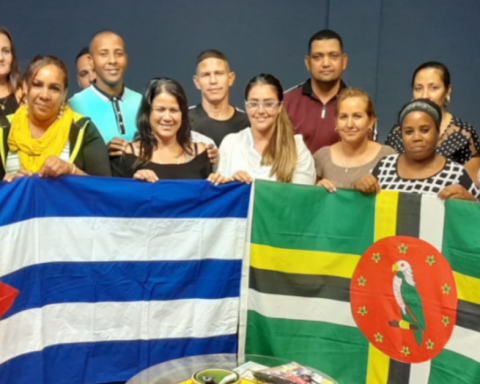
The cameras of 14ymedio They recorded the scene: a group of American visitors, wearing caps and jeans, observed the stalls full of merchandise with “Made in USA” labels. Some of the newcomers, participants of the Cuba-United States Agricultural Conference and surrounded by a strong operation, they did not hide their satisfaction. In a market that continues to carry a name linked to the Revolutionary Armed Forces, North American products – meat, rice, legumes – are increasingly abundant.
Of course, the imported loin, cleaner and better packaged, divides opinions. “It is lean meat, well cut and has almost no bones,” defends a buyer. “But it doesn’t taste the same,” replies a woman, “it lacks the taste of the pork raised by the guajiros here.” Be that as it may, few dispute its ubiquity: the foreign pig has arrived to prevail over the local pork rinds of what was once considered “the national mammal.”
The numbers tell the background of this change. In 2018, Cuba produced about 149,000 tons of pork. In 2023 it barely exceeded 13,000, and last year It didn’t even reach 10,000according to official figures. Many state farms closed and animal feed became scarce. Most of the private breeders, who at the time supplied the neighborhoods and New Year’s parties, also gave up.
The deficit opened the door to the foreign market. In the last five years, the United States, Spain and Brazil became the new suppliers of meat that, for decades, was emblematic of Cuban self-sufficiency. According to the monthly reports of the United States-Cuba Economic and Trade Council (US-Cuba Trade), exports of American pork to Cuba in 2024 were between two and four million dollars per month, for an annual total that exceeded 25 million.
/ 14ymedio
Spain, which is among the world leaders in the pork sector, has increased its shipments to the Cuban market since 2022, and Brazil – the region’s agri-food power – placed thousands of tons of frozen cuts on the Island.
The result is visible: in the stalls of the Tulip Street market there are an abundance of loins with Brazilian export stamps. Portuguese labels mix with sacks of Spanish rice and North American beans. “The cleaner and prettier, the more expensive it is,” summarizes a customer who reads the information on a package of sugar from Brazil. The smell of reheated fat coming from some food stalls, and the reggaeton music playing from the speakers, complete the scene.
In a WhatsApp group, a private business in the Miramar neighborhood, Havana, offers a wide range of foods brought in from outside. Grapes, peppers, red onions and even carrots are part of an offer that is mainly aimed at diplomatic personnel and Cubans with resources. The private business emphasizes in its advertising that everything is “clean, beautiful and tasty” and adds “fresh and recently arrived.”
Pork is more than just an animal protein. In Cuba it has symbolic value. No end of the year is understood without his presence: the roast on the pick, the crunch of the leather, the smell of the mojo. But this time, the flavor of the party will come packaged and frozen, coming from refrigerators in Iowa, Toledo or São Paulo.
While much of the world is committed to reducing the distance between the field and the table, Cuba is taking the opposite path. In recent years, local markets, local cooperatives and the “kilometer 0” label have multiplied in Europe and Latin America, but on the Island, food travels thousands of miles before landing on pallets.
What was previously a relatively short production and consumption network – the farmer selling to the forklift driver and the forklift driver to the neighborhood – has been replaced by a system where the food supply is measured in containers and currencies. Thus, if in Madrid or Buenos Aires a local tomato is a source of pride, in Havana the novelty is a sack of rice with letters in English or a pork loin packaged in Portuguese.
The scene becomes more and more picturesque. Beans are no longer beans: now they are “porotos” or “alubias”. The peas appear in bags that say green peas and the sugar bears the seal of a Guatemalan mill. Even the fruits, which once came from the south of Mayabeque or Jagüey Grande, now come from Florida or Yucatán. What happened portrays the Cuban paradox: in a country that is agricultural by vocation, it is increasingly difficult to eat something that comes from its own land.
“People don’t ask where it comes from; they ask if it’s good quality and they complain that it’s expensive”
A salesman, wearing a stained apron, watches as some customers look disgusted when they read the prices and comments: “People don’t ask where it comes from; they ask if it’s good quality and they complain that it’s expensive.” In these daily gestures the change of an era is summarized: Cuba imports what it previously raised. If until recently many dreamed of a Creole pig, this December they will have to settle for its globalized relative.
Inflation has done the rest. With the dollar at 440 pesos in the informal market, a carton with 30 eggs costs almost half the monthly salary, and pork loin at 1,200 pesos has become a luxury that few can afford. “The national pork was for the poor, but now not even the poor can buy it,” says an old man while comparing prices. “Everything we eat now comes from outside.”
Under the midday sun, the EJT market continues to fill up. The blackboards are smudged with new numbers, the smell of imported garlic mixes with that of Peruvian tangerines, and the refrigerators hum on the verge of blackout. The pig, that old protagonist of Cuban celebrations, has a foreign passport this year.