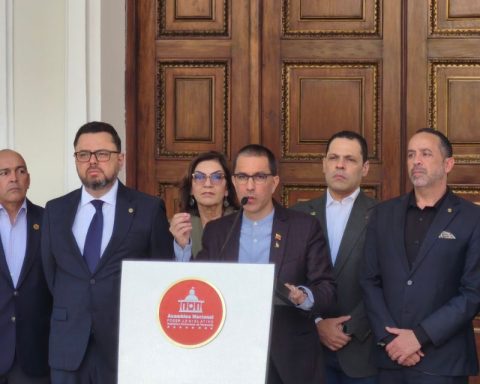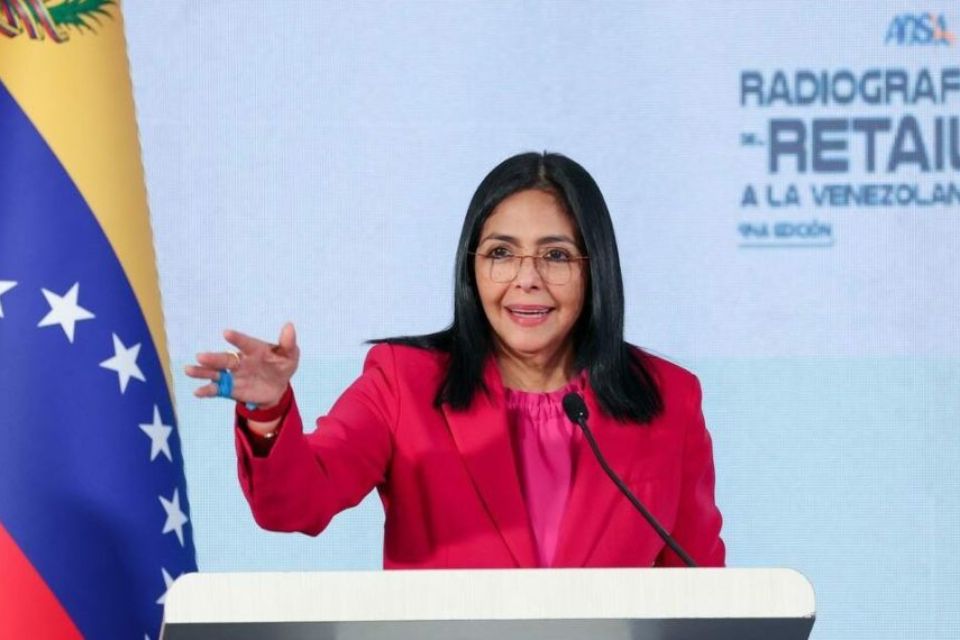
Vice President Delcy Rodríguez veiledly accused the United States of “having plans to dollarize the economy of several countries in our region and they have Venezuela on the list, but they will have to cross it out and delete it because we will continue down the path of defending the bolivar.”
Venezuelan Vice President Delcy Rodríguez ruled out this Tuesday the 11th that dollarization would occur in the country, while reporting an economic growth of 8.71% for the third quarter of the year where, she assured, the commercial sector played an important role.
During a forum on the retail situation organized by the National Association of Supermarkets and Supermarkets (ANSA), Rodríguez said that in dollarized countries “organized crime activity proliferates” and gave the situation in Ecuador as an example. «You know that Ecuador is the country where 77% of the cocaine that is exported to the United States comes from, it is not Venezuela.
“Our currency, its defense and maintenance, is fundamental,” said Rodríguez, while veiledly accusing the United States of “having plans to dollarize the economy of several countries in our region and they have Venezuela on the list, but they will have to cross it out and delete it because we will continue down the path of defending the bolivar.”
According to the vice president, 97% of payments in retail stores are made in bolivars. The number of card operations grew 20.63% between January and September of this year compared to the same period in 2024, while national consumption in bolivars grew 40%.
“If we do not protect the income of workers, which was one of the main social wounds of the economic war against Venezuela, we would not be able to have this process of growth and recovery,” said the official.
However, the Venezuelan currency has faced depreciation against the dollar of 68% between January and August of this year due to the policies of the Central Bank of Venezuela and the political crisis, economists have said. During the first ten days of November alone, the dollar has risen 3.3% or 7.44 bolivars.
The vice president cited ECLAC projections that place Venezuela as the country with the highest growth in Latin America. «We know that the projection for the first semester of Venezuela’s GDP is 8.5%. We close the third quarter with 8.71% after eighteen consecutive quarters of growth.
He also said that Venezuela is the country in the region with the highest banking rate, reporting 93% of the population with bank accounts. He also stated that the credit portfolio grew 11.2% in the last 12 months, while tax collection has increased 13.5% between January and September 2025, compared to the same period last year.
Likewise, he explained that 90% of the products displayed on supermarket shelves and other formal businesses are Venezuelan. The rest is exported. “We want a commercial sector that can distribute the country’s production, the efforts of producers, farmers, fishermen, manufacturers.”
Rodríguez said that the economy has remained stable despite the fact that the country “has nine warships in front in the Caribbean Sea, which has permanent threats.”
“We are prepared without fuss, prepared and ready to defend the country, but where we have defeated them the most is in the economic sector, because the psychological war that they have launched on Venezuela for almost three months no country can withstand it, the economy would already be creaking, and we remain imperturbable,” he stated.
The ANSA x-ray
The president of the National Association of Supermarkets and Supermarkets (ANSA), Ítalo Atencio, stated before the closing of the event that the habit of large biweekly purchases completely disappeared from the Venezuelan map.
“There is no longer a market of the month or a fortnight,” said Atencio, who explained that customers now enter the supermarket two or three times a week and cancel purchases that range between $8 and $23, depending on the size of the store and purchasing power.
In a 200 square meter store located in popular areas, the average barely exceeds $8 per purchase. Meanwhile, a medium-sized establishment of a thousand meters in middle-class sectors reaches 18 dollars per customer. Large stores in higher-income neighborhoods close at over $23 per bill.
Despite this, the sector has grown 5% so far this year and 714 thousand direct and indirect jobs have been generated, an increase of 8% compared to 2024.
Atencio also indicated that three major supermarket chains already accept cryptocurrencies at their checkouts and announced that by March 2026 at least 10% of transactions could move in digital currencies. “Digital assets stopped being the future and became the present.”
*Journalism in Venezuela is carried out in a hostile environment for the press with dozens of legal instruments in place to punish the word, especially the laws “against hate”, “against fascism” and “against the blockade.” This content was written taking into consideration the threats and limits that, consequently, have been imposed on the dissemination of information from within the country.
Post Views: 393