The offer of “simultaneous humanitarian management” by Ukraine also includes sending to the Island the remains of Cuban combatants killed in the conflict.
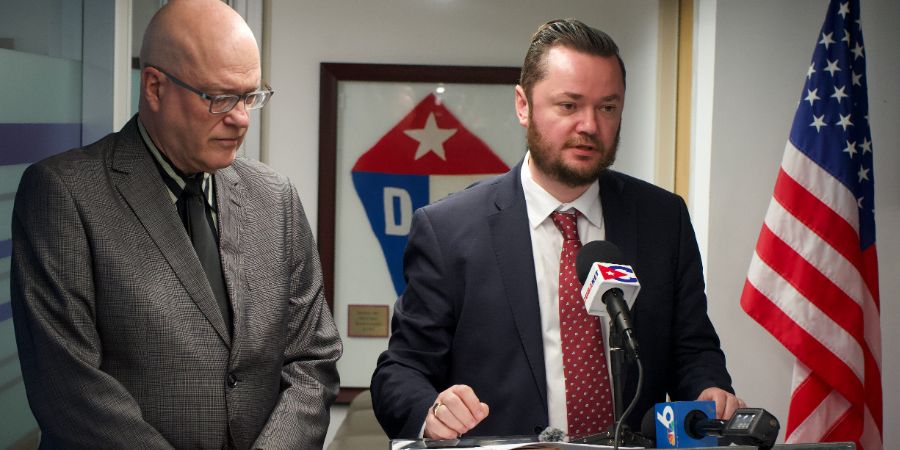
MIAMI, United States. – The Ukrainian deputy Maryan Zablotskiy raised this Tuesday, during a press conference held in Miamiconsider the release of Cuban mercenaries captured in its territory—and the return to their families of the remains of 41 Cubans who died on the front—in exchange for the simultaneous release of a group of political prisoners in Cuba.
“We can consider releasing Cuban mercenaries if there is a simultaneous gesture to release Cuban political prisoners,” Zablotskiy said.
The politician, president of the Pro-Free Cuba Committee of the Ukrainian Parliament, specified that there are two options on the table: for Moscow to hand over Ukrainian prisoners to kyiv in exchange for Cubans, or for Havana to release some of the more than 1,000 political prisoners on the island in exchange for its nationals detained by Ukrainian forces.
Likewise, he recalled that, “since the invasion began, in none of the prisoner exchanges” carried out between Moscow and kyiv “has Russia asked for any foreign fighters. They only ask for the Russians,” he stated.
The legislator confirmed that kyiv keeps Cuban fighters in custody and anticipated an increase in that number. “I want to say categorically that we have four Cuban prisoners. (…) Of course, the number of prisoners is going to increase,” he said.
He also highlighted the conditions of confinement: “They are being treated humanely and, more than humanely, we are treating them well,” he assured. “Some of them have told us that it is the first time that they eat three times a day and that they would rather be in a Ukrainian prison than return to Cuba.”
The offer of “simultaneous humanitarian management” by Ukraine also includes sending to the island the remains of combatants killed in the conflict. “We have identified 41 Cuban bodies. “We can continue to identify bodies and report to the families in Cuba what has happened to these men who have died,” Zablotskiy said.
Likewise, the legislator denounced that “there are many Cubans that the Russians have not let go after completing their one-year contract in the Armed Forces. They still have them there in the Army fighting for Russia,” he noted.
Participating in the press conference were, among others, Orlando Gutiérrez-Boronat, leader of the Assembly of the Cuban Resistance (ARC); René Bolio, president of the Mexican Human Rights Commission; and Dragos Dolanescu, president of the Hemispheric Front for Freedom, among other activists and human rights defenders.
Gutiérrez-Boronat maintained that the “largest contingent” of foreigners fighting for Russia would be Cuban and that Havana had “abandoned” its imprisoned citizens, while reading the names of 41 deceased Cubans.
In the same forum, Bolio presented a priority list of 17 political prisoners whose immediate release he proposed linking to the Ukrainian gesture. “After analyzing – and of course we want the absolute, unconditional and immediate freedom of all political prisoners in Cuba – we have selected the most urgent cases,” he said.
List of Cuban political prisoners that the ARC asks to prioritize in the event that “a simultaneous humanitarian management” takes place between Havana and kyiv:
1. Luis Manuel Otero Alcántara (artist sentenced to five years in prison; he does not receive adequate medical care and his health is deteriorating).
2. Maykel Castillo Pérez (musician, winner of the Latin Grammy for the song Homeland and Lifesentenced to nine years in prison; He is in prison with serious threats to his life).
3. Miguel Díaz Bauza (sentenced to 30 years in prison; 81 years old).
4. Ángel de Jesús Veliz Marcano (sentenced to six years in prison for the protests of July 11, 2021).
5. Sayli Navarro Álvarez (Ladies in White activist, arrested for the protests of July 11, 2021).
6. Félix Navarro (72 years old; in serious condition; arrested for the protests of July 11, 2021).
7. Rolando Yusef Perez Morera (sentenced to eight years in prison for the protests of July 11, 2021; in serious condition).
8. Sissi Abascal Zamora (Ladies in White activist, arrested for the protests of July 11, 2021).
9. Yeris Curbelo Aguilera (independent journalist sentenced to two years for covering the peaceful protests of May 6, 2023).
10. María Cristina Garrido (sentenced to seven years in prison for the protests of July 11, 2021).
11. Francisco Rangel Manzano (64 years old, sentenced to six years in prison for the protests of July 11, 2021; in serious condition).
12. Lizandra Góngora (mother of five children, sentenced to 14 years in prison for the protests of July 11, 2021; in serious condition).
13. Virgilio Mantilla Arango (systematically arrested for peaceful activism, awaiting sentencing on October 17).
14. Donaida Pérez Paseiro (sentenced to eight years in prison; has two small children).
15. Loreto Hernández García (sentenced to seven years in prison; in serious health condition).
16. Jordan Marrero Huerta (arrested on April 24, 2025; remains in prison without trial for denouncing abuses against political prisoners on social networks).
17. Manuel Vázquez Licea (sentenced to six years in prison for the protests of July 11, 2021).
18. Alexis Borges Wilson (59 years old, sentenced to 17 years in prison for the protests of July 11, 2021).
19. Daniel Alfaro Frías (Cuban peasant sentenced to nine years in prison for his activism).
Bolio also demanded guarantees “that they will not be imprisoned again” or that they will be “expelled from the country because [Cuba] It is their homeland.”
The president of the Hemispheric Freedom Front supported the proposal and offered logistical support to make it viable, including the resettlement of Cuban combatants who do not wish to return to the Island. “Ukraine’s humanitarian proposal must be processed and found viability. The Hemispheric Freedom Front offers to collaborate and guarantee the benefits for its completion,” he said.
“We are committed to finding the third country to receive the Cuban mercenaries, currently imprisoned in Ukraine, since they cannot return to Russia and they themselves do not want to return to Cuba. (…) The mercenaries have expressed that they prefer a Ukrainian prison to returning to the prison that is today the Island.”
In his initial intervention, Gutiérrez-Boronat recalled that, as the Ukrainian Foreign Ministry has announced, “the largest international contingent fighting for Russia is the Cuban one,” that Ukraine “voted in favor of the freedom of the Cuban people” at the UN (that is, against the resolution to end the US embargo presented each year by the Cuban regime at the United Nations General Assembly) and announced the closure of its embassy in Havana.
The opposition leader also thanked the presence of regional allies – among them Julián Obiglio, president of the Union of Latin American Parties – and highlighted that “it has been the Cuban resistance that has been concerned” about the situation of detainees of Cuban origin in Ukraine.
Zablotskiy insisted that kyiv does not want to keep Cubans in its prisons or see them fighting for Russia. “We don’t need them to be in our prisons and we don’t need them to be fighting for Russia either,” he said. He also highlighted the contrast between the treatment reported by Ukrainian prisoners of war in Russian hands and that claimed to be accorded to Cuban captives: “We already know that the Ukrainian prisoners of war are being tortured and mistreated by the Russians. The Russians are not treating them the way we treat the Cubans.”