Several agents informed him that he could not travel because he planned to “participate in an event that was going to take place in the United States (…) for the Ladies in White.”
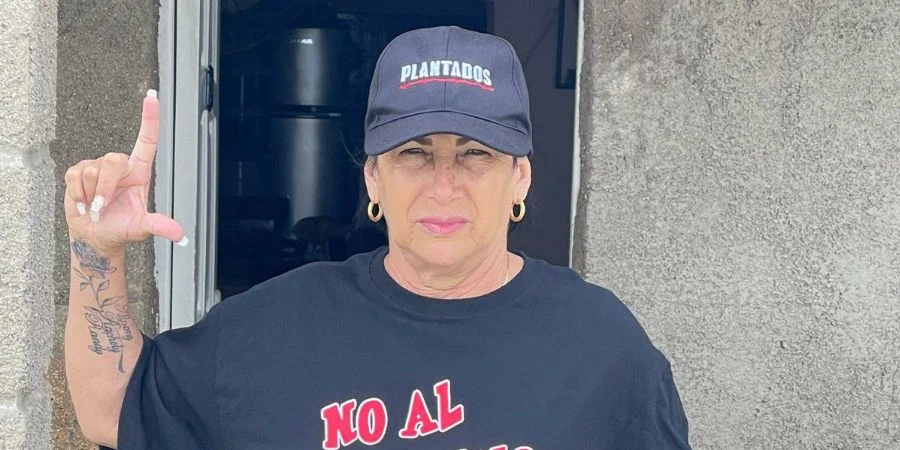
MIAMI, United States. – Ladies in White activist Leticia Ramos Herrería reported this Monday that State Security officers prevented him from boarding a flight to the United States when he had already completed the regulatory check before boarding a plane. The activist, who lives in Matanzas, did not specify in which airport the events occurred.
“A lieutenant colonel dressed in uniform stopped me. They took me to a small room,” he said in a video posted on Facebookin which he identified several agents and stated that they told him that he could not travel because he planned to “participate in an event that was going to take place in the United States (…) for the Ladies in White”.
The agents specified that, for them, she was not a human rights activist, but a “mercenary.”
Ramos Herrería added that she was kept “in detention for several hours” and held State Security responsible for her health: “I hold State Security responsible for my health, for what may happen to me, because I am at the expense of heart surgery.”
“If I was regulated for nine years, I will leave when they want, when they want,” she said, ensuring that she will continue her activism “in defense of human rights.”
According to his testimony, in addition to the lieutenant colonel, “Captain Laura, Major Ramón” and “two officers (…) from Havana, who did not say their names,” intervened. The activist assured that the officers told her that “they are the ones who rule this country and do whatever they want.”
In the written message that accompanies the video, the Ladies in White activist specified that she was going to travel to the United States and that “the henchmen of the regime” prevented her “once again from leaving Cuba.”
The term “regulated” is a euphemism used by the Cuban regime to refer to the discretionary ban on leaving the country imposed on activists, opponents, journalists and dissidents in general. The normative basis of these restrictions is in the Immigration Law (Law 1312) and its 2012 reform (Decree-Law 302), which allow passports to be denied or departure prevented for broad reasons such as “national defense and security” or “other reasons of public interest.”
Although in 2013, the island’s regime eliminated the old “exit permit,” the authorities have maintained discretionary powers to prevent travel by critics and opponents. According to Human Rights Watchthis is a violation of international law.
The Inter-American Commission on Human Rights (IACHR) has repeatedly warned of restrictions on the freedom of movement of activists, journalists and human rights defenders in Cuba, including a ban on travel to attend international conferences and events.
In its 2020 report on Cubathe IACHR asked the State to guarantee freedom of movement “to leave and enter the country” and to refrain from applying these arbitrary restrictions. Amnesty International too registered in 2024 the persistence of the “prohibition of leaving the country” and “forced exile” as tactics of repression against critical voices.
In 2024, the National Assembly published a draft new Immigration Law which, in addition to organizing the system, maintains clauses that enable entry and exit limitations for “national defense and security” and for “other reasons of public interest,” and provides for notifiable restriction measures with limited avenues for challenge.
The official document details, for example, that “any person who is in the national territory cannot leave the country” when causes such as those mentioned occur, and that the Immigration Authority can apply “entry and exit limitations” in exceptional cases.
Cuban civil society organizations and media such as the Patmos Institute have kept public records of “regulated” and have underlined the political nature of many prohibitions.