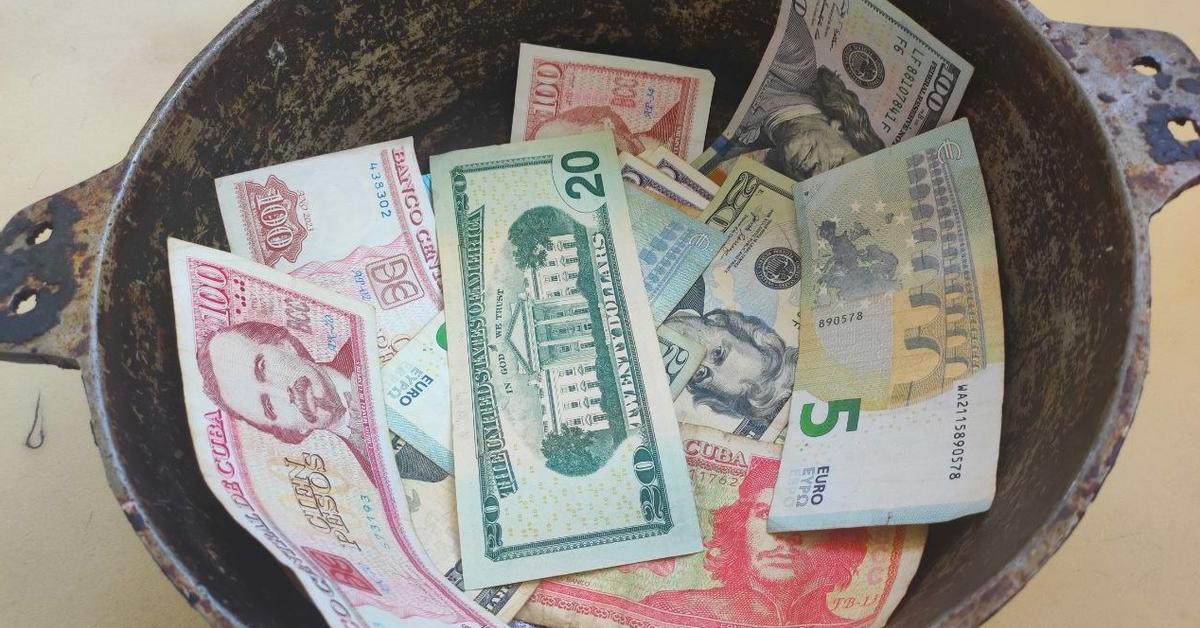
Madrid/The signs of rebound that the dollar was giving in the informal currency market will be consolidated throughout this month, and the speed it is taking is reflected in the fact that this Tuesday it rose 10 pesos compared to Monday. In just four days, the increase is 6%, going from 415 pesos per dollar on Saturday to 440 today, Tuesday.
“The predicted rebound is based on a market that is beginning to be dominated by excess demand. At the current price of currencies, fewer participants want to sell. The current price also seems low for buyers, which encourages them to try to buy before it rises,” says the Observatory of Currencies and Finance (OMFi). The institution, directed by the Cuban economist Pavel Vidal and linked to The Touch It is expected that the US currency will have recovered by the end of November the exchange rate it had at the end of October, when the arrival of Hurricane Melissa precipitated the rate drop.
According to forecasts, the dollar will be exchanged for 470 pesos on average, although the range may be between 450 and 490. For its part, the euro, which on November 1 was at 525 pesos and just four days later fell to 475, will once again gain strength to 520 pesos on average, with the possibility of a minimum scenario of 490 and maximum of 535.
According to forecasts, the dollar will be exchanged for 470 pesos on average, although the range may be between 450 and 490
Vidal explains in the report that October ended with what appears to be “another episode of overreaction (overshooting) in the Cuban informal market.” The economist points out that this phenomenon was warned precisely in the bulletin previous to this one and that the causes were in different commercial reasons – from imports to consumption in dollar markets – added to speculative purchases. Thus, that previous era of overvalued dollar should be followed, by probability, by a sudden fall, “an issue that usually happens after cycles of acceleration in prices fueled by expectations and subjective factors.”
The expert affirms that the psychological barrier of 500 pesos worked, but also points out “the coordinated campaigns on social networks and promoted by actors related to the Government to discredit the Representative Rate of the Informal Market (TRMI) that calculates The Touch and to promote an artificial decline in the dollar.” In recent days, the ruling party, led by the Minister of Foreign Affairs himself, Bruno Rodríguez, had insisted that the independent media acts as salaried party in an economic war against the Island led by the United States. The argument has been used repeatedly when the exchange rate rises, although it is forgotten if it falls.
The monthly report reviews the background economic panorama that affects the situation, dominated at this time by a program presented almost a month ago by the Government that calls for reducing inflation, the fiscal deficit and monetary issuance through the fall in spending and the increase in taxes on families and the private sector, without the true structural reforms that the situation requires.
“The program omits the Gaesa conglomerate [Grupo de Administración Empresarial S.A.]which concentrates close to 40% of national production, which generates income 3.2 times greater than the State budget and which manages the country’s foreign currency reserves; but it does not pay taxes or make contributions to the budget,” highlights the report, which regrets the asymmetry of a plan that neither foresees modifying the burden on the economic group of the Armed Forces nor proposes a better use of international reserves “which should be under the control of the Central Bank.”
The OMFi reproaches the Cuban Government for insisting on mentioning the floating rate that it has been talking about for a year without specifying when there is barely a month and a half left in 2025 and attributes the damage caused to the private sector to this absence and the volatility of the market.
“When currency prices stop generating consensus among participants, a large part of the purchase and sale transactions stop; which generates a shortage of dollars or pesos (depending on the market imbalance) that are essential for MSMEs and other private actors,” he highlights, while asking that the market be allowed fluidity so that companies maintain operational liquidity, both in national currency and in foreign currencies.
In a context like the Cuban one, he laments, “the partial interruption and disorder of the foreign exchange market aggravates the financial tensions of the private sector, which ends up having a negative impact on the functioning of consumer markets and, therefore, on families.”