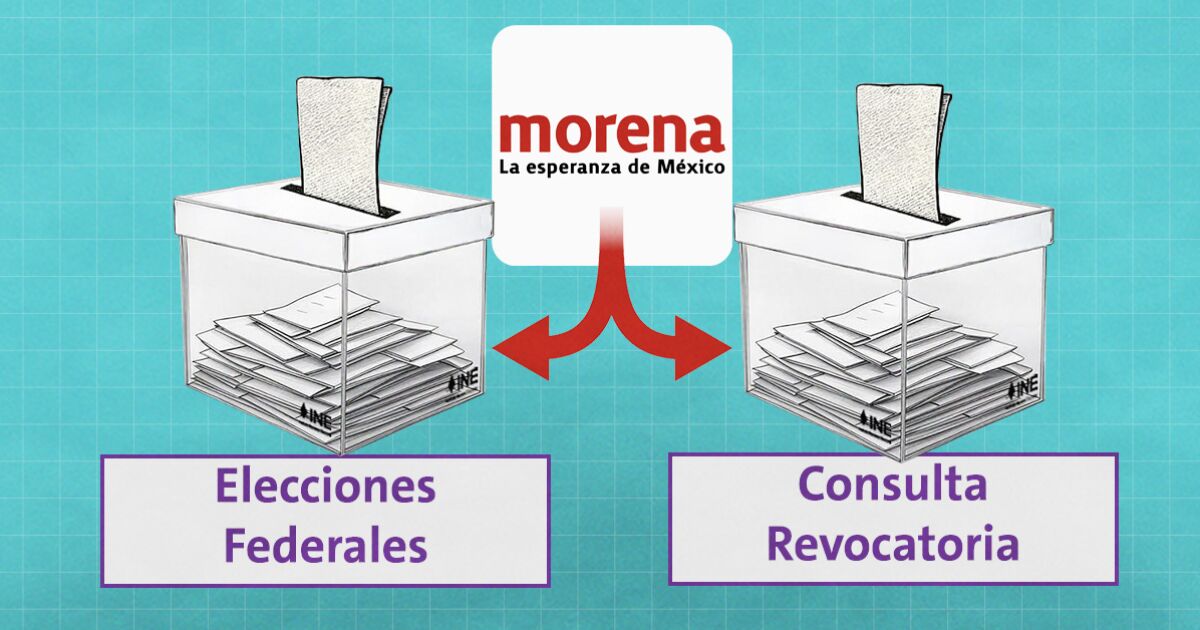
On September 18, Morena deputy Alfonso Ramírez Cuéllar presented an initiative to reform article 35 of the Constitution to advance the date of carrying out the processes of revocation of mandate and establish that this is the same day as the federal elections.
The initiative would be ruled last night for discussion this Tuesday, November 11 in the plenary session of the Chamber of Deputies, but the ruling was postponed and is pending.
Although Morena has enough votes to approve it at any time, the coordinator of its deputies, Ricardo Monreal, indicated that it seeks to expand the discussion, as requested by members of the opposition parties.
This reform, added to the obligation already established by the Judicial Reform of 2024 that in three years the second half of the members of the Judicial Branch of the Federation would be elected, will cause thousands of positions to be put up for election on June 6, 2027, in a single day.
But these positions are of a different nature, so it will be necessary to duplicate polling stations, says Marco Antonio Baños, former counselor of the National Electoral Institute (INE).
(Photo: Crisanta Espinosa Aguilar/Cuartoscuro)
Chaos would be created, the expert believes, if on the same day judicial positions (more than 2,600 positions of federal and local judges), 500 federal deputies, 17 governorships, 31 state congresses and 2,246 mayors are put to vote.
“If they continue with the idea of having the federal and local elections on the same day combined with the judicial elections, it will be a real disaster, because they will have to set up two different blocks of polling stations,” he says. “A block of boxes will be required to receive the vote for the elections of deputies, governors, city councils and local congresses and another block of boxes to receive the vote for the judicial elections.”
This is due, he explains, to the fact that the Judicial Reform prohibited all participation of political parties in the election of judges and magistrates, so now the boxes could not be mixed, since in some there will also be party representatives.
This duplication of boxes would reduce the savings that, the promoter of the proposal – Congressman Ramírez Cuéllar – assures, his reform proposal would bring with it, says Baños.
On the other hand, adding revocation would violate other provisions of the Constitution, since political parties are not only prevented from participating in judicial elections, but are also restricted from intervening in mandate revocation processes.
(Photo: Crisanta Espinosa Aguilar/Cuartoscuro)
Arturo Espinosa Silis, director of the Electoral Laboratory, remembers that no official can appear in campaigns other than their own, nor promote any candidacy.
If President Claudia Sheinbaum appears on the revocation ballots, she would not comply with that restriction, so the reform to article 35 of the constitution would open the door to unduly influencing the electorate.
“This is contrary to what has been required for years of the presidents of Mexico, that they stay out of non-presidential elective processes and avoid in any way influencing the electorate to vote for one party or another, as happened in many previous governments, and that so many complaints and changes to the electoral law brought with them,” says Espinosa.
Furthermore, advancing the process would violate the nature of the revocation, since being before the end of half of the mandate leaves citizens without instruments or information “to know how the rest of the six-year term will continue.”
Regarding the supposed savings, the expert assesses that it does not matter how much savings are sought with the electoral turnout, “if the necessary inputs and amounts are not provided to guarantee the correct functioning of the electoral system.”
Therefore, the member of the Electoral Laboratory calls on legislators to carry out a real analysis of the needs and capacities of the Mexican electoral system, of citizens and of strengthening participation and accountability exercises.
“We must not forget that all the changes that have been made and will be made to the electoral system will be the rules in which those who are now the government will once be the opposition – as recent history has shown,” he indicates.