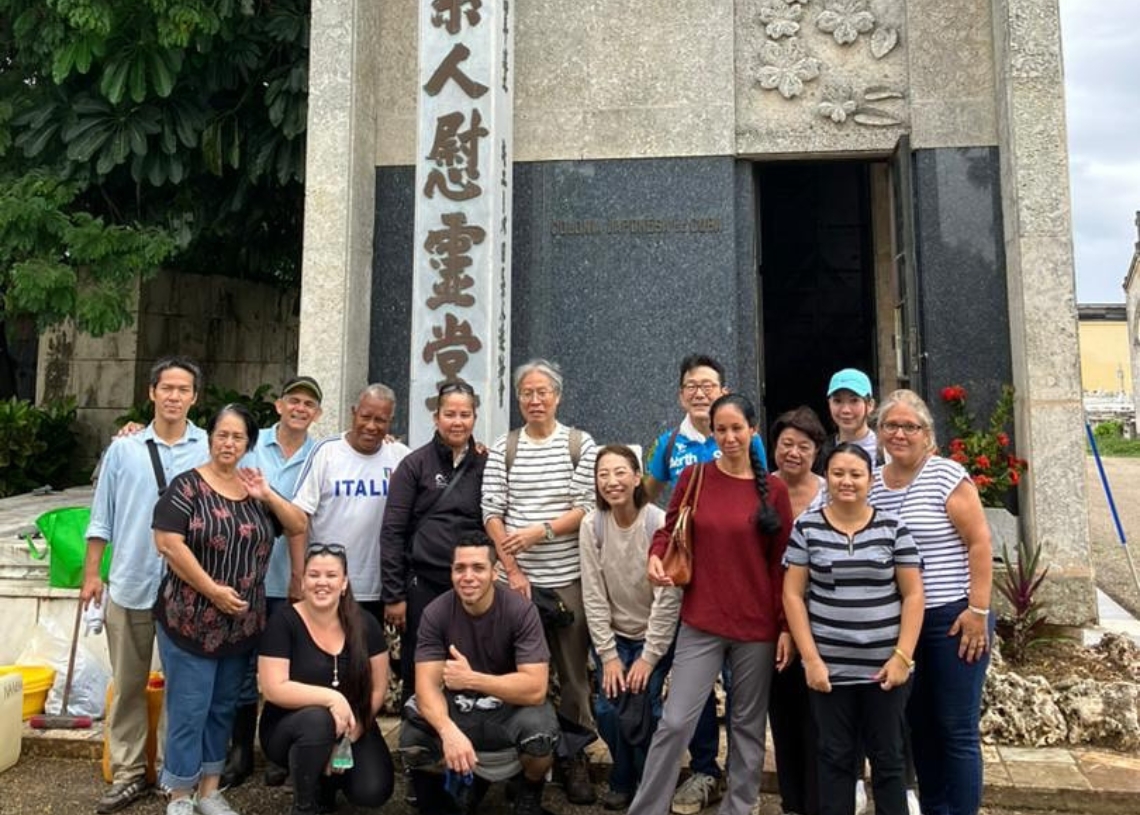
Nearly 200 descendants of Japanese, known as “Nikkei,” gathered this Sunday at the Colón cemetery in Havana to honor their ancestors with a Buddhist ceremony, said a dispatch from the Spanish agency EFE.
In front of the pantheon of the Japanese colony of Cuba, the event consisted of an offering of incense and the recitation of several prayers and was supported by the embassy of the Asian country on the island.
“This pilgrimage is a good opportunity to strengthen the bond with the ancestors, to protect traditional culture and, in the case of young people, to maintain their Japanese origin,” the Japanese ambassador to Cuba, Nakamura Kazuhito, told EFE.
In his speech, the Japanese diplomat highlighted the ties that unite Cuba and Japan and stressed that the Nikkei community is “essential” for bilateral relations, since they are “a very important bridge” between both countries.
Currently, the Nikkei in Cuba number around 900 people spread throughout the country. With the difficulties of distance and the passing of generations, they keep Japanese culture alive on the island.
“Maintaining the language is more difficult because there are only three places where Japanese is taught,” the president of the managing committee of the Nikkei Association in Cuba, Francisca Ponce de León Arakawa, explained to EFE.
According to this descendant, the collective keeps certain artisan traditions alive, which it spreads in workshops, such as the making techniques of mizuhiki (knots), omamori (amulets) and daruma (votive figures without arms or legs).
Origin and geography of the word Nikkei
The term “Nikkei” refers to people of Japanese origin living outside Japan, including their descendants, even if they are of mixed ancestry.
It comes from the Japanese word “Nikkeijin” (日系人), which means “person of Japanese origin.” There are more than 5 million Nikkei in the world, with the most populous communities located in Brazil, the United States, Peru, Mexico and Argentina.
On the other hand, the Nikkei 225 is the most important stock index in Japan, representing the 225 largest and most liquid companies listed on the Tokyo Stock Exchange, including giants such as Toyota, Sony, Nintendo and SoftBank.
The pioneer of the Japanese in Cuba
The first Japanese to arrive in Cuba was Hasekura Tsunenaga, a samurai who landed in Havana on July 23, 1614. In his honor, there is a sculpture located on Avenida del Puerto, in Old Havana.
In addition to being a warrior, Hasekura was a diplomat and led an embassy sent by the shogun Tokugawa Hidetada bound for Spain and Rome, with the aim of establishing relations with the Spanish crown and the Holy See.
On his journey through the Pacific and then through Mexico, Hasekura arrived in Havana, becoming the first recorded Japanese to set foot on Cuban soil.
The immigration Japanese to Cuba began in 1898, and maintained a constant flow until 1926. From this connection between two archipelagos in Asia and the Caribbean, a community of descendants with common experiences emerged, who were located throughout the 20th century in almost all of the current Cuban provinces.
Chemical fertilizer introducers
In 1920 several immigrants headed to the then Isle of Pines, where They formed the first agricultural production cooperatives known in Cuba, and introduced the use of chemical fertilizer.
The growing Japanese community, however, had its tough years during the Second World War, when Japanese emigration was paralyzed and those living in Cuba were detained in concentration camps on the Isle of Pines and in Havana.
According to research, the end of the war and the concentration did not end the tensions with Japan, which came to an end in 1959, when Fidel Castro’s revolution came to power and normalized relations with Tokyo and emigration was restored, although to a lesser extent.
In 2020, in Cuba only 25 first-generation Japanese remained, 15 of whom arrived before 1959. Although the best-known Japanese settlement is Isla de la Juventud due to the popularity of the farmer Mosaku Harada and his family (12 children, 20 grandchildren and great-grandchildren, a total of 46 members), Havana became a stronghold, with more than 200 descendants of Japanese emigrants.
In addition to the farmer Harada, another Japanese who achieved popularity in Cuba was the horticulturist Kenji Takeuchi, who was commissioned to develop the Soroa orchid garden, in the province of Pinar del Río, where he cultivated more than 700 species of these flowers.
Japan and Cuba have maintained strong political ties for decades despite the geographical and cultural distance. Tokyo has supported Havana with significant donations and development programs over the years.
This Saturday, a shipment of Japanese emergency aid arrived in Cuba for the hundreds of thousands of people affected by Hurricane Melissa.