With the help of artificial intelligence (AI), among other tools, the Fluminense Federal University (UFF) Riskclima project identifies the areas of Brazil most vulnerable to climate extremes and the social problems caused by them. With this information, specific solutions are proposed for each location to improve the population’s quality of life.
Sometimes the solutions are simple, like a constant reminder for the population to drink water. “This could save lives.” In areas of intense heat waves, it is common for people to have a heart attack, especially the elderly, and dehydration is among the negative factors.
Funded by the National Council for Scientific and Technological Development (CNPq), the project Riskclima it was created in 2022 and is expected to last until 2026. Researchers have been observing what is happening with the climate over the last six decades and making climate projections.
“The idea is to create an executive report and, in some way, try to make it contribute to the creation of public policies”, says the coordinator of the Riskclima project, Márcio Cataldi, professor at the Climate System Monitoring and Modeling Laboratory (Lammoc) at UFF.
How the project works
Riskclima researchers investigate which are the most frequent and most intense extreme phenomena that can, depending on vulnerability, cause some type of risk. Based on the assessment of the dangers prevailing in each area of the country analyzed, a survey of appropriate actions is carried out to mitigate the climate impact in each area.
One of the tools used in the project is AI, used to adapt the climate models of the Intergovernmental Panel on Climate Change (IPCC) to the current Brazilian reality. The IPCC has models used around the world, which will indicate climate change in 20 years.
AI is used to select the most effective models for predicting the current climate. For example, if a model performs a satisfactory simulation but underestimates rainfall, the AI will learn and apply this knowledge to a next scenario.
Results found
In the North Region, for example, where next week the 30th United Nations Conference on Climate Change (COP30)in Belém, Pará, research has observed waves of intense heat. “We have observed the increase in heat waves and during the project we developed a heat wave index, which we had applied in Europe. When we applied this index to Brazil, to our surprise, the region where heat waves have been most intense in the last ten years was the North Region. They increased throughout the country, but in the North Region it was where they increased the most. So, this was a result that we were not aware of. It was a little scary, because it is the region where you have the least capacity to adapt”, Cataldi explained this Friday (7) to Brazil Agency.
Cataldi argues that the Northern Region has to be discussed at various levels of knowledge. The more riverside, more traditional populations do not want, for example, very invasive actions. According to the UFF professor, these populations are used to dealing with natural climate variability.
“So, you can’t come with a fan or an electric generator for them. You have to try to work with solutions that they accept. But, to do this, you must first work with these populations at the level of environmental education, showing that the natural variability of the climate that they are used to dealing with no longer exists. All of their ancestors have always dealt with climate fluctuations, but the way the climate is oscillating today is different. So, they do need technological adaptations or adaptations that are creative, but they are different adaptations. This is the first challenge. These are very traditional populations”, pointed out the professor.
Floods in the South
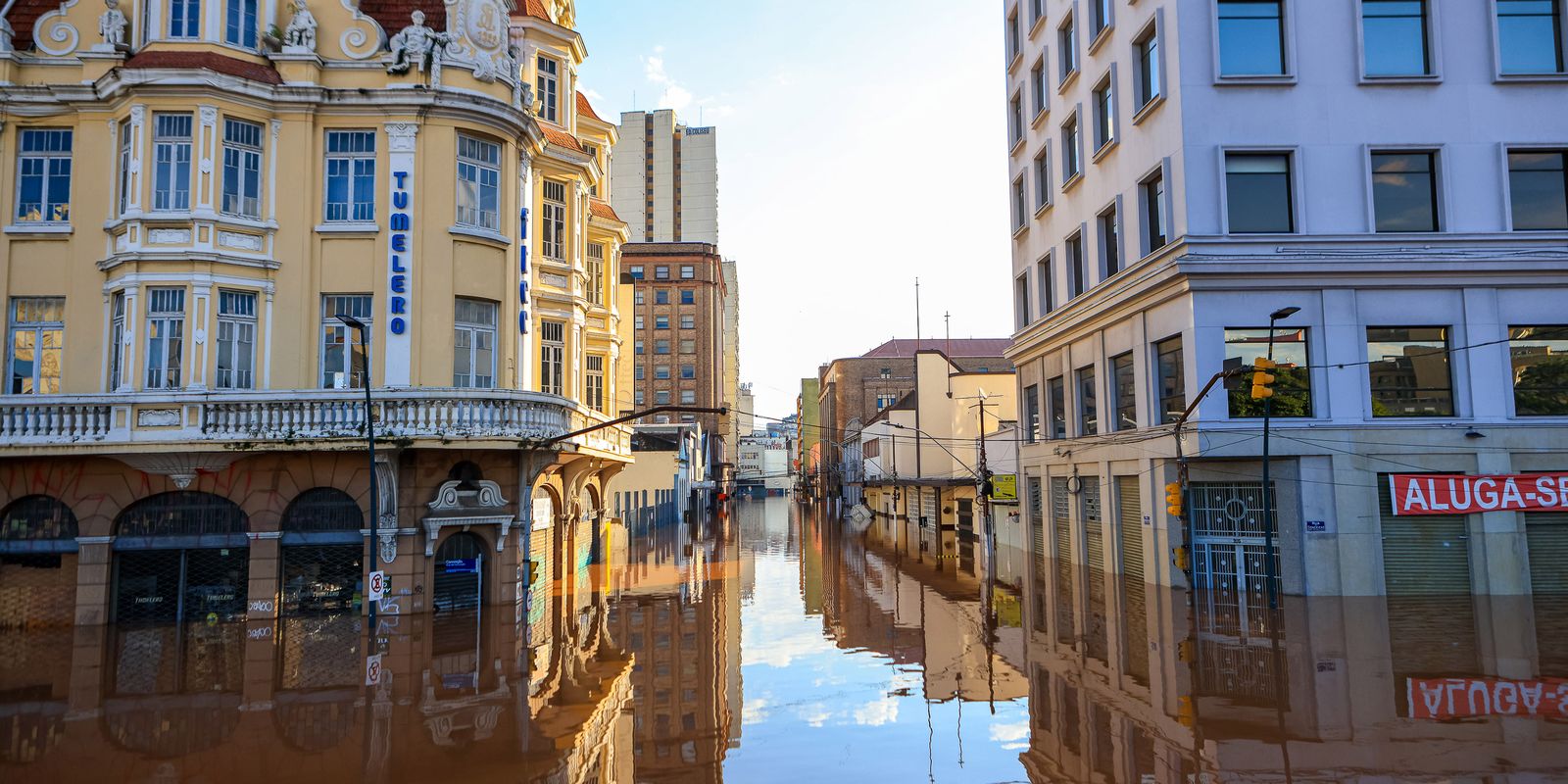
In the South Region, the rains are the biggest concern. There, the Riskclima project analyzes the increase in atmospheric blockages. “This means that when we have a blockade in the Southeast Region, the cold fronts are unable to advance to the Southeast. They remain stopped in the South, as happened in April and early May last year.” The researcher refers to the floods that left 184 deaths in Rio Grande do Sul in 2024.
Márcio Cataldi recalled that, this year, the phenomenon also happened, but with less intensity. “The whole problem is that this seems to be the normal pattern as of now.” The researcher assessed that a survey needs to be carried out, for example, of flood areas.
In Porto Alegre, for example, a large part of the flooded areas are normally prone to flooding, due to their geographical position. Márcio Cataldi the tragedy in the city was worsened by the lack of maintenance and inoperability of the floodgates in the capital of Rio Grande do Sul.
Cataldi indicated that it is necessary to deal with these problems seriously, create policies and work with legislation so that these policies are continued. “It can’t be a government thing because then another comes along and says that I don’t care about this. It can’t be.”
Dry
In the Southeast and Midwest, drought prevails due to the absence of rain. An article published by Riskclima researchers in Nature Magazine shows that the most serious first step of drought is that soil moisture decreases. This happens because for consecutive years it has rained less than average. NASA satellite sensors were used to show this.
Cataldi highlighted that the Southeast and Central-West constitute the most populous region of the country, the region with the greatest agriculture, where the large energy reservoirs are located. Therefore, the researcher highlights the need for science and decision makers to think about how to make water a national priority. “Each sector requires a specific solution.”
For example, it is necessary to optimize irrigation, water generation from aquifers, optimize alternative, renewable energy generations, such as wind and solar, and preserve water generation. “Because it has to be used when you don’t have other generation sources at the base, because the reservoirs, for a long time, have not been able to reach very high levels. There are a series of solutions that have to be thought of for each sector. Because we are talking about water supply for humans and animals, agriculture, in other words, everything demands energy. It is a basic need for the Brazilian population.” Therefore, the issue of drought and the worsening of drought is a very important point to be addressed urgently, highlighted Cataldi.
Also in the Northeast, in the Caatinga region, in the hinterland, in the semi-arid region, the main problem is the worsening of the drought leading to a process of desertification, which is already advancing. “It’s a region that was dry, but is getting drier.”
Public health
All of these climate problems also have impacts on public health, varying between regions. Atmospheric blockages, for example, are more frequent in the Southeast Region. UFF research is studying how much these atmospheric blockages affect air quality, because they trap pollutants close to the surface.
“One point that we will see is a worsening of air quality, with the increase in these blockages. Another important point is the issue of heat. When you have a very large loss of water, during an episode of heat wave, the blood becomes more viscous; it is as if it becomes easier to ball up and, then, this facilitates clotting, resulting in thrombosis and heart attack”. This abrupt dehydration ends up causing heart attacks.
The professor said that the number of deaths from dehydration in Europe is absurd. In the last heat wave, recorded in 2023, there were 70,000 deaths, he reported. “We have to be careful, because even though Brazil is used to heat waves, we need to work on hydration, especially for the elderly.”
Márcio Cataldi highlighted that caregivers and those responsible for the elderly must also be informed of the need for everyone to hydrate. This is a big challenge, he admitted. These are everyday things that we need to be more alert to.
Next steps
Before the end of the project, scheduled for 2026, an executive report will be presented to the Brazilian authorities with proposed solutions, with a view to taking measures and developing public policies that help resolve these different climate problems.
“The important thing is to sit down with the authorities, show the urgency of implementing these policies and make ourselves available, as a public university, to help start mitigating climate problems,” said Cataldi. “We can’t wait,” he highlighted.
Cataldi argued that one should not wait for 2050, because climate dangers are already happening now. The objective, he emphasized, is to work with the level of knowledge we have, so that these solutions are adapted and begin to take effect, that is, they begin to improve all climate problems, until they begin to mitigate them.
The researcher also clarified that even if countries stopped emitting greenhouse gases today, the climate would not return to what it was before. “It would still take two decades to return to balance. So, what we want to do is try to show where mitigation actions should be a priority.”