Rapporteur of the Parliamentary Commission of Inquiry (CPI) on Organized Crime, senator Alessandro Vieira (MDB-SE) argues that “simply” equating factions with terrorism could harm ongoing investigations, since combating terrorism is a federal responsibility. 
In conversation with the Brazil Agency This Friday (7), the senator spoke about his expectations with the CPI, about the role of the Armed Forces in combating crime and assessed that it may be necessary to make exceptions in the spending ceiling to finance public security.
“The mere transformation of a violent criminal faction into terrorism will cause criminal proceedings for these actions to migrate from state to federal justice and this means killing investigations, throwing away knowledge accumulated by qualified professionals for years in the fight against serious crime”, highlighted Vieira, who has been a Civil Police delegate for 20 years and is licensed to exercise the mandate.
Vieira added, on the other hand, that it is possible to equate factions with terrorism in relation to the size and enforcement of sentences, but “with technical care” to “not throw away all the work done”.
The senator argued that the Armed Forces should play a role in controlling borders and questioned the efficiency of operations to guarantee law and order carried out by the military.
“It’s another example of measures that don’t work, don’t generate results and only serve for media purposes. We had several opportunities for intervention by the Armed Forces in urban territory and the results were minimal and absolutely temporary”, highlighted Senator Alessandro.
>> Follow the channel Brazil Agency on WhatsApp
The Sergipe parliamentarian also said that he does not agree with the summoning of faction leaders by the CPI, as requested by some requests. According to him, this could help the crime itself.
Also according to the rapporteur of the CPI installed this week, operations Carbono Oculto – which targeted the laundering of criminal money via gas stations – and Containtion – which resulted in the murder of 121 people in Rio de Janeiro – are complementary, each having a role in combating crime.
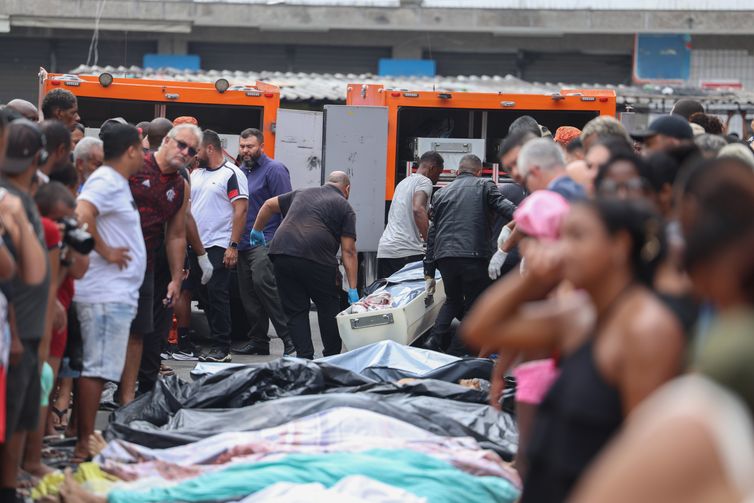
Rio de Janeiro (RJ), 10/29/2025 – Dozens of bodies are brought by residents to Praça São Lucas after Operation Containment – Tomaz Silva/Agência Brasil
Check out the full interview:
Brazil Agency: What is the main – or main – errors in public security policy in Brazil to combat organized crime and how can the CPI help?
Senator Alessandro: The CPI will enable a complete diagnosis. With this diagnosis, we will provide guidance on which solutions work and those that have never worked, although they are repeated from time to time.
But what we can point out very clearly is the issue of insufficient funding, the lack of planning and the lack of continuity in security policy.
Because of the security policy, it takes time to generate consistent results. It costs a lot of money, it requires a firm political will to combat crime. These are the main points.
The issue of the lack of integration between forces is also a relevant point, but the ones I mentioned before seem more important to me. By listening to professionals and listening to experts, we will most likely reach these conclusions.
Brazil Agency: How can we find money for public safety with the current fiscal rules that limit Union and state spending?
Senator Alessandro: In the same way we find space for every expense that politics considers important. A country that spends R$5 billion to finance its election, it has money, it certainly has money to finance the defense of life, property and citizen security. It is a question of political definition.
With the CPI, we hope to be able to gather a volume of data and political strength that will finally enable the construction of a national security plan agreed between states, municipalities and the Union, sufficiently financed and stable for it to have continuity and generate the results that Brazil needs.
Brazil Agency: Could the resource fall outside the fiscal target of the spending ceiling?
Senator Alessandro: The format will be defined. The first answer is not that. The first question is what volume is needed. What do we need to do to generate significant change? From there, make fiscal spaces viable, either by redirecting resources, which is always ideal, or by moving away from any specific fiscal rule limit, as long as it is done in a timely and technical manner. We’ve done this dozens of times.
Brazil Agency: What is your assessment of the debate on whether or not to label these factions and militias as terrorists?
Senator Alessandro: Technically speaking, and there is no disagreement on this, they are not terrorist organizations, because terrorism presupposes a religious, ideological or political component. These factions aim for profit, money.
But it is possible for you to advance some proposal for equivalence for the purposes of punishment, serving a sentence, but with the necessary technical precautions so as not to throw away all the work you have done.
Because the mere transformation of a violent criminal faction into terrorism will cause the criminal proceedings for these actions to migrate from state to federal justice and this means killing investigations, throwing away knowledge accumulated by qualified professionals for years in the fight against serious crime.
Nothing done in a rush is a solution. There are good paths and good projects that are already in the Senate and the Chamber. We will try to help our colleagues do this screening. Creating a procedural logic cannot be a patchwork, and within a logic that has consensus.
We can greatly aggravate the sentences for this type of criminal, even more so for their leaders, by toughening the sentence.
Brazil Agency: Node work planyou mention the contribution of the Armed Forces to operating on the borders and routes used by trafficking. What is the role of the military in fighting crime?
Senator Alessandro: We first need to listen to Armed Forces professionals. The Minister of Defense has already been invited, but the Brazilian constitutional design and what actually works point to the need for the Armed Forces to act in the border region.
The Armed Forces, only very exceptionally, and for a very limited duration, can play a role in a GLO action [Garantia da Lei e da Ordem] in a city, metropolis or community.
This is yet another example of measures that do not work, do not generate results and only serve for media purposes. We had several opportunities for intervention by the Armed Forces in urban territory and the results were minimal and absolutely temporary.
If, on the other hand, I manage, in partnership with the security forces, with the Armed Forces, to restrict the access of weapons and drugs across our borders, I directly impact organized crime, I increase their costs, reduce their attractiveness and, consequently, reduce crime. So, each one in their own square, with political leadership from the Union and integration.
Brazil Agency: When the work plan was presented, you highlighted the need to pay special attention to the penetration of organized crime into legal markets. Why is this important?
Senator Alessandro: Because there is a very accelerated advance of organized crime in segments of the formal economy. What attracted the most attention recently was the segment of fuels and their derivatives. But this happens in other areas of the formal economy.
We need to create, first, the same dynamics of collecting data, listening to professionals who work in the segment and forwarding solutions. In some cases, these will be legislative solutions, creating more obstacles to this access by organized crime or reducing the potential interest of organized crime in this segment.
I have projects presented, perhaps a year ago, in the fuel area to try to close the door on money laundering through the use of gas stations. We will be able to advance measures of this type, protecting the formal economy, the legal economy, and making the various money laundering mechanisms that are used today unfeasible.
Brazil Agency: What would be the best way to reduce the economic and military power of these criminal organizations in Brazil?
Senator Alessandro: A series of actions, there is no silver bullet, a series of actions that complement each other. Many people compared Operation Zero Carbon and Operation Containment.
These are totally different operations, incomparable, but connected. Because I have to decapitalize crime, combat money laundering, identify and arrest these operators and close these doors for dirty money to pass through.
But, at the same time, I have to take back the territory that is currently occupied by crime. This retaking of territory requires the use of violence by the State. You can’t compare one thing to another, they complement each other.
Public security activity is complex, although it’s no secret to anyone, we know what works and what doesn’t, but it has all these layers. When the drug dealer is decapitalized by the seizure of drugs, he commits robbery. He’s a criminal, he wants easy money, he won’t stop. He just gets arrested.
You had 2,500 Rio de Janeiro police men on the hill, in a violent confrontation that resulted in 120 deaths, and inside the prison, in the same Rio de Janeiro, the same faction determined retaliatory or diversionary actions by the State, by the city of Rio de Janeiro. This shows a failure in the management of a fundamental point that is in our work plan, which is the prison system.
Brazil Agency: Do you support summoning arrested heads of criminal organizations, as requested by Senator Marcos do Val? Why?
Senator Alessandro: It does not have my support, but the CPI is a collegiate body. We will listen to colleagues respectfully and ask them to explain what the objective of a hearing of this nature is.
There is no reason to give space, a stage or a microphone to a criminal when you are already aware that this criminal will not bring any relevant information that favors the fight against crime. He will use this space to try to strengthen crime.
So we have to have this clarity, we will respectfully listen to the author of the request, but we will vote against it because it is unproductive and harmful to Brazil’s interests.