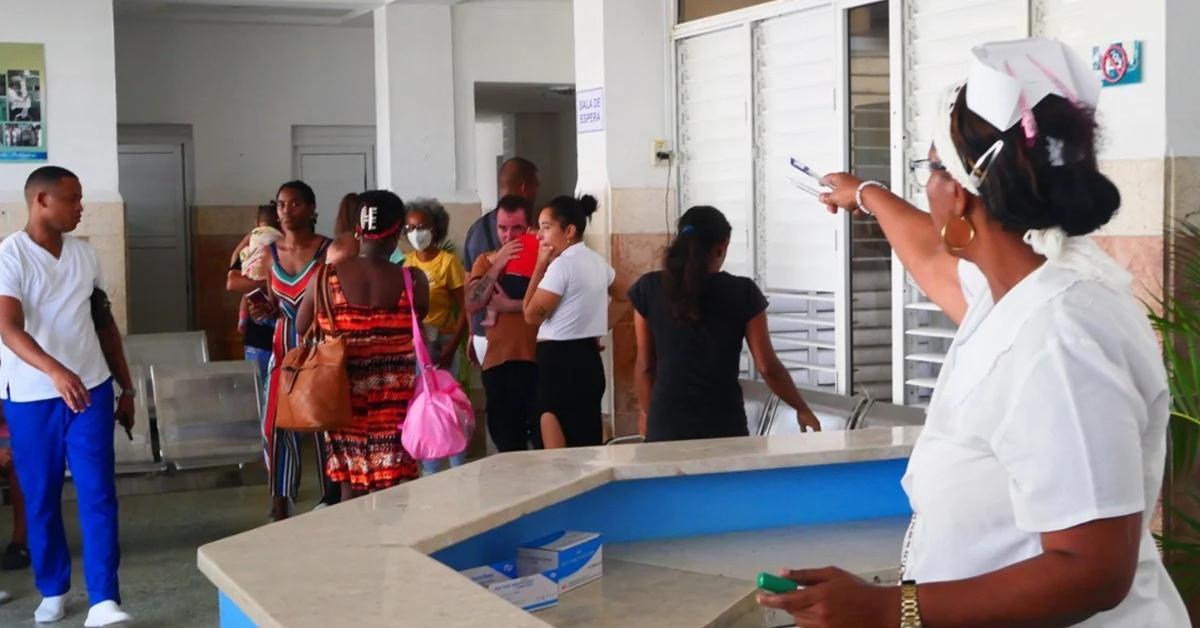
Havana/“At my job there are 14 doctors, nurses and staff members convalescing with the new viruses,” a worker at the Doctor Cosme Ordóñez Carceller polyclinic, in the Havana municipality of Plaza de la Revolución, tells this newspaper. “Most of my colleagues are sick,” she adds, and confesses that she feels “overwhelmed” by the number of daily cases she must attend to at the medical center.
Tamara Alonso, who lives in Lawton, writes to us: “Here all the families have had at least one person with the disease, at least. On my block everyone went through it and they are still going through it. In my house there are three of us, and all three of us went through it. I also have a friend who went to Vedado four days ago, and he told me that on (Avenue) 23 almost everyone was walking in robots. The during and after is horrible.”
The health crisis has the entire country in check. The José Martí Pérez Pediatric Teaching Hospital, in Sancti Spíritus, has increased its capacity due to the increase in arboviruses in the province. Thus, they have added 20 beds to the 152 they already had, according to Escambray its general director, Ramón Aquino Lorenzo, and the areas of the guard and nursing corps were reinforced. The doctor asks the population “not to stay at home” and “go to the doctor in the first few hours to prevent possible complications that may appear in this type of pathology,” something that Cubans tend to resist, especially because of the shortage of media and reagents in health centers.
The news, published this Friday in the provincial newspaper, and others in the official media about the health emergency, reflect the sudden concern of the authorities after months of ignoring her. In Forwardthis Thursday there was an alert of an “exponential” rise in diseases transmitted by the mosquito in Camagüey. Aedes aegyptiespecially chikungunya and dengue. In the capital of the province, there is “a daily average of 450 people with febrile symptoms and a cumulative infestation index of 2.16.”
The scene he describes seems taken from the dystopian film ‘Juan de los Muertos’
Also this Thursday, clinical trials of the drug Juzvinza began, intended for the treatment of “inflammatory joint manifestations that persist in many patients once the infection” of chikungunya has been overcome. The doctor Perla María Trujillo Pedrozaa specialist in Comprehensive General Medicine at the Manuel Piti Fajardo Polyclinic in Santo Domingo (Villa Clara), who had expressed himself very critically about the inaction of the authorities in the face of the epidemic, thanked the announcement of the tests – “Late? Yes, but something is better than nothing,” he wrote on his Facebook wall -, although he asked to “continue working on prevention, about which very little has been done.”
Many Cubans in exile are distressed about the situation of their relatives in Cuba. “Some of my uncles in Cruces, Cienfuegos, are all in bed,” a Cuban resident in the United States tells this newspaper. “They are very old people, 89, 91 and 94 years old. The one left standing was a 69-year-old daughter and she fell ill this week.” The scene he describes seems straight out of a dystopian movie. John of the Deadby Cuban Alejandro Brugués: “During the day, in the part of the town where they live, not a soul is seen on the streets. Everyone is convalescing. And at night, without power as almost always, only moans can be heard. In the silence you can hear people lamenting their pain.”
Hurricane Melissa not only left broken roofs, flooding and endless blackouts, it also complicated the health situation that was already serious before the cyclonic event. Arboviruses – dengue, Zika, chikungunya, the most recent oropouche, and others not yet recognized – are no longer seasonal events, but are part of daily life in neighborhoods where water stagnates without reaching household tanks, garbage accumulates even though the Government poses for photos in “voluntary work” and sanitation depends more on neighborhood inventiveness than on the management of the authorities.
The mother of Duannis León Taboada –political prisoner of 11J–, denounced that his son has been sick since Wednesday and that he has not yet received medical assistance. “My greatest fear came. My son is unjustly imprisoned and the damn virus caught him. He has fever and vomiting and a lot of pain,” wrote Jenni Taboada. Her message conveys uncertainty and desperation: “What do you want, for him to die? I am extremely worried about my son’s life,” she concluded.
Opacity in Cuba is part of the political model. For decades, the Island was a regional benchmark in epidemiological surveillance. Today, we talk about “focus control” but not about incidence rates. It is stated that “reagents are available,” while patients and doctors quietly confirm that diagnoses depend on luck or contacts in the health sector.
Arboviruses find fertile ground in a population without defenses or minimum hygiene conditions
Tamara Moisés, a resident of Santiago de Cuba, made a extensive publication on their social networks about the critical deterioration of living conditions after the hurricane, with a direct impact on the proliferation of arboviruses. According to his testimony, the city has been without sanitation for more than nine days, with accumulated garbage and branches, clogged sewers and an explosion of mosquitoes and gnats. On his street, with few homes, 17 cases of chikungunya have already been reported.
Moisés attributes the spread and severity of these diseases not only to the unhealthy environment, but to widespread immune decline caused by poor nutrition, which he describes as “famine.” It also points out the critical shortage of food, medicine and drinking water, in addition to the endless blackouts, the lack of gas to boil water and pharmacies without basic medications.
The testimony warns of a possible worsening of the health crisis with risks of multiple outbreaks, an increase in tuberculosis and diseases associated with malnutrition, in a context that the woman from Santiago describes as a “failed state” and “inhumane”, where arboviruses find fertile ground in a population without defenses or minimum hygiene conditions.
State media talk about “anti-vector battles”, “community mobilizations” and “the people’s struggle alongside the authorities.” But in these chronicles the essential detail never appears: how many patients are there? In how many municipalities? How fast are infections growing? How many deaths are really attributed to arbovirus complications and how many are diluted into generic clinical categories?