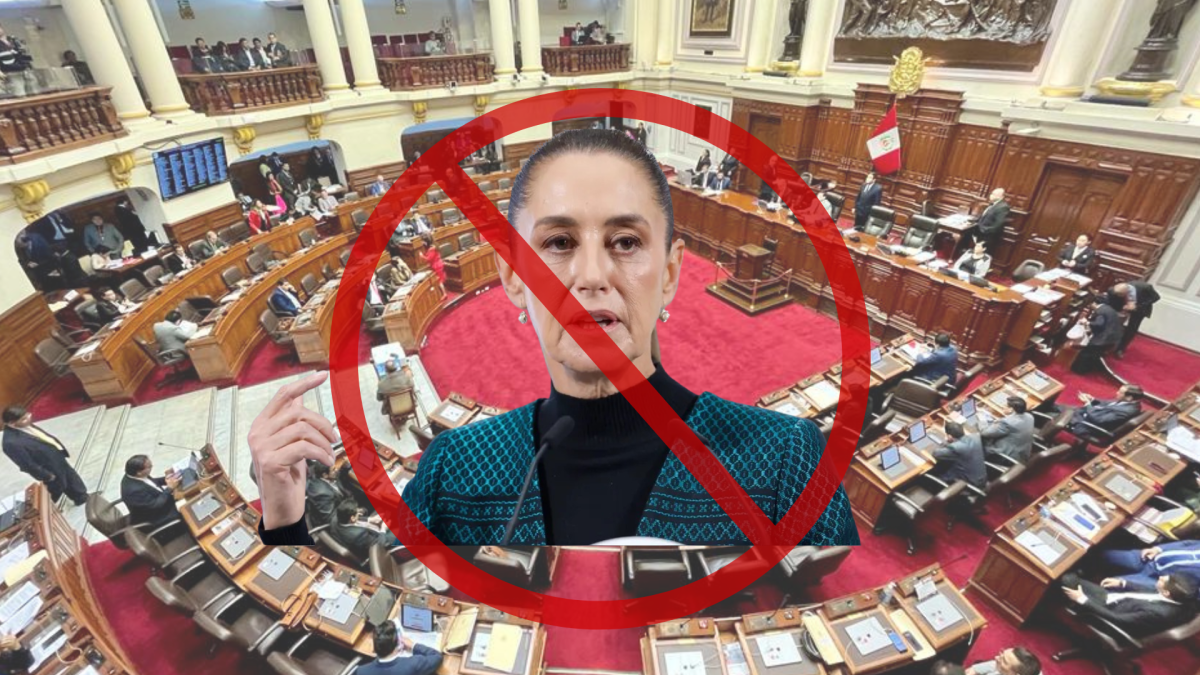
With 63 votes in favor, 34 against and two abstentions, Congress approved the agenda motion that declares the president of Mexico as persona non grata. Claudia Sheinbaumafter announcing that he would provide political asylum to the former premier Betssy Chavez.
During the motion’s support, Congressman Ernesto Bustamante argued that Mexico’s position, begun with former President López Obrador and continued a year ago with President Sheinbaum, has “crossed the limits” of mutual respect and sovereignty.
The legislator pointed out that the conduct of the Mexican president goes beyond a simple difference of opinion, constituting a “systematically hostile” position and with a “strong ideological bias.”
Bustamante stated that Sheinbaum has “repeatedly defended former President Castillo as truly being the current legitimate president of Peru,” a position he has maintained since assuming the presidency in October 2024.
THEY ENTERED INTO DEBATE
When the debate began, amid the participation of the legislators, many of the parliamentarians interrupted the floor, so the order of the Plenary was requested.
Despite this, the congressmen managed to give their divided points of view on the issue. Congressman Guido Bellido of the Podemos Peru bench opposed the motion, describing the initiative as a “direct affront” that lacks legal basis and that exposes the country to “international shame.”
He affirmed that what is intended to be done in Congress “is a direct affront because a power of the state is facing an elected president of a sister country.” He recalled that declaring the president of another country “persona non grata” is an act without real effect, since this figure applies to “diplomats who are in our national territory.”
In that same context, parliamentarian Roberto Chiabra of Alliance for Progress, explained that declaring the president of another country “persona non grata” is an act without real effect, since this figure applies to “diplomats who are in our national territory.”
Chiabra defended that the decision to confront Mexico and determine the issues of asylum and safe passage falls exclusively on the Executive Branch, specifically on the Foreign Ministry and the president in his capacity as head of state and government. For the legislator, it is the president who must “assume the decision” and responsibility.
Congresswoman Patricia Juárez from Fuerza Popular also intervened in the debate on the motion against the president of Mexico, Claudia Sheinbaum, to defend the sovereignty of Peru and demand from Congress a firm position rejecting what she described as “direct political interference” and an international smear campaign orchestrated from the Aztec country.
Juárez confronted the legislators who oppose the motion, pointing out a division between “those who defend Peru” and “those who consider that they should rather defend a person, a president of another country.”
RECOMMENDED VIDEO