He was 26 years old when he got on a 19-foot boat carrying 22 people. They say that whoever jumps into the sea does not know if he will arrive. He didn’t know it either.
MIAMI.-Joel Hernandez He was born in Santo Domingo, a small municipality in Villa Clara where everyone knew each other and childhood was spent among quiet streets and neighbors who treated each other like family. He grew up in a Baptist home, with a faith that came from his grandparents and great-grandparents. That spiritual inheritance, however, marked him from early on.
At school, remember the first day of school well: “Children who go to church, raise your hands.”
It was a routine phrase for teachers, but for him it meant being exposed, singled out. He didn’t understand why having a belief made him different from the rest.
After finishing high school he moved to Santa Clara to study Medicine. He maintained high averages – something that bothered some UJC militants, incapable of accepting that a young religious man was among the best in the ranks – but Joel continued and obtained a direct position to specialize in general surgery.
Their first destination was Sagua la Grande. There he found something he did not expect: teachers who supported him without prejudice and classmates who became lifelong friends. That coastal municipality would also be key in its future. Between patients, guards and new friends, Joel began to hear stories of people who jumped into the sea to leave the country. Every day, upon arriving at the hospital, someone would comment: “Did you know who left last night?” .
When he returned to Santa Clara to complete his specialty, he found a different environment: rivalries, ideological conflicts, arbitrariness in the management of the hospital. There he began to think, for the first time, about leaving Cuba. The contrast with life in Sagua—where he had worked with freedom and respect—led him to a decision he had never imagined: going to sea.
He was 26 years old when he got on a 19-foot boat carrying 22 people. They say that whoever jumps into the sea does not know if he will arrive. He didn’t know it either.
They spent three days sailing, followed by another three waiting on a key after being located by Brothers to the Rescue. On March 11, 1994, at dawn, he arrived in Key West. Everything I imagined about America was shattered upon landing. The reality was different, harder, lonelier.
The beginning was difficult: without family, without English, without certifications and without guarantees. But he had something in his favor: his training. His first job was as a surgical assistant. Even so, the road to revalidate their titles was long and full of obstacles. It took Cuba more than a year to certify that he had really studied medicine. When the letter finally arrived, his English exam had expired and the rules had changed. He lost almost another year.
He finally became certified in 2001. Then came another blow: Surgery program directors warned him that almost no one would accept an already trained foreigner as a surgeon because he would be “too advanced” for the first year. Joel didn’t give up. He redirected his path toward family medicine and landed a residency position in Montgomery, Alabama.
a new life
After completing residency, he specialized in emergency medicine, a dynamic environment that excites him to this day. Then the pandemic arrived and, with it, a period of forced pause that he turned into an opportunity: studies in intravenous therapies, weight control, facial harmonization, botox, fillers… even a master’s degree in medical education that he later re-certified at Harvard.
By gathering all this knowledge, an idea was born that would transform his future: open his own medical center.
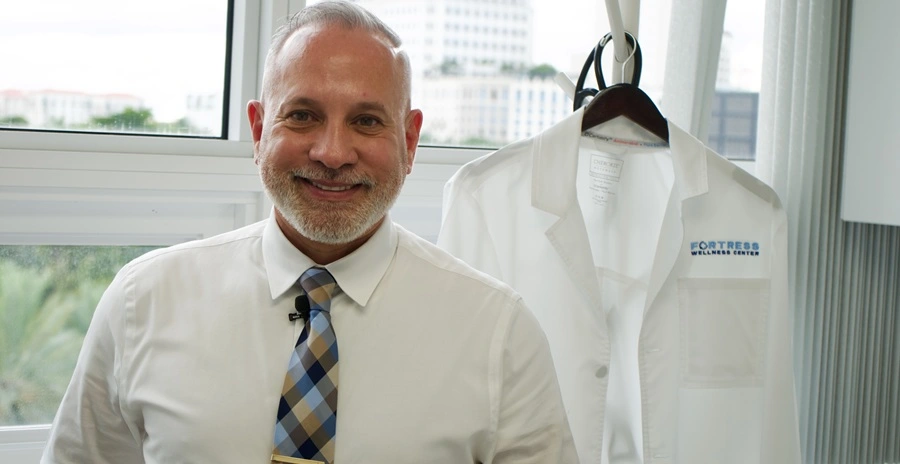
This is how Fortress Wellness Center emerged, a family practice focused on primary medicine with a holistic approach. Joel and his team work from prevention: nutrition, exercise, lifestyle habits, control of chronic diseases and complementary therapies that seek to reduce dependence on medications.
The project grew quickly in Miami. Advertising helped, but the key was the recommendations of the patients themselves. Many arrive looking for an aesthetic service or a weight control program, but end up staying as primary patients and bringing their family members. In a few months, the number of people served tripled.
For Joel, the center is more than an office: it is a piece of his town. Most of the patients come from the same province; many know him from Cuba. That has turned the office into an extension of his home, a space where medicine, memory and community mix.
Today he balances—as best he can—hospital shifts, family life, and running the clinic. “We juggle,” he says, but he says it with satisfaction. Because every achievement has behind it the weight of everything he left behind and everything he rebuilt.
If he had stayed in Cuba, he believes he would be frustrated. I would continue to be a surgeon, yes, but trapped in the shortcomings, the pressures and the lack of horizons. On the other hand, in the United States he achieved what he never imagined when he raised his hand, timid, in that classroom: build his own path, create his own medical project and give back to others—from health—a little of everything that he had to fight to achieve.















