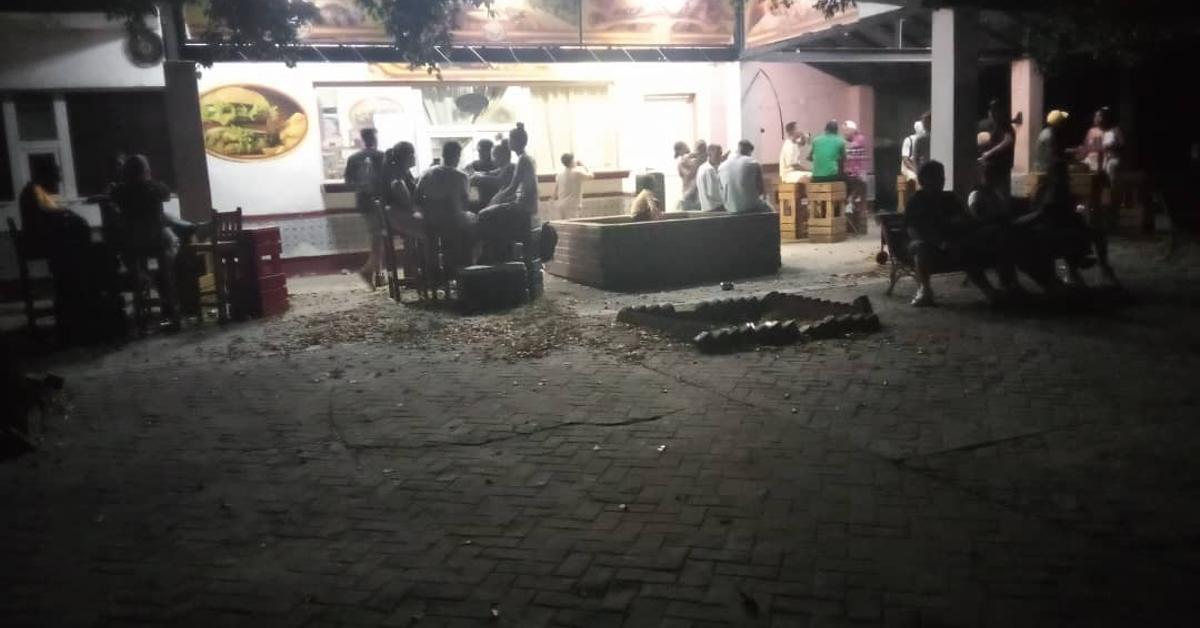
San José de las Lajas (Mayabeque)/The clock already strikes eight at night San José de las Lajas The night has swallowed him. Since the time changed, with the blackouts lasting more than ten hours in a row, the town has been plunged into darkness so dense that even the dogs remain silent. Just a faint glow, that of the hamburger restaurant on the boulevard, breaks the blackness. The electrical plant of the premises, rented to a private party, purrs like a tired heart, powering two light bulbs and a small freezer.
“When I was coming here on my bicycle I tripped over a pothole in front of the Cultural Plaza. I almost fell, but when there is no power this is the only place where I can communicate with my daughter,” says David, a 58-year-old neighbor who tries, without success, to send a message on WhatsApp. “The Etecsa tower is close, but the connection is terrible. They imposed the great rate and we continue with the same problems,” he laments.
The scene repeats itself every night: groups of people come together looking for light, internet or company. Some arrive with phones in their hands, others just with the fatigue of the day. The gloom thickens outside the illuminated circle. No one sits by the fountain without water, from which a sour smell rises. “On those dark benches there could be a couple kissing or a mountain of trash,” David says, looking into the shadows.
The sign says ‘Hamburger’, but there is no bun or hamburger. The only thing they sell is Mayabe beer, cola and some cookies.”
An old man crosses the threshold between light and darkness asking for twenty pesos to eat. A woman teaches the multiplication table to a girl, taking advantage of the minimal clarity that allows her to do her schoolwork. In the background, the store’s employees move slowly. “This doesn’t look like a business, it looks like a shelter,” says Samuel, a young man who arrived with two friends. “The sign says ‘Hamburger’, but there is no bread or hamburger. The only thing they sell is Mayabe beer, cola and some cookies.”
Samuel shrugs his shoulders and smiles with resignation. “Inefficiency is everywhere, in the State and in individuals as well. They don’t know how to take advantage of the fact that people are spending part of the blackout here. They could sell anything they wanted, and they don’t.” His criticism, between bitter and mocking, provokes nods around him. Nobody argues.
The employee listens from the counter. “The plant is barely enough for the freezer and two light bulbs,” he explains. “At least that’s how we see each other’s faces, even if it’s in these five or six meters. Everything else in the town is dark.” She has been working all day and, even so, she prefers not to go home alone: ”My husband can’t come pick me up and I’m afraid to walk in so much darkness. “One time someone followed me to the corner.”
As he speaks, the murmur of the people grows. Some discuss the price of the dollar in the informal market, others check their cell phone balance. Someone says that the blackout started at eight in the morning. “And there are still no signs that the light will return,” he adds. The statistics of the last month confirm it: according to data from the Electrical Union, the generation deficit has exceeded 1,500 megawatts per day. In Mayabeque, the cuts usually last up to 12 continuous hours.
/ 14ymedio
The province does not escape the national pattern: blackouts, paralyzed domestic life and the negative impact on businesses. In municipalities such as Güines or San Nicolás, business owners report that the power plants are not enough to keep food refrigerated.
On the lajero boulevard, the scene confirms this diagnosis. A group of young people surrounds an improvised table. “Here you come more for the light than for the beer,” says a boy who is not over twenty, laughing. The dim glow illuminates sweaty faces, phones with barely a battery left, and plastic cups. Mosquitoes do their part: “If you stay home, they will devour you,” summarizes another.
Beyond the small illuminated circle, the night returns to a closed darkness. The pedicab pit, in front of 40th Avenue, begins to empty. “This looks like a wolf’s den,” a man mutters as he turns on his flashlight to cross the street.
No one knows when power will return or which circuit will “benefit” first. The Electric Company barely issues confusing statements in its Telegram group. “They say it’s due to lack of fuel, but the problem is that this has already become normal,” says the employee while serving a soft drink at room temperature. At home, another task awaits her: washing her son’s school uniform. “Let’s see if they can give us some power before tomorrow.”
Around eleven o’clock, the sound of the generator goes off. A thick silence spreads through the town. “There the plant went,” someone says and darkness fills everything. The few that remain get up without haste. In the shadows, San José de las Lajas disappears completely.














